Dairy Foods logo
search
cart
facebook twitter linkedin youtube
  • Sign In
  • Create Account
  • Sign Out
  • My Account
Dairy Foods logo
  • NEWS
    • DAIRY REGULATIONS
  • PRODUCTS
    • New Products
    • Butter
    • Cheese
    • Cultured Dairy
    • Frozen Desserts
    • Ice Cream/Novelties
    • Milk
    • Non-Dairy Beverages
    • Sales Data
    • Whey, Milk Powder
    • Dairy Alternatives
  • INGREDIENTS
    • Cocoa
    • Colors/Flavors
    • Cultures/Enzymes
    • Fiber
    • Gums, Stabilizers, and Texturants
    • Inclusions
    • Omegas/Lipids
    • Prebiotics
    • Probiotics
    • Sweeteners
    • Other
  • OPERATIONS
    • SUSTAINABILITY
    • Equipment
    • Processing
    • Packaging
    • Food Safety & Sanitation
    • Membrane Technology
  • MEDIA
    • Dairy Foods TV
    • Podcasts
    • Webinars
  • DIRECTORIES
    • Buyers Guide
    • Dairy Plants USA
  • MEMBRANE FORUM
  • MORE
    • Associations
    • Dairy Foods' News & Views Newsletter
    • Blogs
    • Case Studies
    • Classifieds
    • Custom Content & Marketing Services
    • Dairy Foods Store
    • Market Research
    • Supplier Spotlights
    • Tradeshows and Events
    • Strategy Guides
  • AWARDS
    • Dairy Plant of the Year Award
    • Breakthrough Award
    • Dairy Processor of the Year
  • EMAGAZINE
    • eMagazines
    • Archive Issues
    • Contact
    • Advertise
    • SIGN UP!
    • Columnists
    • Dairy 100
    • State of the Industry Report
    Dairy Foods ColumnistsDairy Processing and Equipment

    3-A Today

    Validating cleaning performance in dairy processing equipment

    In rigorous protocols, food often requires three successful cleaning runs.

    By Sharif Uddin
    Close up of dairy processing equipment.
    Image source: Zenistock / iStock / Getty Images Plus
    February 17, 2026
    ✕
    Image in modal.
    Sharif Uddin
    Sharif Uddin has more than 25 years’ experience working in dairy, foods, cosmetics, OTC, and consumer products manufacturing facilities. He is currently working as principal engineer of process cleaning for Rockline Industries Inc., a global manufacturer of wet wipes and coffee filters. He is an SME in hygienic design, cleaning, and cleaning validation. He earned accreditation as a Certified Conformance Evaluator (CCE) in hygienic design and cleaning from 3-A Sanitary Standards, Inc. Sharif was involved as a group leader in the ASTM E55.03 WK98596 committee to develop the standard guide The Science and Risk-Based Design of Clean in Place Clean Friendly Equipment for Pharmaceutical and Biopharmaceutical Applications (CbDby Design). He is a regular speaker at the Pharmaceutical Cleaning Validation Conferences in Europe and the US.

    Cleaning and sanitizing dairy processing equipment is a complex task influenced by the nature of dairy products, intricate equipment designs, strict regulatory standards (FSMA, PMO), and environmental conditions. Dairy residues — such as milk proteins, fats, and minerals — can form stubborn films on equipment surfaces, promoting bacterial growth and making removal difficult. Pathogens such as Listeria, Salmonella, and Cronobacter are especially resilient, often hiding in hard-to-reach areas and posing significant contamination risks.

    Inadequate sanitation can lead to product recalls and outbreaks, especially when manual cleaning is required for dry systems or equipment with complex internal geometries like heat exchangers. Equipment designed with 3-A Sanitary Standards plays a critical role in cleaning success. Features such as smooth surfaces, round corners, sanitary welds, gasket-retaining grooves requirements, and maintaining correct slope for proper drainage help eliminate common sanitation challenges. Easy access to cleaning areas is essential — if equipment is hard to reach, it increases the risk of missed spots and contamination.

    3-A design also supports faster cleaning cycles, quicker verification, and minimal disassembly, reducing labor hours and production downtime. These designs are compatible with standard verification tools, streamlining audits and regulatory inspections.

    “Clean” is both a visual and microbiological concept. It refers to the removal of visible and invisible contaminants — including dust, debris and microorganisms — from surfaces and environments. In industries like food and pharmaceuticals, cleanliness is validated through rigorous protocols, often requiring three consecutive successful cleaning runs confirmed by visual, microbial and chemical testing. Figure 1 illustrates the critical validation steps: pre-rinse, cleaning, post-rinse, sanitizing, and verification sampling.
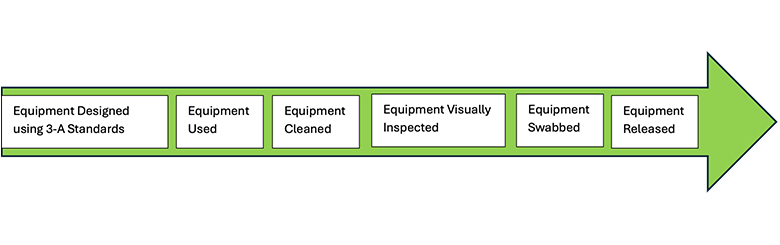
    A green arrow diagram of Figure 1: Cleaning Validation Steps

    (Click on image to enlarge) Figure 1: Cleaning Validation Steps arrow diagram. Source: Sharif Uddin

    However, a visually clean surface doesn’t guarantee it's free from bacteria. Acceptable residual limits must be defined by the quality department. For example, a tank that appears clean should still be swabbed for microbial testing to confirm sanitation. In cases where visual inspection is impractical — such as pipelines — sanitation and rinse water samples analyzed through Heterotrophic Plate Count (HPC) or Total Organic Carbon (TOC) testing can verify cleaning effectiveness. There are several methods to verify cleanliness.

    1. Visual Inspection – Visual inspection is defined as the process of using the eye, alone or in conjunction with various aids like a flashlight or borescope, from which judgments may be made about the condition of the equipment to be inspected. It is a primary method to verify cleanliness; however, operators need to be trained and qualified to perform this task.
    2. Adenosine Triphosphate (ATP) – It is a popular method to measure the organic residue on the surface. It is a rapid method to check the cleanliness of the surface. It helps the operator to ensure the equipment surface is free of residue.
    3. Sanitation Swabs – Surfaces are swabbed and cultured to detect bacteria or fungi. It is highly accurate, but it takes time (three to five days) to process. The QA department uses swabs to ensure the equipment is cleaned and sanitized effectively before running for production.
    4. Heterotrophic Plate Count (HPC) – HPC is utilized to assess the bacterial load in rinse water. It helps determine whether the bacterial population in a 100 mL sample exceeds acceptable limits, which would indicate contamination. HPC testing is instrumental in evaluating whether a production line is contaminated. Typically, a pre-detergent sample is collected to identify existing contamination, while a post-sanitizer rinse sample is analyzed to verify the effectiveness of the cleaning process in eliminating bacterial residues.
    5. Total Organic Carbon (TOC) – TOC analysis is used to detect any remaining organic residues in the rinse following cleaning with detergent and sanitizer. During cleaning validation, TOC serves as a key indicator to confirm the effective removal of cleaning agents and product residues. Prior to validation, an acceptable TOC threshold must be established to ensure compliance with cleanliness standards.

    3-A equipment simplifies the validation steps. Its design allows for easier cleaning and verification, enabling faster line changeovers and production restarts. By eliminating problem areas and supporting standard verification tools, 3-A equipment reduces audit times and frees up QA and operations personnel.

    Ultimately, “clean” is not a fixed endpoint but a balance of necessity, perception, and consequence. In everyday life, clean may mean comfort; in industry, it means precision and safety. The real challenge lies not in cleaning for appearance but in defining cleanliness in a way that aligns with quality standards, operational efficiency, and regulatory compliance. True cleanliness isn’t absolute sterility; its responsible adequacy achieved through three pillars: hygienically designed equipment, validated cleaning procedures, and reliable verification methods. When these elements align with 3-A Sanitary Standards, dairy processors gain confidence in every batch, every shift, and every audit.

    3-A Design Features That Make Cleaning Verification Easier

    • Self-draining designs eliminate pooling that harbors bacteria.
    • Smooth, 32 Ra or better finishes prevent product adhesion.
    • Accessible inspection ports enable visual verification without disassembly.
    • Standardized connections facilitate consistent CIP flow rates.
    • Minimal dead legs reduce microbial harborage points
    KEYWORDS: 3-A Sanitary Standards clean in place dairy plants food contamination risk food safety microbial testing

    Share This Story

    Looking for a reprint of this article?
    From high-res PDFs to custom plaques, order your copy today!

    Sharif uddin headshot 200x200

    Sharif Uddin has more than 25 years of experience working in dairy, food, cosmetics, OTC, and consumer products manufacturing facilities. He is currently working as the principal engineer of process cleaning for Rockline Industries Inc., a global manufacturer of wet wipes and coffee filters. He is an SME in hygienic design, cleaning, and cleaning validation. He earned accreditation as a Certified Conformance Evaluator (CCE) in hygienic design and cleaning from 3-A Sanitary Standards, Inc. Sharif was involved as a group leader in the ASTM E55.03 WK98596 committee to develop the standard guide, The Science and Risk-Based Design of Clean in Place Clean Friendly Equipment for Pharmaceutical and Biopharmaceutical Applications (CbDby Design). He is a regular speaker at the Pharmaceutical Cleaning Validation Conferences in Europe and the US.

    Recommended Content

    JOIN TODAY
    to unlock your recommendations.

    Already have an account? Sign In

    • Lifeway Organic Kefir in different flavors inside a refrigerated grocery shelf.

      Dairy Foods names Lifeway Foods 2025 Processor of the Year

      Lifeway Foods donates $10,000 to wildfire victims,...
      Dairy Foods & Beverages
      By: Brian Berk
    • Two female farmers are standing in a field, holding a large milk canister, looking at several cows at dairy farm.

      Honoring Women Leaders Shaping the Dairy Industry

      For the fourth consecutive year, Dairy Foods is proud to...
      Dairy Foods & Beverages
      By: Barbara Harfmann
    • Main feature for State of the Industry with dairy products album cover with a gradient circular--patterned backgorund.

      2025 State of the Dairy Industry

      Welcome to the 2025 State of the Industry report. For...
      Dairy Foods & Beverages
    Manage My Account
    • eMagazine Subscription
    • Dairy Foods News & Views Newsletter
    • Online Registration
    • Manage My Preferences
    • Subscription Customer Service
    • Connect with Dairy Foods

    More Videos

    Popular Stories

    Close up of man adding Greek yogurt while preparing healthy smoothie in the kitchen.

    An expert guide to dairy and GLP-1 receptor agonists

    Splash of milk in form of arm muscle. 3D illustration.

    Protein: The Powerhouse of Health and Wellness

    Grilling foods

    Dairy’s Enduring Moment: Why Resilience and Renewal Define Today’s Dairy Story

    Nominate your product for the 2026 Dairy Foods Product of the Year!


    MTF webinar


    Food Safety webinar

    Events

    July 8, 2026

    Membrane Purification Enables Clean Beauty Actives

    The global cosmetics market is undergoing a major shift towards the use of natural bioactive ingredients as consumers grow more skeptical of traditional formulations and demand greater transparency and sustainability.

    July 8, 2026

    Advancements in RO for Dairy Processing

    Reverse osmosis (RO) membranes are well established in dairy processing but continue to evolve to improve performance, reduce energy use, and increase operational longevity. 

    View All Submit An Event

    Products

    Probiotic Ice Cream: Science and Technology

    Probiotic Ice Cream: Science and Technology

    See More Products
    health and wellness


    plant of the year

    Related Articles

    • Is your cleaned dairy processing equipment clean?

      See More
    • admix

      New dairy processing equipment offers cost-savings, efficiency

      See More
    • GEA Westfalia introduces new dairy processing equipment at Anuga FoodTec

      See More

    Related Products

    See More Products
    • 9781771887656.jpg

      Nanotechnology Applications in Dairy Science Packaging, Processing, and Preservation

    • tech inv.jpg

      Technological Interventions in Dairy Science: Innovative Approaches in Processing, Preservation, and Analysis of Milk Products

    • Cleaning-in-Place: Dairy, Food and Beverage Operations, 3rd Edition

    See More Products

    Related Directories

    • SMI-Dairy Processing Div.

    ×

    Stay ahead of the curve. Unlock a dose of cutting-edge insights.

    Receive our premium content directly to your inbox.

    SIGN-UP TODAY
    • RESOURCES
      • Advertise
      • Contact Us
      • Directories
      • Store
      • Want More
    • SIGN UP TODAY
      • Create Account
      • eMagazine
      • Newsletter
      • Customer Service
      • Manage Preferences
    • SERVICES
      • Marketing Services
      • Reprints
      • Market Research
      • List Rental
      • Survey/Respondent Access
    • STAY CONNECTED
      • LinkedIn
      • Facebook
      • YouTube
      • X (Twitter)
    • PRIVACY
      • PRIVACY POLICY
      • TERMS & CONDITIONS
      • DO NOT SELL MY INFORMATION
      • PRIVACY REQUEST
      • ACCESSIBILITY

    Copyright ©2026. All Rights Reserved BNP Media, Inc. and BNP Media II, LLC.

    Design, CMS, Hosting & Web Development :: ePublishing