Dairy Foods logo
search
cart
facebook twitter linkedin youtube
  • Sign In
  • Create Account
  • Sign Out
  • My Account
Dairy Foods logo
  • NEWS
    • DAIRY REGULATIONS
  • PRODUCTS
    • New Products
    • Butter
    • Cheese
    • Cultured Dairy
    • Frozen Desserts
    • Ice Cream/Novelties
    • Milk
    • Non-Dairy Beverages
    • Sales Data
    • Whey, Milk Powder
    • Dairy Alternatives
  • INGREDIENTS
    • Cocoa
    • Colors/Flavors
    • Cultures/Enzymes
    • Fiber
    • Gums, Stabilizers, and Texturants
    • Inclusions
    • Omegas/Lipids
    • Prebiotics
    • Probiotics
    • Sweeteners
    • Other
  • OPERATIONS
    • SUSTAINABILITY
    • Equipment
    • Processing
    • Packaging
    • Food Safety & Sanitation
    • Membrane Technology
  • MEDIA
    • Dairy Foods TV
    • Podcasts
    • Webinars
  • DIRECTORIES
    • Buyers Guide
    • Dairy Plants USA
  • MEMBRANE FORUM
  • MORE
    • Associations
    • Dairy Foods' News & Views Newsletter
    • Blogs
    • Case Studies
    • Classifieds
    • Custom Content & Marketing Services
    • Dairy Foods Store
    • Market Research
    • Supplier Spotlights
    • Tradeshows and Events
    • Strategy Guides
  • AWARDS
    • Dairy Plant of the Year Award
    • Breakthrough Award
    • Dairy Processor of the Year
  • EMAGAZINE
    • eMagazines
    • Archive Issues
    • Contact
    • Advertise
    • SIGN UP!
    • Columnists
    • Dairy 100
    • State of the Industry Report
    Dairy Foods & BeveragesDairy Foods ColumnistsIce Cream/Novelties

    How to manage economics with frozen desserts

    Ice Cream industry advised to take a step back into the what, why’s, and how’s of achieving ongoing cost control and management.
    By Bill Sipple, Steven Young
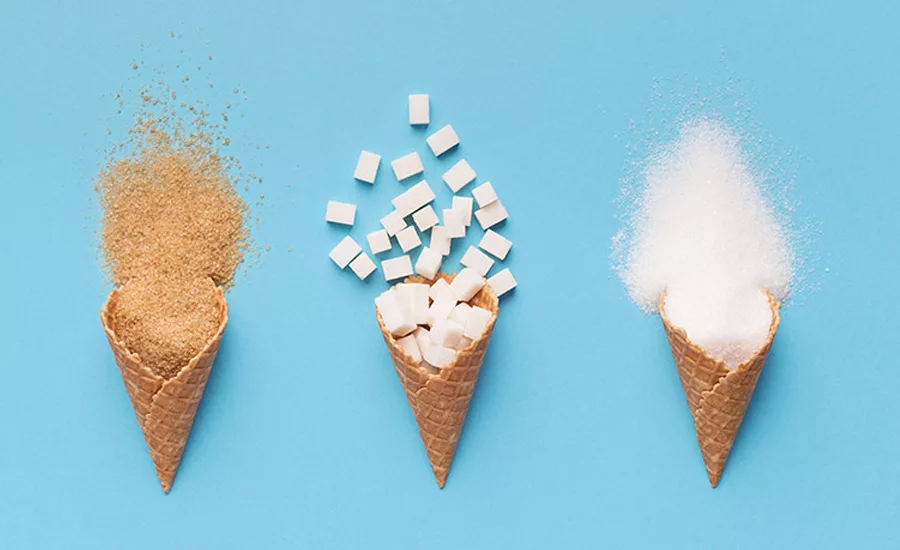
    ice cream cones filled with brown sugar, white sugar and cubed sugar

    Photo courtesy of Prostock-Studio / iStock / Getty Images Plus

    February 19, 2024
    Steven Young
    Bill Sipple
    Steven Young, Ph.D., is principal, Steven Young Worldwide; Bill Sipple is principal, Wm Sipple Global Services.

    We are often asked about possible cost control/savings resulting in changing the amount and type of sweeteners used in frozen desserts. To respond, we need to take a step back into the what, why’s, and how’s of achieving ongoing cost control and management.

    Among all frozen dessert ingredients, sucrose (“sugar”), fructose-containing corn sweeteners (HFCS’s 42, 55, 90 and crystalline fructose), and cornstarch-based hydrolysates (i.e., corn syrups, corn syrup solids, maltodextrins, high maltose corn syrup solids, etc.) have been, and rightly so, promoted to be low-cost sources of solids, “bulk” and sweetness.

    On a cost-per-unit solids basis that might be true, but consider the basic reason we use such products — as sources of sweetness. As such, each source of sweetness delivers ever so slightly different amounts and “quality” of sweetness. Hence, each combination of sweeteners seeks to become more “sucrose-like” in sweetness delivery.

    How does each sweetener now compare to themselves and to other evolving, novel and varying sources of solids and, of course, sweetness? 

    Relative sweetness (i.e., theoretical sweetness vs. sucrose) is obvious and a good place to start. However, a further differentiating factor amongst and between sources of sweetness is the concept of “cost-per-unit sweetness” (CUS). CUS starts to make sense (cents!) in some interesting ways…

    Let’s start with the basics.

    There are three basic groups of sweeteners:

    • Nutritive Sweeteners (i.e., sweeteners that have and deliver calories): These include sucrose, the HFCS’s, regular corn syrups (20-90 DE; plus syrup solids from other starch sources, e.g., tapioca, rice, potato), and maltodextrins (< 20 DE; plus maltodextrins from tapioca, rice, potato, and other starches). Even the “rare” sugars (e.g., allulose, tagatose, etc.) and nearly all sugar alcohols are “nutritive” per their specific caloric contributions. Relative sweetness versus sucrose varies greatly sweetener-to-sweetener.
    • “Not-so-natural” (i.e., artificial) Non-nutritive Sweeteners (i.e., do not deliver significant caloric contribution, nor solids, to finished ice creams based on use rates): These include high-intensity sweeteners, such as acesulfame-k, aspartame, sucralose and the like. 
    • “Natural” high-intensity sweeteners: These include monk fruit, stevia and extracts and purified fractions, or each as well as other natural extracts that have sweetness. Again, based on usage rates, these do not deliver caloric contributions to finished ice creams.

    Across time, each group above has been “decoupled” from the other groups marketing and pricing-wise and each group finds itself competing with sources of sweetness within its own group. Thus, in most cases, pricing policies vary group-to-group including influences from “commodity” sources of sweetness. This means that despite being decoupled between groups, pricing within each group is highly competitive and leverageable.

    Consider the following from 2023:

    Although high-intensity sweeteners (HIS’s) have relatively stable and ultra-low CUS’s, there is still need for some sort of soluble solids (i.e., low calorie bulking agents), So, to  simply make ice cream and related products, not only for new market positioning but for current market positioning as well, sweeteners and bulking agents are needed. But ice cream manufacturers also have to manage a variety of mix analytics. These include: relative sweetness; freezing point-related analytics;  water control index; mix and ice cream densities (pounds per gallon); yields (gallons of finished ice cream per gallon of mix (including any yield improvements); freezing point; draw temperature (temperature at which 50% of the water in the mix is now ice); hardness index (amount of water as ice at a specific temperature coming out of hardening — 0 degrees Fahrenheit core temp? or -10 degrees Fahrenheit retail freezer temperature); texture stability index (amount of water that transitions from ice-to-water-to-ice between two select temperatures (0 F to +10 F.)

    Ultimately, these myriad factors get compared to any given selected “control” or “current” ice cream being produced to determine likelihood of success throughout the ice cream making process and into the supply chain.

    Given the above, it may be possible to use HIS with inherently low CUS not only to spare “sugars” and calories but also to address the ongoing demand for reduced cost per gallon of finished ice cream. This is appropriate as nearly 60% of an ice cream’s value coming out of manufacturing can be attributed to ingredient costs.

    From there, additional margin demands from the manufacturer/marketer, supply chain and retailer compound to result in the final on-shelf pricing. Therefore, any savings, albeit small and/or limited, related to ingredients, particularly, mix ingredients, and thus, sweetener selection and use, gets compounded throughout the supply chain, and, ultimately, into final returns-on-investment back to manufacturers and marketers.

    Aren’t you glad you asked??

    KEYWORDS: frozen desserts ice cream novelties sugar sweeteners

    Share This Story

    Looking for a reprint of this article?
    From high-res PDFs to custom plaques, order your copy today!

    Bill sipple headshot 200x200
    Bill Sipple is the principal of Wm Sipple Global Services.
    Steven young headshot 200x200
    Steve Young is the principal of Steven Young Worldwide in Houston, Texas.

    Recommended Content

    JOIN TODAY
    to unlock your recommendations.

    Already have an account? Sign In

    • Lifeway Organic Kefir in different flavors inside a refrigerated grocery shelf.

      Dairy Foods names Lifeway Foods 2025 Processor of the Year

      Lifeway Foods donates $10,000 to wildfire victims,...
      Dairy Processor News
      By: Brian Berk
    • Two female farmers are standing in a field, holding a large milk canister, looking at several cows at dairy farm.

      Honoring Women Leaders Shaping the Dairy Industry

      For the fourth consecutive year, Dairy Foods is proud to...
      Innovation
      By: Barbara Harfmann
    • Main feature for State of the Industry with dairy products album cover with a gradient circular--patterned backgorund.

      2025 State of the Dairy Industry

      Welcome to the 2025 State of the Industry report. For...
      Dairy Foods & Beverages
    Manage My Account
    • eMagazine Subscription
    • Dairy Foods News & Views Newsletter
    • Online Registration
    • Manage My Preferences
    • Subscription Customer Service
    • Connect with Dairy Foods

    More Videos

    Popular Stories

    Close up of man adding Greek yogurt while preparing healthy smoothie in the kitchen.

    An expert guide to dairy and GLP-1 receptor agonists

    Splash of milk in form of arm muscle. 3D illustration.

    Protein: The Powerhouse of Health and Wellness

    Grilling foods

    Dairy’s Enduring Moment: Why Resilience and Renewal Define Today’s Dairy Story

    Nominate your product for the 2026 Dairy Foods Product of the Year!


    MTF webinar


    Food Safety webinar

    Events

    July 8, 2026

    Membrane Purification Enables Clean Beauty Actives

    The global cosmetics market is undergoing a major shift towards the use of natural bioactive ingredients as consumers grow more skeptical of traditional formulations and demand greater transparency and sustainability.

    July 8, 2026

    Advancements in RO for Dairy Processing

    Reverse osmosis (RO) membranes are well established in dairy processing but continue to evolve to improve performance, reduce energy use, and increase operational longevity. 

    View All Submit An Event

    Products

    Probiotic Ice Cream: Science and Technology

    Probiotic Ice Cream: Science and Technology

    See More Products
    health and wellness


    plant of the year

    Related Articles

    • RFID tags and GPS-enabled transport

      How to manage the dairy supply chain

      See More
    • How to manage the parade of auditors, inspectors in your dairy plant

      See More
    • Philip R’s Frozen Desserts has a hit with Lollibons

      See More

    Related Products

    See More Products
    • icecream.gif

      Tharp & Young on Ice Cream: An Encyclopedic Guide to Ice Cream Science and Technology

    • Making Artisan Gelato

    • download.jpg

      Probiotic Ice Cream: Science and Technology

    See More Products

    Events

    View AllSubmit An Event
    • April 9, 2013

      Ice Cream & Frozen Desserts: Formulating & Processing for Success

      On-Demand until 4/9/2014: Steven Young, Ph.D. and Bruce Tharp, Ph.D. will give an overview of innovative ice cream and frozen desserts both here and abroad, what are the hottest new products and why?
    View AllSubmit An Event

    Related Directories

    • GS Gelato & Desserts Inc.

      G.S. Gelato is the leading manufacturer of gelato, sorbet, non-dairy frozen desserts and soft serve for the foodservice and retail/grocery industries with branded and private label products. With innovative flavors and unparalleled customization options, we craft the best ingredients into extraordinary products!
    ×

    Stay ahead of the curve. Unlock a dose of cutting-edge insights.

    Receive our premium content directly to your inbox.

    SIGN-UP TODAY
    • RESOURCES
      • Advertise
      • Contact Us
      • Directories
      • Store
      • Want More
    • SIGN UP TODAY
      • Create Account
      • eMagazine
      • Newsletter
      • Customer Service
      • Manage Preferences
    • SERVICES
      • Marketing Services
      • Reprints
      • Market Research
      • List Rental
      • Survey/Respondent Access
    • STAY CONNECTED
      • LinkedIn
      • Facebook
      • YouTube
      • X (Twitter)
    • PRIVACY
      • PRIVACY POLICY
      • TERMS & CONDITIONS
      • DO NOT SELL MY INFORMATION
      • PRIVACY REQUEST
      • ACCESSIBILITY

    Copyright ©2026. All Rights Reserved BNP Media, Inc. and BNP Media II, LLC.

    Design, CMS, Hosting & Web Development :: ePublishing