Outlook Report
Finding the right infant formula is crucial to a baby’s growth and development
The global infant formula market is valued at $51B.

Proper infant nutrition is essential for growth, development, and long-term health, starting from birth through the first years of life. While mom’s milk, or breastfeeding, is highly recommended for the first six months of life because of the antibodies that help protect the baby against illness and infections, breastfeeding is not always possible.
In fact, approximately 44% of babies are exclusively breastfed for the first six months, while 50% are formula-fed or receive both, according to the World Health Organization (WHO), which "strongly recommends"breastfeeding as the optimal source of nutrition for infants.
"Breastmilk provides essential nutrients, antibodies, and promoting cognitive development, higher IQ, and better long-term health outcomes,"the Geneva, Switzerland-based WHO stated.
While most infant formula is still cow’s milk-based powder, other options tailored to specific needs and preferences include:
- Standard Formula: Designed for healthy infants; contains cow’s milk protein.
- Hydrolyzed Formula: For babies with protein allergies; proteins are broken down.
- Lactose-Free Formula: For infants with lactose intolerance.
- Soy-Based Formula: For babies who cannot tolerate cow’s milk or lactose.
Experts note that both breast milk and formula remain the primary source of energy and nutrients until solid foods are introduced, usually around 6 months of age. In the beginning, how much a baby eats is less important than getting him or her used to the idea of eating solid foods and experiencing different tastes and textures. The baby is traditionally weaned from formula at a year old.
"If a baby experiences symptoms like fussiness, gas, or spit-up, it does not automatically mean the formula isn’t right, but, in some cases, differences in formulation may affect a baby’s tolerance,"says Angela Vranich, co-founder and chief product officer of Little Spoon. "Parents should consult a pediatrician before making changes to their baby’s formula."
Sophie Nicolas, global marketing innovation lead – Early Life Nutrition at FrieslandCampina Ingredients, Amersfoort, the Netherlands, citing Euromonitor International, notes that the global infant formula market was valued at around $51 billion in 2025.
Despite lower birth rates in several regions, the market continues to grow at a measured pace, with forecasts pointing to annual growth of approximately 2% in value between 2025 and 2030, with volume increasing more moderately, the market research firm states.
Among the growth drivers are rising urbanization, more dual-income households and increasing expectations around quality, safety and functionality in infant nutrition, Nicolas says.
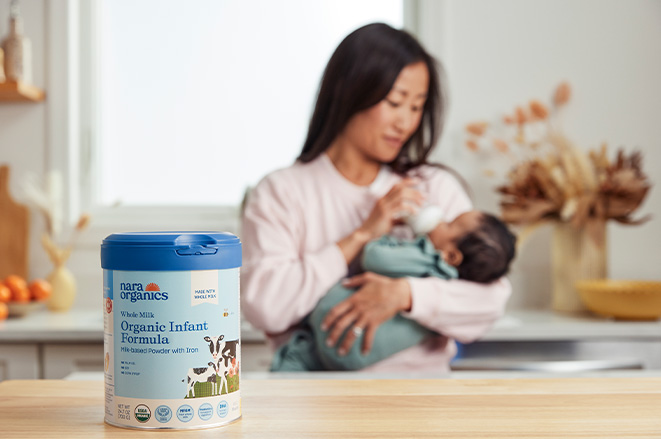
Nara Organics, the infant formula based on whole milk with no skim milk, was unveiled in July 2025. | Photo courtesy of Nara Organics
What should parents look for?
Perhaps nothing is as important as choosing the right infant formula to give your baby the best nutritional foundation for him/her to grow. However, this process can be overwhelming.
Esther Hallam, founder and CEO of New York, N.Y.-based Nara Organics, notes that any formula legally permitted to be sold in the United States must be registered with the U.S. Food & Drug Administration (FDA) and, therefore, must meet the nutritional needs of a growing baby as mandated by the FDA.
"Parents shouldn’t need to worry about adequate nutrition of an FDA-registered formula,"she explains. "Working with pediatricians, parents should first determine if their baby can tolerate a routine formula or if their child needs a specialty formula based on their unique medical need. Then, I would prioritize other factors that are important to you and your family such as ingredients, (organic v. conventional), optional nutrients, price point, availability, etc."
While there’s a wide choice of infant formulas on the market today, most parents feel pressure to "get it right,"Nicolas says.
"While many parents are already well informed, formula labels can sometimes be overly technical, complicating rather than clarifying the decision-making process. When comparing different products, a helpful starting point is to look for ingredients with robust scientific research,"she says.
Little Spoon’s Vranich offers other key considerations, including:
- Nutritional completeness: All formulas must meet strict federal standards, but parents may look for formulations aligned with their baby’s specific needs.
- Ingredient sourcing and transparency: Many parents prioritize organic certification, clear labeling, and traceable sourcing.
- Fat and protein composition: The balance and type of fats and proteins can influence how closely a formula resembles the structure of breast milk and how well a baby tolerates it.
- Digestibility: Some babies respond differently to certain formulations, so tolerance and comfort are important considerations.
- Safety and testing standards: Reputable brands follow rigorous testing protocols and comply with U.S. regulatory requirements.
- Building support: The inclusion of prebiotic FOS (fructooligosaccharides), nucleotides and/or probiotics to help support microbiome and immune system development.
"The usual basis for typical routine infant formula is some form of cows’ milk protein, either intact or partially hydrolyzed,"Hallam says. "When a baby cannot tolerate cows’ milk formula, other formulas such as soy protein-based formula can be used. Recently, goat-milk formula is gaining popularity.
The majority of the infants only require routine formulas,"she continues. "Only in cases of severe cases of milk intolerance or milk allergy, hypoallergenic formulas are recommended — the doctor usually assesses and prescribes these specialty formulas and they are expensive."
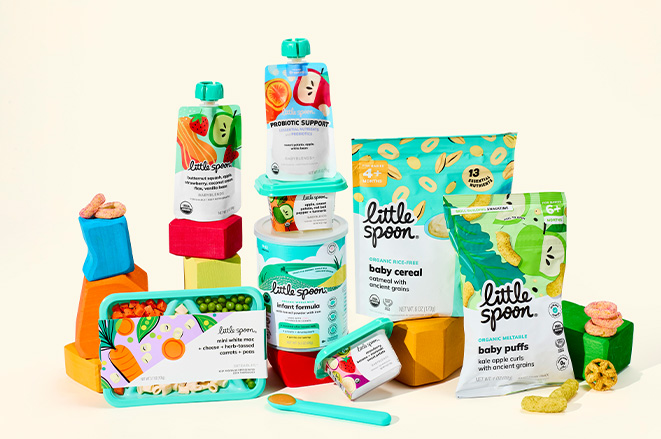
Little Spoon built a full feeding system to support families through every stage — from those first feeds through toddlerhood and beyond — so parents have more nutrient-rich options. | Photo courtesy of Little Spoon
New product development
Abbott, Mead Johnson, and Perrigo are the three largest infant formula manufacturers, according to Nara Organics’ Hallam.
"Each of these companies have several brands in their portfolio that slightly differ from one another,"she explains. "Abbott’s hero brand is Similac, Mean Johnson’s Enfamil, and Perrigo makes several stores brands that are essentially the same within a particular category with minor differences in their composition from one brand to another. Perrigo also makes formulas for Earth’s Best, Bobbie, and Little Spoon."
Noting that it took seven years and jumping through two hoops — one to get a new GRAS (generally recommended as safe) notification for the highest use of whole milk and a clinical study to demonstrate the safety and efficacy of Nara Organics — the infant formula based on whole milk with no skim milk was unveiled in July 2025.
"It is important to note that when we started with our clinical study with the whole milk formula, there were none on the market,"Hallam proudly reveals. "So, we had to get authorization to use the highest amount of whole milk permitted in an infant formula with a 60:40 whey to casein blend because we had decided to not use any skim milk in our formula."
Additionally, while Nara’s study was being conducted, some brands tried to preemptively enter the market before the New York City-based company. "Nara is still the first and only at present to have conducted a clinical study with its 60:40 whey to casein blend that contains only whole milk and not skim milk. The others are relying on demonstrating equivalence with their prior clinical study that was conducted on a skim milk formula.
Image courtesy of Nara Organics
"We also include DHA/ARA at levels found in the global average levels of breastmilk and recommended by experts,"she continues. "We also include [galacto-oligosaccharides] (GOS), a prebiotic known to support the development of gut microbiota."
New York City-based Little Spoon, which was founded in 2017, officially entered the infant formula space in March 2026 with its Organic Grass-Fed Whole Milk Infant Formula because it saw a real gap in the market — especially when it came to trust, transparency, and ingredient quality, co-founder Vranich says.
Little Spoon’s infant formula seeks to provide a formula with complete nutrition that is gentle on tummies, using only the highest-quality ingredients and full transparency.
Vranich explains: "From day one, our goal has been to raise the bar on safety and give parents visibility they simply haven’t had in the baby and kids' categories. Like all of our baby products, every batch of our formula is tested for 500-plus contaminants, including heavy metals, pesticides, and pathogens, and we publicly share those results. On the formulation side, we start with organic, grass-fed whole milk sourced from New Zealand cows, which live on pasture over 300 days per year. Using a whole milk base from a high-quality source means babies get more naturally occurring milk fats, so we can rely less on added oils."
The company’s quest to provide a full feeding system doesn’t stop at the bottle. She explains, "We’re building a full feeding system to support families through every stage — from those first feeds through toddlerhood and beyond — so parents have nutrient-rich options that make feeding their families easier, more joyful, and less overwhelming."
Alongside the launch of its new infant formula that is dual EU and USDA certified, the nutrition company introduced Spoon Fed. The online platform, created with experts, is designed to give parents clear, genuinely helpful guidance so they feel more confident and supported in their feeding journeys. For more information, click here. (https://www.littlespoon.com/spoon-fed)
There’s no debating that healthy nutrition in infancy, toddlerhood, childhood and adolescence is important for proper growth and development.
Yet, there’s mounting pressure for parents to be more selective, driving demand for products that deliver clear, tangible benefits.
FrieslandCampina Ingredients’ Nicolas says: "We’re seeing rising interest in premium infant formulas with ‘added value’ nutrition, particularly in markets such as China. The Chinese Ultra-Premium infant formula segment outperformed other price tiers in 2025, including mainstream infant milk formula. Even amid economic uncertainty, ultra-premium segments have shown notable resilience. This suggests that many parents remain willing to invest in products they perceive as offering superior nutritional value compared to mainstream brands."
Additionally, this shift is closely tied to growing awareness of specific ingredients and their role in early development. For instance, formulations that include well-researched ingredients such as lactoferrin, prebiotics and essential fatty acids like omega-3 and omega-6, which are often associated with areas like immune, gut and brain health, provide evidence-based benefits, Nicolas says.
"Brands can play a key role in guiding parents through label complexity by clearly communicating evidence-based benefits and highlighting what matters most to parents,"Nicolas suggests. "For instance, digestive comfort and gut health are consistently among parents’ top concerns — an area where galacto-oligosaccharides (GOS) are standout. GOS have been widely studied and are known to support the development of the gut microbiota, contributing to a healthy gut, which makes them a particularly reassuring ingredient to showcase on-pack and in communications."

Healthy nutrition in infancy, toddlerhood, childhood and adolescence is important for proper growth and development. | Photo courtesy of FrieslandCampina Ingredients
The future of early life nutrition
With more than 80 years of experience in early life nutrition, FrieslandCampina Ingredients’ approach is centered on providing scientifically substantiated, functional ingredients that address parents’ most pressing concerns and preferences.
"In particular, our portfolio of proteins and prebiotics supports areas like immunity, brain and gut health. This includes high-quality dairy-derived ingredients such as milk fat globule membrane (MFGM)-enriched whey, lactoferrin and GOS,"Nicolas says. "MFGM, for example, is a naturally occurring, tri-layered structure that surrounds fat droplets in both human and bovine milk. It contains a unique combination of bioactive components, including phospholipids, lactoferrin and immunoglobulin G.
"Interest in MFGM has grown significantly as research continues to highlight its potential role in supporting cognitive development and immune function in early life,"she continues. "Clinical studies in infants have associated MFGM-enriched formulations with outcomes such as a reduced incidence of common infections, including diarrhea and middle ear infections, while emerging research is also exploring its potential antiviral properties against respiratory syncytial virus (RSV) in vitro."
Although the manufacturing process and technical conditions of thermal processing and spray drying powdered infant formula is largely unchanged, Nara Organics’ CEO Hallam suggests there could be "significant differences in processing from manufacturer to manufacturer in terms of equipment, parameters, and the culture for safety."
That’s why advancement in detection methods and the time to get results, new understanding about environmental monitoring and contaminant control are being established by regulatory authorities and experts.
This, she shares, equates to a huge step forward in securing the infant formula supply chain from raw ingredients to the finished product.
Hallam also applauds more rigorous science into the understanding of breastmilk and the rich components that benefit developing infants.
"So, new ingredients such as breastmilk-identical oligosaccharides (HiMOs) are available. Similarly, beneficial roles and levels for other ingredients that are considered important but not essential (like DHA and ARA) are getting established,"Hallam states. "Goat milk formula is also getting accepted by consumers. So, overall, the landscape for infant formula, aided by the development and advancement of science, is changing at a rapid pace."
She concludes: "The understanding of breastmilk and its components is developing at a very fast pace. So, new ingredients such as HiMOs and their benefits for infants are already underway. As we understand the benefits of some other functional ingredients such as certain proteins, they will also provide exciting future developmental opportunities. Other technological developments that can mask organoleptic properties such as taste and odor can also provide meaningful innovation opportunities. So, the future outlook of infant formula innovation is very bright."
Looking for a reprint of this article?
From high-res PDFs to custom plaques, order your copy today!