Packaging Technologies
Why it might be worth it for dairy processors to add aseptic/ESL lines
Despite the costs involved, such packaging can meet the needs of consumers.

Although there are upfront costs, adding aseptic and extended shelf life (ESL) lines could provide a good source of revenue for some dairy processors. The proof is in the numbers. As Dairy Foods alluded to last month in our State of the Industry report, aseptic juice dollar sales increased by nearly 7% for the 52-week period ending Sept. 7 to $2.6 billion, according to data provided by research firm Circana. Unit sales rose a respectable 3% year over year to 516 million.
Fortune Business Insights predicts the global aseptic packaging market will grow at an excellent clip. In a report released Sept. 22, the research firm stated the global aseptic packaging market size was valued at $80 billion in 2024 and should grow to $185.8 billion by 2032 at a compound annual growth rate (CAGR) of 11.1% during the forecast period.
"Aseptic packaging is a commercially produced finished good that is kept in a sterile container under aseptic conditions and then sealed in the said containers to prevent contamination," the India-based research firm states. "The packaging makes the product shelf-stable at ambient conditions. The benefiting properties of this packaging include chemical resistance, thermal stability, lower level of contamination from microorganisms while also providing resistance from ionizing radiations."
Asia Pacific "dominated the aseptic packaging market with a market share of 33.7% in 2023," the firm adds. "Moreover, the aseptic packaging market in the U.S. is projected to grow significantly, reaching an estimated value of $33.1 billion by 2032, driven by the increasing smart and active packaging initiatives provide both shelf stability and after-sale advantages."
Aseptic/ESL suppliers confirm this growth. For example, Mat Rutz, vice president of Contract Manufacturing, Tetra Pak U.S. and Canada, Denton, Texas, calls aseptic/ESL a "game changer" for both consumers and food and beverage manufacturers.
"We are absolutely seeing growth in aseptic sales, especially in the dairy sector and, in fact, we believe that dairy will actually accelerate in this direction in the coming years. The areas where we are seeing dairy and consumer demands align continue to present great opportunities for aseptic solutions, particularly in value-added dairy products," he says.
"And now, more and more producers are finding a way to utilize aseptic to save costs, broaden their geographical reach and expand to new markets, all the while not requiring a change in the consumer who still buys dairy products cold.," Rutz adds.
'Chad Ellis, vice president, Imports at Shibuya Hoppmann, states the Manassas, Va.-based company has seen more inquiries for its aseptic beverage filling systems. "One contributing trend could be the growing health consciousness among consumers. Nutritional drinks containing proteins are seeing increased sales in recent years," he tells Dairy Foods. "The production of such low-acid beverages benefits from aseptic filling and since aseptically filled products have a long shelf life and do not require cold distribution channels, this contributes to expanding sales areas and improvement in production flexibility and planning."
Kyler Jackson, director of ESL/Aseptic at Statco-DSI, Huntington Beach, Calif., adds aseptic/ESL technology is rapidly gaining traction. "Aseptic processing allows low-acid products to remain shelf-stable for months, reducing spoilage and enabling bulk purchases, drawing in those eco-conscious shoppers that appreciate minimizing food waste and the environmental impact that comes with it," he states.
Jackson continues aseptic/ESL offerings are changing as consumers preferences have shifted. "Consumers are increasingly seeking natural ingredients, transparent labeling, and no preservatives in their food. The ESL/aseptic market allows products to carry a longer shelf life without any additives, further aligning with the consumers' clean-label expectation," he affirms.
Ellis is seeing current aseptic/ESL trends in high protein and lactose-free products. "In addition, most customers are trending toward PET (polyethylene terephthalate) bottles instead of HDPE (high-density polyethylene). This is due to recycling sustainability as well as streamlining raw material supply by allowing for blow/fill blocked systems utilizing preforms, eliminating the need of managing the entry of palletized empty bottles onto the line," the Shibuya Hoppmann executive notes.
Anything organic, lactose-free or ultrafiltered is "growing like wildfire" as brands discover the many benefits they can bring, Rutz adds. "And the myth that consumers are sensitive to the taste profile of products that are treated with UHT (ultra-high temperature) is turned on its head because the products that are driving trends of growth in the dairy case are overwhelmingly ultra-pasteurized or UHT treated," he relays.
"Aseptic packaging, in particular, is ideal for these products, primarily due to its ability to protect the contents from light, oxygen and harmful microorganisms without the need for preservatives, while the aseptic processing used in ESL extends the refrigerated life of products dramatically, thereby reducing food waste," Rutz adds.
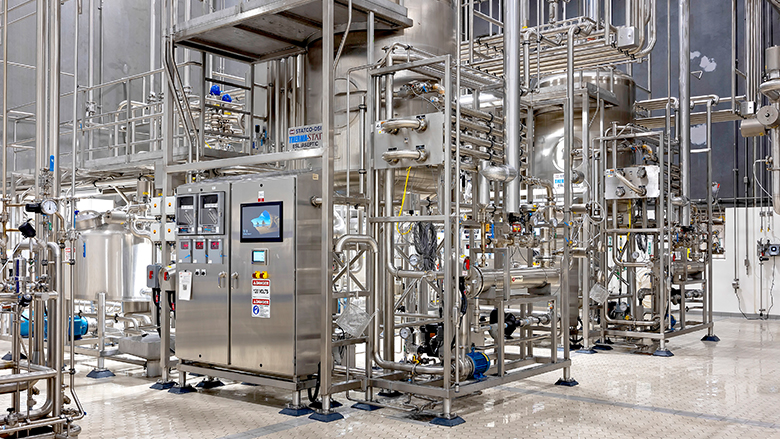
Statco-DSI’s Direct Steam Injection Therma-Stat is capable of producing both dairy and non-dairy products and is compliant with CFR113 and the PMO. Courtesy of Statco-DSI.
Is it worth it?
Any dairy processor considering adding aseptic/ESL lines to their plant operations must know there are potential space requirements, some additional costs in equipment, both on the processing and packaging side, "as well as potential additional personnel costs to accommodate regulatory and operational needs," Ellis confirms. "Space is predicated on capacity (speed) requirements but typically systems can be customized to fit into typical production line configurations/spaces," he says.
Here are some other things to look for before making a purchase, the Shibuya Hoppmann vice president suggests. "High production capacity (high speed) contributes to reducing the total cost of ownership (TCO). However, even if the initial investment is kept low, poor machine efficiency and low reliability will ultimately lead to a higher TCO. Therefore, the most important factor is to select equipment that has a proven track record in stable operation both mechanically and relating to aseptic/ESL operations," he says.
Rutz states aseptic processing "demands strict hygiene standards that come with rigorous validation." "This may be a great space for existing ESL producers to consider aseptic, as the investment gap may not be as high as they expect. In the case where some of this specific skill set is missing, contract manufacturers can play a role. Co-manufacturers lower the capital investment risk by allowing smaller brands to use their equipment, giving them agility when they are ready to scale up production," the Tetra Pak executive stresses.
Jackson stresses that aseptic/ESL is about much more than providing a robust shelf life for dairy products. It is also about "leveraging access to safe, nutritious and sustainable foods for the consumer."
Tetra Pak’s Mat Rutz says the company is 'absolutely seeing growth in aseptic sales, especially in the dairy sector, and, in fact, we believe that dairy will actually accelerate in this direction in the coming years.' Courtesy of Tetra Pak
"One key advantage of increasing shelf life is an increase in product distribution radius, allowing for products to be sold into a wider range of markets. This lends itself to ‘value-added’ products such as high-protein, lactose-free, and plant-based beverages as opposed to commodity-style products, which are likely already being produced within this wider geographic footprint," notes the Statco-DSI executive.
Jackson acknowledges that "upfront investment can be more significant [but] the margins on aseptic products exceed those of the commodities, hence justifying the investment through higher returns. It can be advantageous for a smaller processor to break into this value-added market versus their larger commodity-based competitors. Smaller processors may also have an advantage in the implementation of this new technology as opposed to their larger counterparts who have likely committed all of their space to producing their commodity products at scale," he reveals.
Aseptic/ESL product lines can also contribute to meeting consumer demands for more sustainable dairy products. According to Rutz, aseptic/ESL packaging solutions contribute to sustainability in several ways:
- Reduced food waste: Longer shelf life means fewer expired products and less spoilage across the supply chain.
- Lower energy use: Moving from ESL to aseptic can offer real efficiencies by bringing a new plant production schedule and reducing changeovers. Further into the supply chain, aseptic products don’t require refrigeration during transport or storage, cutting down on energy consumption.
- Renewable materials: Tetra Pak’s cartons are made primarily from renewable resources and are recyclable.
- Efficient logistics: Square and rectangular packaging shapes optimize palletization and reduce transportation emissions.
Attests Statco-DSI’s Jackson, "Aseptic and ESL technologies align closely with sustainability goals by reducing the reliance on energy-intensive cold chains and minimizing food waste through extended shelf life. They also enable the use of lighter, recyclable or renewable packaging materials, lowering the overall environmental footprint. For dairy processors, this means delivering safe, high-quality products while supporting circular packaging initiatives and reducing transportation and storage emissions, allowing brands to meet consumer demand for both convenience and eco-conscious choices."
Ellis adds aseptic/ESL lends itself nicely to PET bottles, which are more lightweight and recyclable than other comparable materials, contributing to overall sustainability.
"In addition, extending shelf life helps reduce spoilage and product returns that directly contribute to minimizing waste. Aseptic products do not require cold chain distribution, in effect reducing energy costs and lending to more global sustainability," he states. "In short, aseptic and ESL technologies allow dairy processors to reduce energy consumption, minimize waste, and adopt more eco-friendly, recyclable packaging formats, all while maintaining product quality and safety."
What will the future bring?
Considering sales for aseptic/ESL products are increasing, it is likely more dairy processors will offer this as a packaging option for their products in the future.
Jackson says: "The increasing demand for nutrient-dense drinks such as protein shakes and dairy alternatives is where we see the future growth coming from. Advancement in processing technologies and AI (artificial intelligence)-driven automation will further augment and streamline processes by improving sustainability and reducing contamination risks."
Shibuya Hoppmann’s Ellis expects future innovations to include advanced packaging materials (e.g., mono-PET, plant-based plastics) and special oxygen barrier coatings (e.g., SiOx, plasma). "Also, the continuation to reduce energy costs and water saving sterilization (e.g. electron beam sterilization) may gain traction in the United States as this is already realized in the Asian market. [Also], AI innovations for real-time data analytics and predictive maintenance will continue to improve," he notes.
Aseptic and ESL technologies are poised to become even more central to dairy innovation, Tetra Pak’s Rutz prognosticates.
"Future developments include options like advanced barrier technologies," he concludes. "At Tetra Pak, we’re on a mission to create the world’s most sustainable food and beverage package. Every year, we invest millions in research and development to create improved light and oxygen protection in recyclable and renewable materials to extend shelf life without compromising sustainability. We’re also working on advancements in our equipment portfolio such as flexible filling platforms and increasing our platform speeds."
Looking for a reprint of this article?
From high-res PDFs to custom plaques, order your copy today!