Packaging Technologies
Flexible packaging to continue its upward pace
Growth is expected to be steady in the category

As the dairy processing industry continues to increase its growth, so does the packaging industry that houses these products. According to Future Market Insights Inc., the global dairy packaging market was projected to be $25.9 billion in 2025 and anticipated to reach $39.2 billion by 2035, advancing at a compound annual growth rate of 4.2% during the 10-year horizon.
"By 2030, the industry is expected to cross $31.9 billion, supported by increasing adoption of lightweight materials, improved sealing technologies, and growing exports of processed dairy products. The second half of the decade is marked by enhanced demand for functional packaging that ensures extended shelf life, greater portability and improved design appeal," the firm notes in its report.
In a Nov. 24 blog post, the Newark, Del.-based researcher adds: "Leading product formats, including cartons, pouches, and rigid plastics, continue to dominate the market, offering versatility to dairy manufacturers worldwide … Global consumption of milk, cheese, yogurt and butter continues to surge, increasing the demand for packaging that preserves product quality and ensures safe distribution. Ready-to-drink and flavored dairy beverages are driving innovation in portable and convenient packaging formats."
Zeroing in on segments of the packaging industry, rigid plastic and flexible packaging had a projected share in 2025 of 66.1% and 25.1% respectively, according to Jorge Izquierdo, vice president of market development for PMMI, The Association for Packaging and Processing Technologies, based in Herndon, Va. "The trend is for flexible packaging to keep growing at a moderate but consistent rate for the next years while the opposite is true for Rigid Plastic. The projections suggest that by 2029, the shares will be 65% for rigid and 26.2% for flexible (see charts). While glass is showing significant growth in the same period, it’s coming from a much lower base with a projected share of 0.8% in 2025 and 1.1% in 2029," he says.
The PMMI executive adds cost will be a major driver for the rigid and flexible packaging market. "In the right applications, flexible packaging can offer lower costs for manufacturing and prices for the consumer. In the current inflation environment, it’s important for brands to keep their products at the same or similar price point. To do this, brands frequently adjust formats and package sizes," Izquierdo notes.
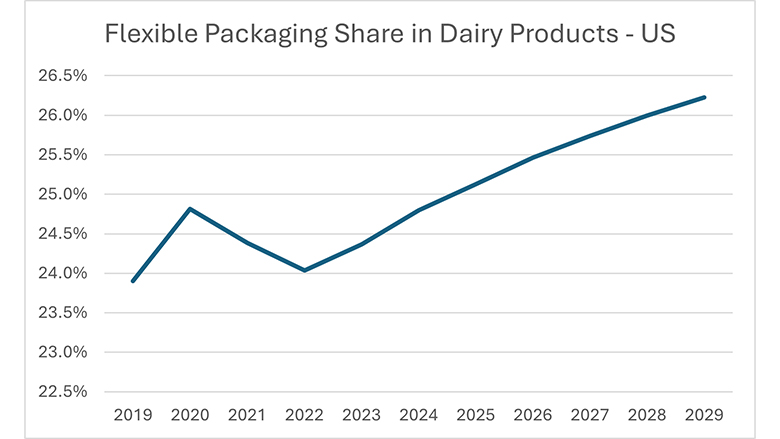
(Click on image to enlarge) Source: PMMI
A second component is consumer convenience. Flexible packaging formats such as stand-up pouches, resealable bags, and single-serve formats are considered more convenient than competitive products. However, Tom Newmaster, Partner, FORCEpkg, Lancaster, Pa., stresses there is a perception in packaging that flexible packaging may be more environmentally friendly, but that may not be completely accurate when you factor in recyclability. "Many times, flexible packaging is automatically considered trash, whereas rigid packaging has a better chance of being recycled. I always fall into the camp of ‘whatever is best for the specific product and whatever delivers the best consumer experience,’" he states.
Sustainability — for which consumer demand continues to grow, also plays a role. "While both materials are plastic, the amount of material used in flexible packaging is lower than in rigid plastic, even if the recycling for rigid plastic is more developed than flexible packaging. The consumer perception tends to see flexible packaging as less impactful than rigid containers," says Izquierdo.
Due to new Extended Producer Responsibility (EPR) legislation being adopted in more states and some starting its implementation, in the long term, it will likely push toward the use of PE- (polyethylene) and PP (polypropylene)-based flexible packaging. "We are already finding many monomaterial laminations that provide extended protection, shelf life and appeal. This will likely accelerate the development of a flexible packaging recycling infrastructure," Izquierdo reveals. "To further facilitate the recyclability of films, a new generation of optical sorters allow them to better distinguish and classify PE and PP. This in conjunction with digital watermarking will allow for higher quality and volume of recycled plastic film streams. In addition to mechanical separation and recycling, advanced/chemical recycling is developing as a practical alternative specifically for food-grade products."
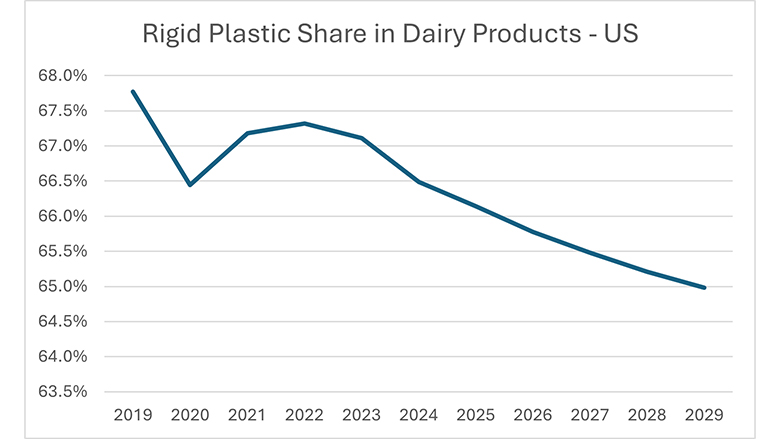
(Click on image to enlarge) Source: PMMI
What’s new in rigid and flexible packaging
According to Izquierdo, most of the technological innovations in the industry come from the flexible packaging side. "Film innovations include recyclable/compostable films, plant‑based materials and efforts to consolidate laminations for easier recycling. Paper as a structural layer for film is gaining traction in some food applications, highlighting the environmental appeal of paper but maintaining the barrier properties of plastic," he notes.
Chemical recycling is becoming a more viable option for recycling content for food products, he adds. "In rigid packaging, post-consumer recycled (PCR) content is ahead of flexible packaging as the recycling infrastructure is more developed," he says.
Newmaster maintains there has been a lot of buzz around materials that are biodegradable and compostable, however, "I’m not convinced the technology is appropriate in all instances. Some of these materials may limit shelf life and start to degrade before getting to the consumer, so this creates another area to manage," he asserts. "In addition, the communication of how to dispose of these packaging materials can be some murky waters. Explaining the difference between a household compost bin and industrial composting, and the proper conditions for biodegrading can get confusing."
No matter where the future leads, it is a safe bet that food safety will be front and center as always, which could lead to major packaging changes. In fact, Newmaster calls food safety regarding rigid and flexible packaging a "complex issue." "There so many variables (from my perspective), material type, filling conditions, storage conditions, delivery formats, etc. Every new material needs to be tested, but we can’t forget to test how those materials impact the consumer perception of the brand," he asserts. "Does the material change the user experience, opening, closing, dispensing, storage and disposal? Will the consumer need to be educated (re-educated) on how to use the product? The changes could be drastic and that could have a negative impact on sales."
Izquierdo predicts labor shortages and employee turnover are translating directly into operational challenges related to food safety and sanitation in dairy operations. "This is accelerating investment in automatic self-cleaning functions and digital integration to adopt preventive cleaning based on operational data and to maintain data logs for regulation compliance (see chart). The opportunity for digital integration to support sanitation is significant as there is a significant number of food processors not using any digital integration strategies to support their sanitation process," he relays. "The opportunity for digital integration to support sanitation is significant as there is a significant number of food processors not using any digital integration strategies to support their sanitation process."
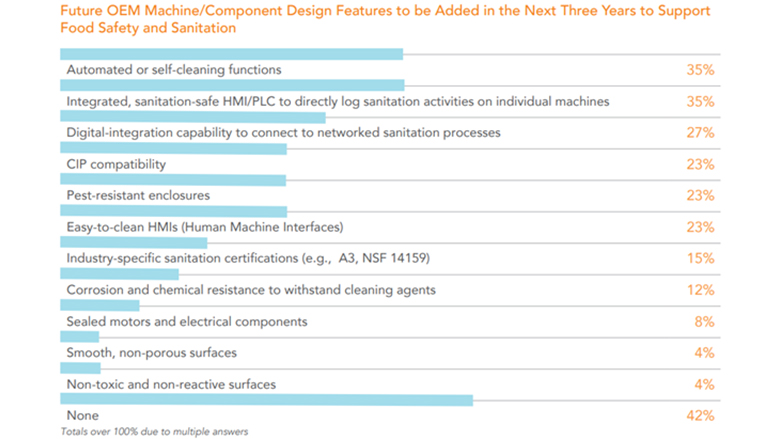
(Click on image to enlarge) Source: PMMI
Flex plan
Last year, when Dairy Foods penned a similar story, we stated, "The emergence of flexible pouches and bags has made its way to dairy, and it looks like it is here to stay." We asked respondents for an update on this statement. According to Newmaster, this declaration still holds true. "As new packaging materials and forms work their way into a category, and consumers become familiar, and as long as they perform or outperform previous packages, they will become common. It really has to do with acceptance and whether or not the material or form makes sense," he notes.
FORCEpkg’s executive adds that from a package design and brand perspective, a stand-up pouch can provide a better primary display panel to communicate the product features and benefits. "This could be because of size or better graphics/printing and provide opportunities for special effects and printing techniques to grab the consumer’s attention," he affirms. "Calling out ‘new and improved’ is a great strategy, assuming it’s true. It’s all in how you use it and capitalize on everything the material or package form can offer."
PMMI’s Izquierdo’s perspective is that while flexible pouches and bags are here to stay, its sales will likely be "steady" as opposed to an exploding growth category. Izquierdo concludes that steady flexible pouch and bag growth will be led by:
- More advanced barrier properties for monomaterial laminations to align with sustainability initiatives
- New and better technologies to classify and recycle film
- Convenience of on-the-go, single-serve and resealable fixtures
- Additional manufacturing flexibility that allows for easier changes in size and shape
- Added flexibility of sourcing film versus bottles
- Printing quality and graphic appeal
According to an old proverb, "slow and steady wins the race." Packaging may need to settle for steady growth, but as the health and wellness trend continues to propel the $76 billion dairy industry, packaging sales should continue its upward ascent.
Looking for a reprint of this article?
From high-res PDFs to custom plaques, order your copy today!