Westby Cooperative Creamery only plant in Wisconsin to make cottage cheese
Creamery pursues $14M plant expansion to double capacity.

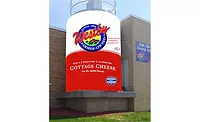
As the only cottage cheese manufacturer in Wisconsin, the creamery showcases its expertise in cottage with a decked-out silo that actually holds sour cream.
Photos by Barbara Harfmann.
Dairy Foods recently went Inside the Plant at Westby Cooperative Creamery, which manufacturers 132 SKUs across cottage cheese, sour cream and bulk yogurt from its 55,000-square-foot headquarters and distribution center at 615 North Main in Westby, Wis., with the manufacturing plant located just one mile down the road.
The cooperative’s claim to fame is its award-winning cottage cheese, which won the prestigious Best of Class Gold Medal in the 2020 World Championship Cheese Contest for its 4% Small Curd Cottage Cheese.
Founded in 1903, Westby Cooperative Creamery started off as a butter and dried milk producer but moved into cottage cheese manufacturing in the early 1930s and has not looked back. In fact, the tiny town of Westby (population 2,366), which is located about 35 miles southeast of LaCrosse, earned the distinction of being named the “Cottage Cheese Capital of Wisconsin.”
As part of that recognition, one of the cooperatives’ 6,280-gallon silos is colorfully wrapped to look like a giant cottage cheese container with the blue and red Westby logo proclaiming “Since 1903 Farmer Owned.” The silo also pays homage to Wisconsin’s rich dairy heritage with a “Proudly Wisconsin Dairy” logo.
While best known for its World Championship 4% Small Curd Cottage Cheese, the creamery also produces 2% small curd cottage cheese and 4% large curd cottage along with organic versions of its 2% and 4% small curd cottage cheese.
While the bulk of the Westby’s production centers around cottage cheese, 1.1 million pounds of production each month, another 1 million pounds are divided between regular and organic sour cream and bulk yogurt. The cooperative’s sour cream and French onion dip are available in 8- and 16-ounce containers. Each month, the creamery churns out 2.1 million pounds of cultured dairy products.
Interestingly, Westby Cooperative Creamery is the only cottage cheese processor in the state of Wisconsin. The cooperative typically produces about 1.1 million pounds a month of regular and organic cottage cheese using fresh Grade A and rBST-free conventional milk and certified organic milk delivered daily from 94 local family-farm owners from Wisconsin with some spillover into Minnesota.
“The low-fat 2% and 4% varieties of our cottage cheese are our biggest movers, covering 70% of our total production. We can’t make enough product, and we’re running 24 hours a day, seven days a week,” says Westby president and CEO JD Greenwalt.
Dave Larson, who has served as plant manager at the creamery since June of 2022, concurs. “Right now, making cottage cheese takes about 16 hours and it’s very labor-intensive process with a lot of hands-on stirring and cutting of the curd,” he tells Dairy Foods. “We fill the vats, we culture the vats and because the culture is a slow set, it takes upwards of four-and-a-half hours for us to reach the proper pH. At that point, we have to cut it, let it heal and then cook it.
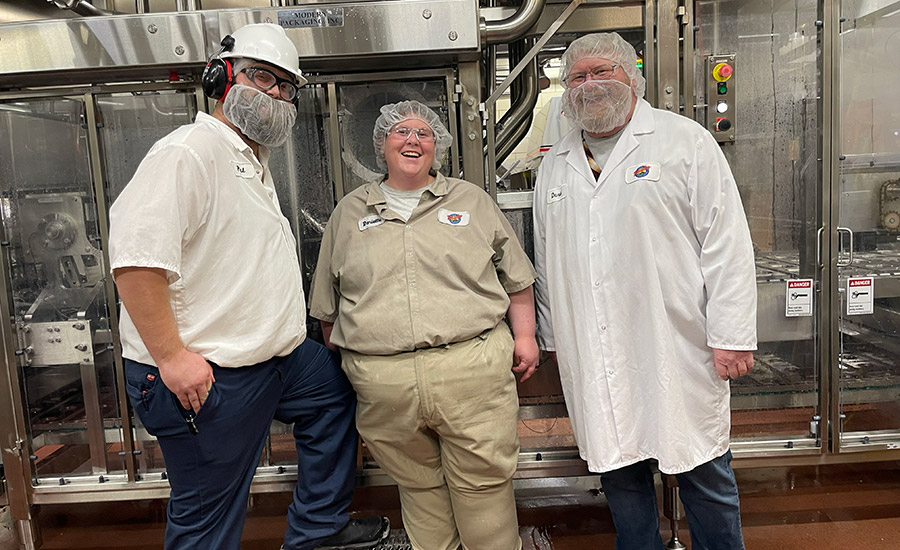
“By the time our cottage cheese is ready to be packaged, it’s been about 16 hours, so it’s a very lengthy process that’s all hands on,” he continues. “In the last 60 days, we had to turn down 13 million pounds of cottage alone. Automation would enable us to more than double our capacity. That’s not pie in the sky. The demand is there, and we’ll be able to add more customers and fulfill our customers’ needs more efficiently without ever losing sight of the small batch, country goodness of our products.”
With the demand for cottage cheese continuing to grow, in 2022 the creamery made the decision to process acid whey — the byproduct of cottage cheese — at the plant by installing equipment that filters out the protein, solids and water.
The creamery invested $1 million into the project and processed 6.9 million gallons of whey in 2022, with its acid whey production remaining steady at 6 million gallons annually, Larson states.

The equipment allows the creamery to sell the filtered material in a more desirable form to a wider customer base. The whey is turned into two usable products — permeate (as animal feed) and protein, which gets sold and is often used as an ingredient in functional ready-to-drink protein shakes and nutritional supplements, the company says. The creamery’s goal is to eventually re-use the water recovered from filtering acid whey.
Automating production
Recognizing that some of its equipment is 40 and 50 years old, the small-batch cooperative will be undergoing a $14 million expansion. This will enable the 123-year-old creamery to install more automated equipment, such as enclosed vats and rinser-drainers, so that it can ramp up cottage cheese, sour cream and yogurt production, Greenwalt says. The CEO anticipates everything being up and running by mid-2026.
The vertically integrated dairy products cooperative derives more than three-quarters of its $65 million in annual sales from contract manufacturing of private-label products and ingredients along with sales to foodservice customers coast to coast. The creamery’s cultured dairy products are available in bulk sizes (5-, 30- and 40-pound containers, 55-gallon drums and 2800-pound totes) for foodservice and industrial customers.
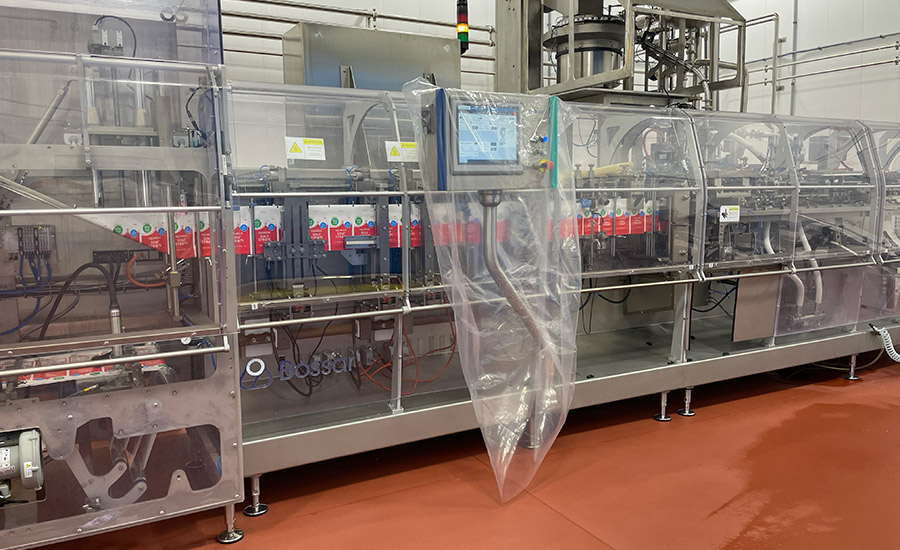
A few years ago, the creamery installed a Bossar pouch filler — currently its most automated piece of equipment — to increase packaging capacity to fill sour cream orders more expeditiously, Larson says. “It can run 40, 14-ounce sour cream pouches a minute,” Larson notes. “Once we start it, it runs pretty much nonstop until a batch is completed.
“We have five filling lines and multiple packaging lines in the plant. One packaging line will handle 5-ounce cottage cheese cups, while the other line handles 8-ounce to 24-ounce cups of sour cream pouches and French onion dip,” he relays. “Cottage cheese and cultured sour cream is our bread and butter. Given the long set time for our cottage cheese, we use our equipment very efficiently.”
The cooperative also is selling more of its batch yogurt due to a new partnership with Perfect Parfait. The Frisco, Texas-based company offers a patented new concept in fresh yogurt service that provides dispensable yogurt from Westby Cooperative Creamery in an easy to load, bag-in-the-box system that keeps yogurt optimally fresh.
Guests at Best Western, Tru and Home2 brands for Hilton are invited to “create their own parfait” with self-service yogurt that they can top with a wide variety of inclusions such as granola, fruits and nuts. Approximately 4,500 28-pound cases of bulk yogurt in Vanilla and Strawberry are shipped monthly, Larson says.
Marketing-wise, Westby Cooperative Creamery’s logo on the side of Perfect Parfait’s dispensing machines could also boost sales. In fact, Greenwalt predicts an 88% increase in yogurt sales due the new collaboration, with more growth expected, as hotels, restaurants and foodservice seek to give customers better-for-you products like high-protein yogurt.
Attention to quality, sanitation and food safety
Working at Westby Cooperative Creamery is a full-circle opportunity for Larson, a Wisconsin native who grew up on a small dairy farm operated by his father and uncle. He honed his food sanitation and plant expertise working for 10 years at an organic dairy, served two separate stints at a chemical sanitation company, and worked at a whey drying facility.
From start to finish, hygienic dairy operations are crucial. “Everything has to move through the plant and things can travel,” Larson explains. “Having an excellent sanitation plan was one of the first steps we had to get implemented here. Are we perfect? No, we're not perfect, but we keep taking steps forward to get better each and every day.”
During a plant tour, the plant manager points out the two intake bays that can receive conventional and organic milk from its 94 patrons throughout the day. Samples are sent to the on-site lab for component testing by Quality Assurance Manager Jason Levendoski, who tests the raw milk for organoleptic characteristics and shelf life. Pathogen testing is handled by an off-site lab.
Larson credits 16-year employee Levendoski for going “above and beyond” in helping Westby install a CEM oracle, which analyzes butterfat solids, sending specimens to other off-site labs and managing the team’s food safety and quality employees. The plant is an SQF (Safe Quality Food) Certified Supplier, Larson adds.
Other components of the plant include four large stainless steel silos (two for conventional milk; two for organic milk) that hold 800,000 pounds of milk; a dedicated 12,000-gallon silo, Silo 7, which handles the whey prior to concentration that Larson notes must be stored at greater than 120 degrees Fahrenheit. It is emptied and processed every third day. In the newest part of the plant, the aforementioned silo decked out like a giant cottage cheese container stores sour cream prior to packaging.
In the bulk filling room, Vat I, with a 6,200-gallon capacity, handles all the sour cream production; Vat G and H, with capacities of 1,250-gallons and 1,000-gallons, respectively, are processing vats for yogurt predominantly but can handle sour cream. The Bag-in-Box filler is used for yogurt and cream cheese. A nitrogen component was added to increase the shelf life.
In 2021, the creamery undertook a $2 million investment that included a new 5-pound Bossar filler for packaging sour cream pouches, new packaging, and renovations to the plant to ensure smoother production and to increase throughput.
The process of putting sour cream in a pouch begins with milk, which is separated to create the main ingredient — cream — for sour cream. Next, the cream is mixed with other ingredients and goes through pasteurization and homogenization. When desired pH levels are reached, the product is cooled and sent to the filler where it is put into 14-ounce pouches.
A bright future
Both Greenwalt and Larson credit their “phenomenal” 94 farmer-owners (patrons) and 146 plant and administrative employees for their strong work ethic.
“Our team works incredibly hard,” Larson says. “We’re one of the few dairies that are still running 12-hour shifts, so even though our staff is working longer shifts, generally they work 15 to 16 days a month. That provides a pretty decent work-life balance.”
With the expansion and more streamlined plant operations, Larson predicts more growth and success. “We’re going to carve out an area within our warehouse to build a clean room and a food manufacturing space. The new footprint will enable us to cut the number of open table vats from 7 to 4 to make 20 million pounds of cottage cheese a year while improving throughput. More automation will significantly cut down a lot of the bending, stooping and manual labor.”
Greenwalt concludes: “Our cooperative has been a mainstay of the dairy industry since 1903 and the farmers that deliver the milk to us are the owners of this business. This makes what we do incredibly important as each of the dots on the map behind me represents a farmer’s livelihood. Our upcoming expansion and more automated equipment will further our success for the next 123 years.”
Looking for a reprint of this article?
From high-res PDFs to custom plaques, order your copy today!