The possibilities are endless with mixed milk cheeses
Combining cow, sheep and/or goat milk produces cheese with unique flavor profiles.
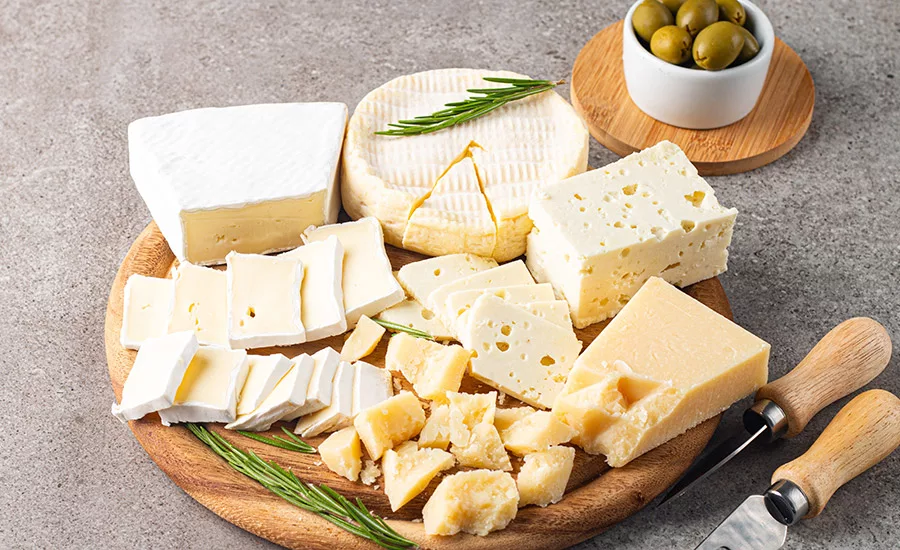
Photo courtesy of Eugenia Lucasenco / iStock / Getty Images Plus

John A. Lucey is a professor of food science at the University of Wisconsin, Madison, and the director of the Center for Dairy Research.
As the name implies, mixed milk cheeses are produced by blending any combination of cow, sheep, and/or goat milk. These cheeses provide an opportunity for cheesemakers to produce products with unique flavor profiles. Mixed milk cheeses may also be more palatable for consumers who may not want the full flavor (or cost) of sheep or goat’s milk cheeses. Use of cow’s milk in a mixed milk cheese can also be helpful if there is only a limited availability of sheep or goat’s milk.
There are many traditional cheese varieties, like feta, that were historically made from a mixture of sheep or goat’s milk. There are also some traditional cheeses that may also contain specific mixtures of sheep, goat, and cow’s milk.
These types of cheeses are relatively new in the U.S. The Wisconsin Specialty Cheese Program, funded by the then Wisconsin Milk Marketing Board, helped launch mixed milk cheeses here in the late ‘90s. At this time, the University of Wisconsin-Madison had a flock of sheep in Spooner, Wis., and the Center for Dairy Research (CDR) started to conduct both product development and research work in sheep milk cheeses with Dr. Dave Thomas from the University of Wisconsin, Department of Animal Science. During this time, CDR also worked with optimizing mixing sheep and cow milk blends for Scott Erickson at Bass Lake Cheese in Somerset, Wis.
Sid Cook, of Carr Valley Cheese in La Valle, Wis., was probably the first cheesemaker in Wisconsin to make blended sheep and goat milk cheeses during the 1998-99 season. Not long after that, CDR held a short course focused on manufacturing mixed milk cheeses in which CDR staff lectured and conducted a hands-on lab featuring different manufacturing techniques. We then worked with Bob Wills at Cedar Grove Cheese to develop a blended sheep and cow milk cheese in conjunction with the Wisconsin Dairy Sheep Cooperative.
Today, mixed milk cheeses have their own classes at contests like the U.S. and world cheese contests. The category continues to grow, and there is a wide variety of award-winning mixed milk cheeses that are popular with consumers and produced by various U.S. cheesemakers.
When making mixed milk cheeses in the U.S., there are no set rules or minimums as to how much goat and/or sheep milk is blended with cow’s milk. Some specific European PDO mixed milk cheeses have very specific ratios that must be used. John Jaeggi, coordinator of the CDR Cheese Industry & Applications program, notes that, in the U.S., blends come down to three key factors: texture, flavor, and cost. Each milk is compositionally different, and all require different make adjustments.
In the case of sheep milk, ideally a minimum of 20% of sheep milk is blended with cow milk if the goal is to make a cheese that has many similar characteristics of a straight sheep milk cheese — for example a Manchego-type. Sheep milk also tends to have higher protein levels (5.25% compared to 3.0-4.0% for cow milk), which improves yield but also carries more insoluble calcium (from the higher casein content).
This makes it necessary to blend a large percentage of cow milk with sheep milk if the goal is to make a pasta filata style cheese like Mozzarella or Scamorza. The increased insoluble calcium levels in sheep milk is why sheep milk cheeses tend to be firm and a bit grainy in texture compared to cheese made from cow or goat milk.
Goat milk cheeses tend to be whiter as it does not contain key carotenoids like beta-carotene as goats convert all of that to vitamin A, which is colorless. Blending goat milk with cow milk will result in a lighter colored cheese depending on the percentages of the blend. Another prominent characteristic of goat milk is that it has small fat globules, which aids in making an acid set cheese like Chèvre.
Again, when making mixed milk cheese, cheesemakers can use any combination of milks. Cheesemakers may have to make slight adjustments on starter, coagulants, and other enzymes based on desired flavor and texture profiles.
This is where the art and science of cheesemaking comes into play. In general, if the cheesemaker wants a firmer bodied cheese, they would use a higher percentage of sheep milk. If the cheesemaker wants to make a whiter cheese or an acid set cheese, they would use a higher percentage of goat milk. If cost is an issue, the cheesemaker would add a higher percentage of cow milk. Adjustment of cultures and enzymes are based on protein levels in the mixed milk cheeses and the desired body, flavor, texture, and shelf life of the cheese.
Ultimately, one of the most important aspects of mixed milk cheese is the flavor profile. Mark Johnson, CDR Distinguished Scientist, has judged at many U.S. and international cheese contests. When judging a mixed milk cheese, Johnson suggests that the judge needs to be able to taste the key milk in that cheese. If a mixed milk cheese is made with sheep and cows milk, the judge needs to be able to taste the sheep milk. While it’s acceptable if the cow’s milk isn’t detected — the flavor of the sheep and/or goat milk needs to be prominent, Johnson adds.
If a judge tastes a mixed milk cheese that contains goat milk but doesn’t get “goaty” flavors, then that cheese will be marked down. Similarly, consumers will expect to taste some sheep and/or goat milk in the mixed milk cheeses that they purchase. So, while there is no minimum on the amount of sheep and/or goat milk used, the flavor of the minor milk(s) needs to come through in the cheese.
Finally, when making mixed milk cheeses, it is important to procure high-quality sheep and/or goat milk and properly handle and store these milks. Goat and sheep milk are more fragile than cow milk. For instance, the fats in goat milk are easily damaged if mishandled and can result in overly strong “goaty” flavors. Considering that there are limited numbers of dairy goat and sheep herds in the U.S., the milk may have to travel a significant distance to get to the cheese plant. One option can be to freeze sheep and goat milk. Unlike cow’s milk, goat, and sheep milk doesn’t get significantly damaged when undergoing the freezing and thawing process.
Overall, many consumers are drawn to mixed milk cheeses because of their unique flavors and appearance. The range of possible flavors and textures are endless in this category and many U.S. cheesemakers are making a name for themselves by producing innovative, high-quality mixed milk cheeses.
Looking for a reprint of this article?
From high-res PDFs to custom plaques, order your copy today!