Conveyors and palletizers keep it moving
The right conveyors and palletizers are critical to today’s dairy processing operations
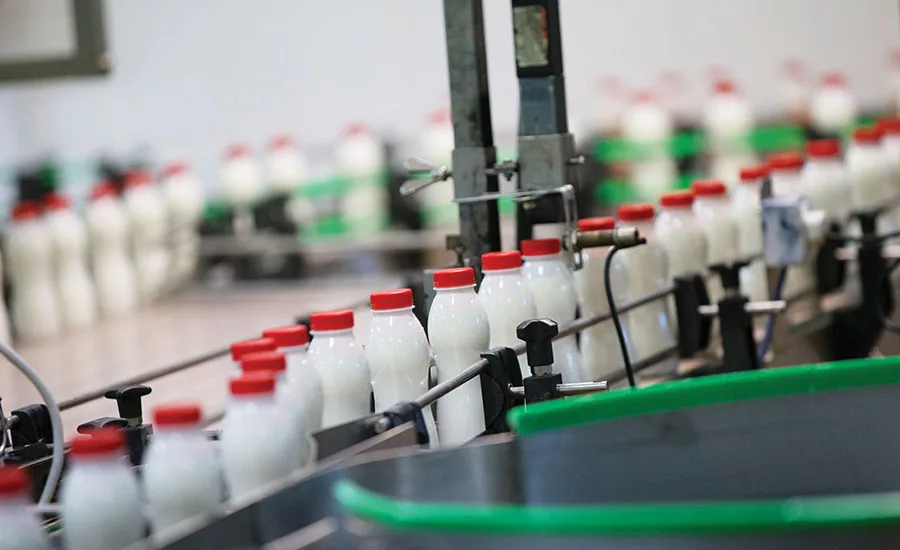
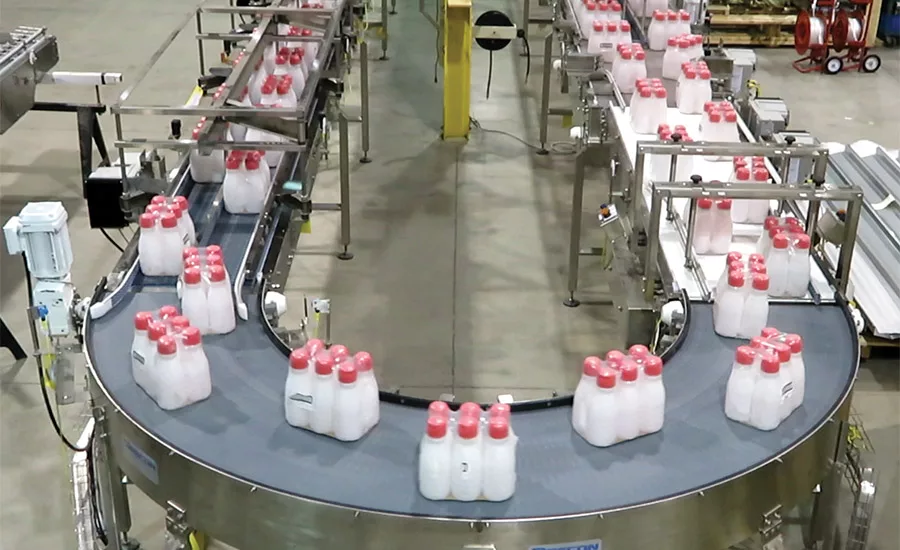
Successfully transporting a product or package from point A to point B is critically important for dairy processing facilities. Downtime resulting from incomplete cleaning, difficulty of disassembly/assembly during maintenance and other issues could be costly. So it’s important that dairy processors select conveyors and palletizers that are up to the task.
Sanitary design a conveyor priority
When selecting a conveyor system for dairy processing operations, 3-A Sanitary Standards should come into
consideration, Ken Lento, senior business strategist for FlexLink Systems Inc., Allentown, Pa., pointed out.
Some companies cut corners when it comes to hygienic design so they can sell the equipment at a lower price, he noted. Such equipment has features that are not easily cleanable and, therefore, could harbor bacteria.
“It’s best if the conveyor has been qualified by 3-A under a 3-A Standard like 75-01,” Lento said. “They should also ask for the hygienic design details, like no hollow tube supports, no metal-to-metal contact in the food zone, and others.”
He said FlexLink submitted its hygienic conveyors to 3-A Sanitary Standards for full qualification.
“Under the Belt [-Type] Feeders Standard 75-01, we qualified the conveyors to meet or exceed the standards,” Lento said. “This included third-party toxicology testing of the belting and plastics that could contact food in production.”
Cheryl Miller, marketing director for Winneconne, Wis.-based Multi-Conveyor LLC, echoed the need for sanitary systems. Dairy processors must not discount the importance of equipment that’s easy to clean — via clean-in-place (CIP) or clean-out-of-place (COP) practices.
“This includes UL certified and sometimes washdown-approved controls,” she said.
Moreover, FDA and numerous other government and certifying bodies have their own food safety requirements, Miller noted.
“Only the most experienced in-house conveyor engineers can ensure these requirements are met,” she said. “A post-installation conveyor retrofit to accommodate agency compliance may be a very expensive fix. Be prepared. Do the compliance homework upfront.”
That said, if a retrofit ultimately is called for,
Multi-Conveyor’s vast engineering expertise can be invaluable in providing dairy processors with solutions that are more functional, cost-effective, productive or space-saving, said Jim Paulsen, sales account manager.
To get the best fit, dairy processors need to ask the right questions, too, suggested Jim Ruff, vice president, process systems and integration solutions for Walla Walla, Wash.-based Key Technology Inc.
“Before selecting a conveyor, a dairy processor should describe their application and ask how the recommended solution will achieve their objectives,” he said. “Also ask about sanitary design features such as polished finishes, ground and polished welds, open frame construction, oil-free drives, minimal laminations and screens that are easy to remove and easy to clean.”
It’s important to consider the sanitary design features not only within the product contact zones, Ruff added, but also within the “splash zones” and in the areas of any structural supports.
In addition, processors would be wise to consult the “10 Principles of Sanitary Design” put into place by the Equipment Design Task Force, added Paul Krechel, international dairy market manager for Deville Technologies, Montreal. It’s “an excellent starting point” as processors consult with industry suppliers in search of equipment that’s hygienic, safe, functional and more.
Outside of sanitary design considerations, dairy processors might want to ensure they are set up to adapt quickly to changes occurring in the industry. For example, single-serve-type packages are becoming increasingly common, noted Dave Farquhar, president and CEO of Descon Integrated Conveyor Solutions, Newmarket, Ontario.
“With that comes a variety of packaging options, higher line speeds and more complex changeover requirements,” he said. “I believe a focus on changeover technology and flexibility is key for an industry that is growing and changing rapidly.”
New and improved
Many conveyor suppliers continue to make sanitary design and other improvements designed to benefit dairy processors.
For its part, Deville Technologies recently began to provide its processing partners with solid frame designs, Krechel noted. The designs help to eliminate bacteria harborage areas, Krechel explained.
“In food manufacturing environments, hollow frame tubing is commonly used for the foundational support of the equipment. When damaged, water and bacteria are able to infiltrate the damaged area,” he said. “As the hollow tube frame is contaminated, it becomes nearly impossible to eliminate the bacteria from the source.”
Deville Technologies also recently introduced conveyors with hinged covers and tool-less dismantling. The result is quicker and more efficient sanitation.
“These types of designs not only protect the equipment for longevity and provide for easy cleaning, but also provide a hygienic environment for processing our food,” Krechel said.
And offerings from PPM Technologies, Newberg, Ore., now include belt conveyors with an open framework design to improve visibility/access for sanitation, said Neil Anderson, vice president of business development.
We have eliminated the use of traditional motors and gearboxes where possible, utilizing drum motors instead to improve maintenance and sanitation,” he added. “Belting materials have improved, and we can eliminate flights on incline conveyors, which greatly decreases sanitation time and improves product quality due to reduced damage.”
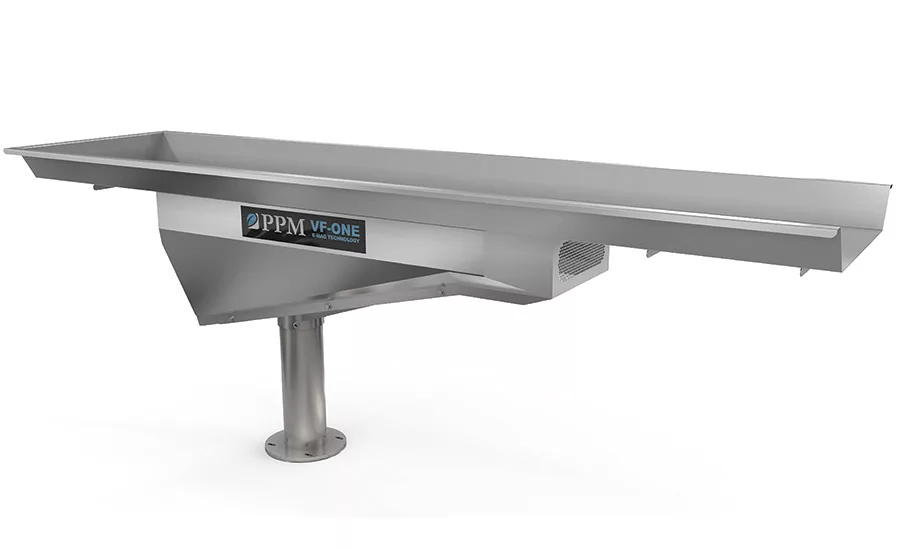
PPM Technologies’ VF conveyor range features an all-stainless-steel construction, Anderson noted, as well as an open-drive design for ease of maintenance- and sanitation-related access. The drive incorporates variable speed and automated stroke control to allow processors to adjust for production rates.
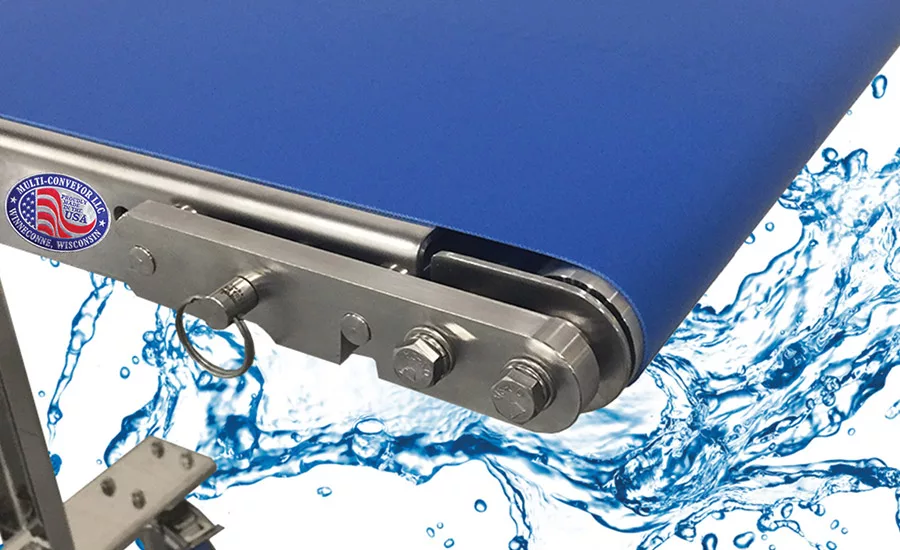
To address the need for conveyors that are not only sanitary, but also low-profile, CIP-able and more, Multi-Conveyor introduced the Slim-Fit, Miller said. The unit’s tool-less pin-pull approach allows the operator to remove the belt in just seconds for routine maintenance. Made of 100% stainless steel, the low-profile frame footprint comes standard with three-ply blue washdown belting.
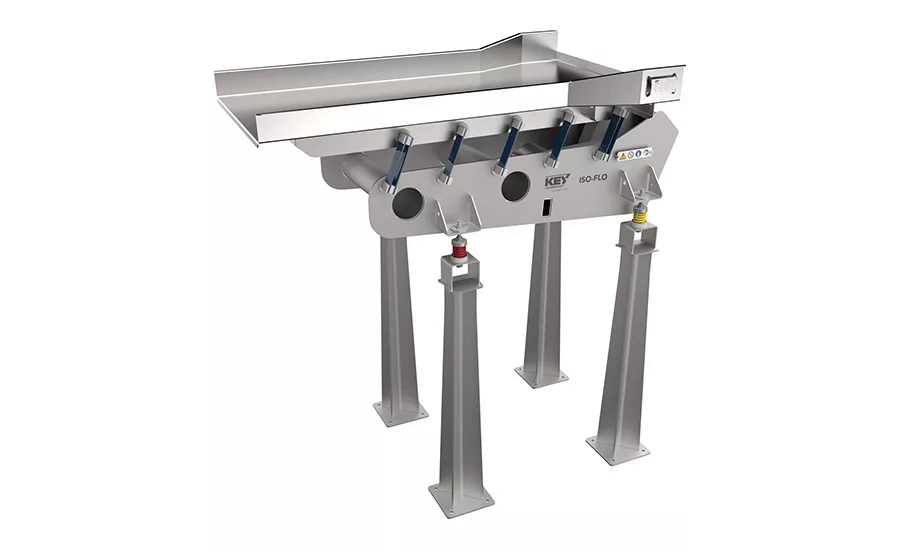
And Key Technology recently introduced a number of available features on its Iso-Flo and Impulse lines of vibratory conveyors, Ruff noted. The conveyors are designed for superior sanitation, ease of use and reliability.
“The sanitary features include a rotary polish on 304 stainless-steel product-carrying surfaces, and ground and polished welds within the product-contact zone, as well as within the ‘drip,’ ‘drain’ or ‘draw’ zones,” he said. “Optional open-plate frames replace hollow tubing to allow access for high-pressure washdown.”
Key Technology eliminated adhesive labels, too — which could peel off — as well as riveted plaques that could harbor bacteria, Ruff said. And a new Vector-Lock feature that secures removable screens and covers enables better clamping and quick release.
Flexibility, meanwhile, was the goal of Descon Integrated Conveyor Solutions when it recently introduced a simple-changeover guide-rail system. The system is infinitely definable within a set of limits and can be adjusted easily via a simple operator interface, Farquhar said.
“As lines and packaging get more complicated, this allows for a simple addition to packaging capability without additional capital investment,” he pointed out. “Using DC linear actuators with a simplistic pivoting design, Descon can meet the needs of today and easily adapt as needs change with high reliability and low operating costs.”
For PPM, a recent focus has been on training plant personnel and updating its service and operations manuals to ensure those plant personnel understand the correct functionality of the equipment, Anderson noted.
“Today’s designs are very different [than] yesteryear’s, and an operator with 25 years of experience [is not necessarily] familiar with today’s technological advances,” he said. “Component suppliers are constantly making small improvements, but if this knowledge is not transferred to the operator, the equipment — and, ultimately, the production process — is not used to its full capability.”
Palletizer considerations
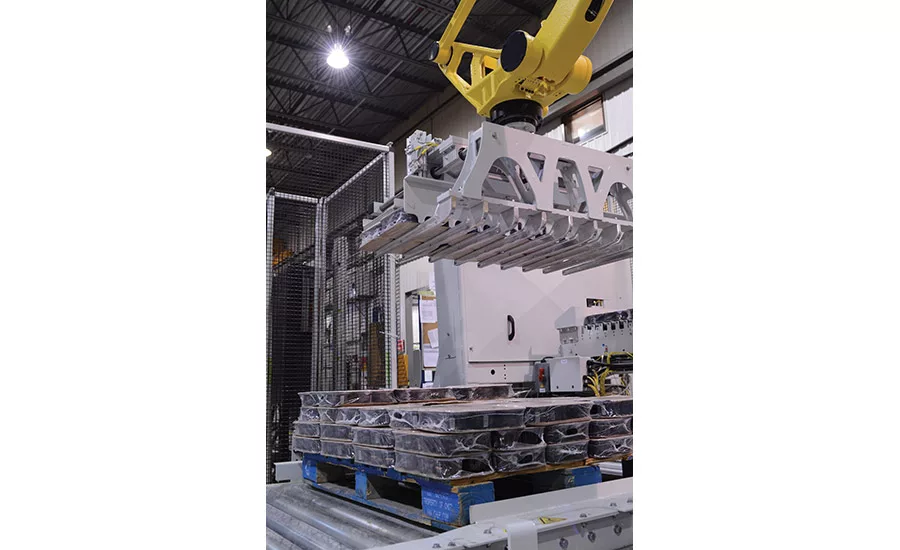
Selecting the right palletizer also is essential to dairy processing operations. The first step here, said Dominic Salvail, field sales manager for Premier Tech Chronos, Rivière-du-Loup, Quebec, is to define current and future operational needs according to production rate, the environment and product variance.
“Working with an experienced automation partner from the beginning often proves beneficial,” he said, “as there is a direct correlation between equipment cost and the application design requirements.”
The No. 1 consideration for dairy processors, however, should be safety, Salvail said. Even one accident could overshadow any financial gains made through increased automation-related efficiencies.
“Selecting an equipment provider where safety is at the forefront of machine designs is paramount,” he stressed.
Eric Cruse, vice president of sales for Benchmark Automation, part of Covington, Ky.-based ProMach Inc., said dairy processors also should ask the equipment provider about its dairy-specific experience, as well as its experience with the specific process in question. Other relevant questions include those related to how case breakage at palletizing would be handled, how the equipment will react to moisture and temperature in the packaging area (for cheese applications, in particular), the materials used in equipment construction, the inclusion or exclusion of coatings or treatments to prevent chemical oxidation on equipment, the source of the stainless steel and any relevant specification, the software used, the availability of 24-hour support, and more.
As on the conveyor side, sanitation is a top priority, too, so it is important for the processor to determine palletizer requirements specific to sanitation, said Bryan Sinicrope, vice president of sales and marketing for Tarpon Springs, Fla.-based A-B-C Packaging Machine Corp.
“If the palletizer will be in a washdown area or adjacent to the area, it will need to be constructed to withstand moisture and cleaning agents,” he said. “Typical requirements include stainless-steel construction, watertight joints and NEMA 4 or 4X electrical panels. However, there are different degrees of washdown, so the dairy’s requirements should be discussed with potential suppliers.”
Plant layout is another consideration, Sinicrope said. Adequate space must be present around fixed equipment, per many food industry requirements, to facilitate cleaning. And drainage must be provided if the palletizer will be subjected to washdown.
“It’s also important to consider the ambient temperature in the palletizing area, as very cold temperatures can affect the machine components,” he added. “For example, air cylinders can fail if the temperature of the air in the plant piping is below the compressed air dew point. To avoid this problem, any air-operated components should be upgraded to mechanical components if the plant temperature is very cold.”
Making progress
Recent advances within the palletizer arena promise to make life a bit easier for dairy processors.
For its part, Quest Industrial, also a ProMach Inc. company, introduced Q-Box software for its Q-Pact robotic palletizer. Don Wickstrum, CEO of Quest, said it is the most advanced software on the market for building single- to five-pick pallet patterns. It features multi-layer pattern building and automatic height correction. Real-time dynamic path modification will be available in the near future.
And Benchmark Automation’s new InFlight FT wrapper infeed takes a single or dual lane of randomly spaced product, and presents it in “a truly noncontact fashion and in registration to your wrapper,” Cruse noted. “The InFlight FT corrects surges and gaps in product delivery by using a floating nose, a series of belt-to-belt transfers and correction belts to gently handle your product,” he said.
A-B-C, meanwhile, offers Model 72A low-level palletizers — a good fit for dairy processors, as the machines are compact and feature open profiles that facilitate sanitation without any upgrades for non-washdown areas, Sinicrope said. The company also offers a stainless-steel construction with upgraded components for washdown applications.
For dairy processors seeking a robotic solution in a limited amount of space, A-B-C’s new 72AN palletizer has a small footprint, he noted.
“We manufacture semiautomatic palletizers that are used by smaller dairies or companies with low-volume lines,” Sinicrope added. “These machines allow users to upgrade from hand-palletizing and eliminate the liabilities related to manual case stacking with a relatively low capital expenditure.”
As for Premier Tech Chronos, it offers end-of-line palletizing solutions that bring about a lower cost of ownership and increased return on investment for dairy processors, Salvail said.
“Our palletizers utilize the latest technology to produce safe, efficient and flexible solutions,” he noted.
No matter how perfect the palletizer solution, dairy processors will want to make time for palletizer training, however.
“Never underestimate the importance of proper training,” Salvail said. “You will save time and money, and get the most out of your equipment. Work with a company [that] provides first-class operator training — there is no such thing as knowing too much.”
Looking for a reprint of this article?
From high-res PDFs to custom plaques, order your copy today!


