Why dairy processors need better inspection history
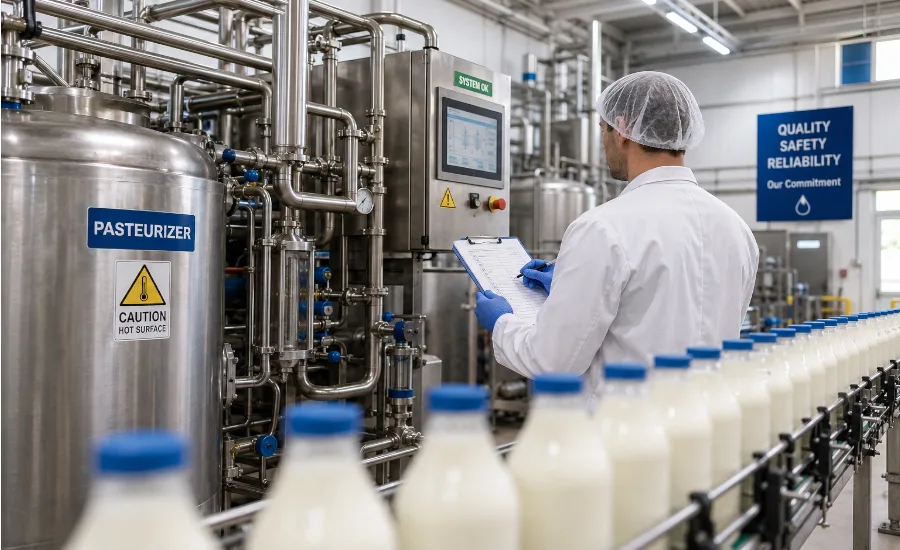
Dairy processing facilities operate under a demanding mix of production, sanitation, quality and maintenance requirements. Pasteurizers, separators, homogenizers, pumps, valves, tanks, fillers, conveyors, refrigeration systems, clean-in-place systems, packaging lines, and utility assets all need to perform reliably while meeting strict food safety and operational expectations.
Most dairy plants already collect a large amount of inspection and maintenance information. Operators complete checks. Maintenance teams document repairs. Quality and sanitation teams record findings. Engineering teams review equipment issues and capital needs. The problem is not always a lack of data. More often, the problem is that records are reviewed as individual events rather than as part of a long-term asset history.
A single note about a valve issue, pump leak, filling-line adjustment, or refrigeration alarm may explain what happened on one shift. A series of related findings can show whether the same problem is recurring, worsening, or affecting similar equipment across the plant. That distinction matters when processors are trying to reduce downtime, maintain product quality, control maintenance costs, and avoid surprises during production.
Inspection Records Should Show Asset History
Routine inspections are part of normal plant discipline. They help teams check visible equipment condition, verify readings, document sanitation concerns, identify leaks, and confirm that critical systems are operating as expected. These checks are valuable, but their long-term usefulness depends on how the information is stored and reviewed.
If an inspection record only proves that a task was completed, much of the value is lost. A completed checklist may satisfy an immediate requirement, but it may not help a plant understand why the same asset keeps requiring attention. A stronger record shows what was found, where it was found, how often it has occurred, what action was taken, and whether the issue returned.
For example, a small pump leak may not seem urgent during a busy production day. If similar leakage appears repeatedly on the same pump or on pumps in the same service, the finding may point to seal wear, operating conditions, sanitation practices, installation issues, or maintenance intervals that need review. A repeated filler adjustment may indicate a mechanical issue, a controls issue, or a change in product or packaging conditions. Without historical context, teams may keep correcting the symptom without understanding the pattern.
Recurring Issues Often Hide in Plain Sight
Dairy plants are good at responding to immediate problems because production demands require quick action. If a conveyor stops, a valve fails to actuate, a pump loses performance, or a packaging line falls behind, the priority is to restore operation safely and efficiently.
However, repeated small issues can be harder to manage. They may not stop production every time, but they consume maintenance time, create scheduling pressure, affect sanitation windows, and increase the risk of quality or production disruption. These recurring issues often hide inside inspection reports, work orders, shift notes, and corrective action records.
A clean-in-place system may show repeated valve or sensor concerns. A refrigeration asset may require frequent attention before a larger failure occurs. A filler may show recurring adjustment needs that vary by product or package size. A conveyor may generate repeated alignment or belt-tracking issues. Each event may be treated as routine, but together they may indicate a reliability opportunity.
The value of inspection history is that it helps teams see repetition. Once repetition is visible, the plant can make better decisions about maintenance priority, troubleshooting, spare parts, repair timing, and whether an asset needs a deeper engineering review.
Connecting Maintenance, Sanitation, and Quality
Dairy processing is not only a maintenance environment. It is also a food safety and quality environment. Equipment condition, sanitation performance, production reliability, and documentation discipline are closely connected.
The U.S. Food and Drug Administration’s Current Good Manufacturing Practice requirements for food emphasize that plant buildings, fixtures, and equipment must be maintained in a clean and sanitary condition and kept in adequate repair where needed to prevent food from becoming adulterated: https://www.ecfr.gov/current/title-21/chapter-I/subchapter-B/part-117
That requirement makes maintenance history more than an internal reliability tool. It also supports confidence that equipment condition is being monitored and addressed in a controlled way. When inspection findings are connected to corrective actions, the plant can better demonstrate that issues were identified, assigned, completed, and reviewed.
The same principle applies to food safety management systems. ISO 22000 emphasizes structured food safety management, communication, prerequisite programs, and continual improvement: https://www.iso.org/iso-22000-food-safety-management.html
Maintenance and inspection records can support those goals when they are consistent, accessible, and tied to the correct asset. A finding that appears during an inspection should not disappear into an isolated note. It should connect to the asset history and, when needed, to a corrective action that can be tracked to closure.
Better Data Supports Better Maintenance Decisions
Maintenance teams rarely have unlimited time, labor, or budget. They need to decide which issues require immediate attention, which can be planned, which need engineering review, and which are routine. Historical inspection and maintenance data can make those decisions more objective.
A plant may have two similar assets of the same age, but their maintenance needs may be very different. One may be stable, while the other may show repeated findings, increasing repair frequency, or recurring performance concerns. Without asset history, those differences may only become obvious after a larger failure. With better records, teams can prioritize before the issue becomes urgent.
Structured asset history also helps with preventive maintenance intervals. A fixed schedule may be appropriate for some assets, but other assets may need closer review based on condition, production load, cleaning frequency, environment, or recurring defects. The goal is not to replace preventive maintenance. The goal is to improve it with real plant evidence.
Digital inspection and asset management tools can help organize this information by tying inspections, findings, corrective actions, photos, and asset records together. Field Eagle, for example, provides resources on how structured inspection workflows can support asset and maintenance programs: https://www.fieldeagle.com/inspection-software/
The important point is not the tool itself. It is the discipline behind the process. Inspection data is only useful when it is complete, consistent, connected to the right asset, and reviewed by the people responsible for action.
AI Requires Clean Maintenance History
Artificial intelligence is beginning to appear in maintenance and reliability discussions across many processing industries. In dairy plants, AI-assisted analysis may eventually help teams identify recurring failure patterns, compare asset performance, flag unusual maintenance demand, or review large volumes of inspection and maintenance history more quickly.
However, AI depends on record quality. If inspection findings are inconsistent, asset names are unclear, corrective actions are incomplete, or work history is scattered across multiple systems, advanced analysis will be limited. A model cannot reliably identify a recurring valve issue if the same problem is described five different ways or recorded under different asset names.
The National Institute of Standards and Technology’s AI Risk Management Framework emphasizes the importance of governance, measurement, management, and reliable context around how AI systems are used: https://www.nist.gov/itl/ai-risk-management-framework
For maintenance and reliability teams, the foundation still matters. Clear asset hierarchies, consistent inspection language, complete corrective action records, and disciplined follow-up are necessary before AI can produce useful operational insight.
Practical First Steps for Dairy Plants
Processors do not need to overhaul their entire maintenance program to gain more value from inspection history. A few practical steps can help.
Start by reviewing assets that generate repeated work orders or recurring inspection findings. These assets may not always be the most critical, but they often reveal hidden maintenance demand. Next, compare inspection records with corrective action history. If a condition has appeared more than once, treat it as a trend rather than a new event.
Standardize inspection language wherever possible. If one technician writes “leak,” another writes “seal concern,” and another writes “wet area near pump,” the underlying issue may be difficult to track. Clear defect categories and asset names make history easier to analyze.
Finally, build regular review into the maintenance process. A monthly review of recurring findings, overdue corrective actions, and high-maintenance assets can help teams move from response to prevention.
Dairy plants already collect much of the information needed to improve reliability. The opportunity is to connect that information, review it over time, and use it to make better decisions before small issues become larger problems.
Looking for a reprint of this article?
From high-res PDFs to custom plaques, order your copy today!