Dairy Foods logo
search
cart
facebook twitter linkedin youtube
  • Sign In
  • Create Account
  • Sign Out
  • My Account
Dairy Foods logo
  • NEWS
    • DAIRY REGULATIONS
  • PRODUCTS
    • New Products
    • Butter
    • Cheese
    • Cultured Dairy
    • Frozen Desserts
    • Ice Cream/Novelties
    • Milk
    • Non-Dairy Beverages
    • Sales Data
    • Whey, Milk Powder
    • Dairy Alternatives
  • INGREDIENTS
    • Cocoa
    • Colors/Flavors
    • Cultures/Enzymes
    • Fiber
    • Gums, Stabilizers, and Texturants
    • Inclusions
    • Omegas/Lipids
    • Prebiotics
    • Probiotics
    • Sweeteners
    • Other
  • OPERATIONS
    • SUSTAINABILITY
    • Equipment
    • Processing
    • Packaging
    • Food Safety & Sanitation
    • Membrane Technology
  • MEDIA
    • Dairy Foods TV
    • Podcasts
    • Webinars
  • DIRECTORIES
    • Buyers Guide
    • Dairy Plants USA
  • MEMBRANE FORUM
  • MORE
    • Associations
    • Dairy Foods' News & Views Newsletter
    • Blogs
    • Case Studies
    • Classifieds
    • Custom Content & Marketing Services
    • Dairy Foods Store
    • Market Research
    • Supplier Spotlights
    • Tradeshows and Events
    • Strategy Guides
  • AWARDS
    • Dairy Plant of the Year Award
    • Breakthrough Award
    • Dairy Processor of the Year
  • EMAGAZINE
    • eMagazines
    • Archive Issues
    • Contact
    • Advertise
    • SIGN UP!
    • Columnists
    • Dairy 100
    • State of the Industry Report
    OperationsDairy Foods ColumnistsFood Safety for Dairy Processors

    How to select and maintain processing equipment with nonmetal surfaces

    Surface materials must meet the same hygienic design, fabrication and cleanability requirements metals must meet.
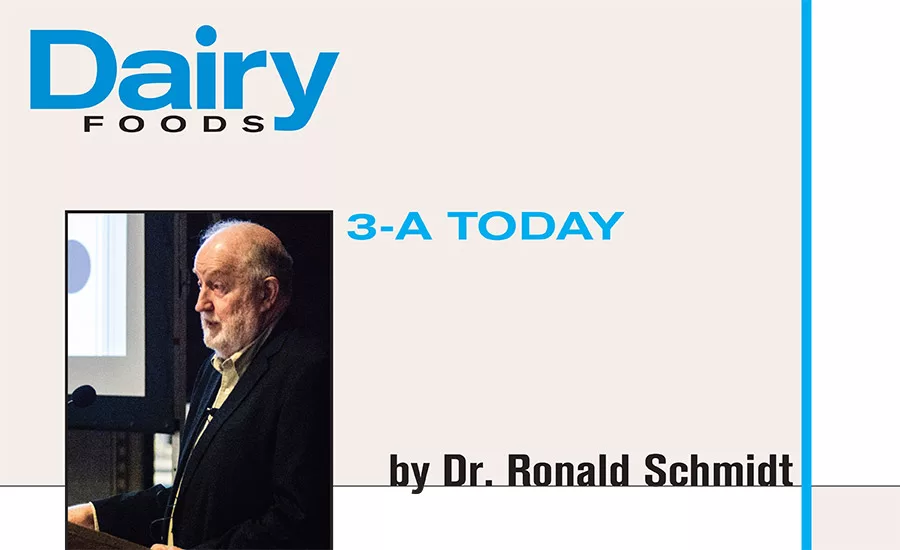
    By Dr. Ronald Schmidt
    3-a schmidt
    July 24, 2020

    A variety of food-contact and non-food-contact applications use nonmetal materials. Plastic, rubber and rubber-like materials are the largest and most diverse category.

    Specialized applications use ceramics and/or carbon composites due to their hardness and rigidity, inertness and resistance to high temperatures and chemicals. Ceramics are commonly used in membrane and mechanical seal applications, while carbon composites are used in molded parts, sensor components and mechanical seal applications. The use of certain nonmetals (e.g., glass, wood, paper, cloth) is restricted to certain applications when necessary and appropriate.


    Basic requirements and beyond

    When used in primary product contact, these materials must meet the same hygienic design, fabrication and cleanability requirements  metals must meet. These materials must be nontoxic and non-contaminating and meet all current and appropriate FDA indirect food additive regulations, including any restrictions for certain uses and applications. 

    3-A Sanitary Standards go beyond these requirements and specify that these materials be inert, nontoxic, nonabsorbent, fat-resistant and relatively resistant to scratching, scoring, decomposition, crazing and chipping under normal use conditions and when exposed to the conditions encountered in the environment of intended use. Providers of components bearing the 3-A Symbol must provide documentation that the equipment meets these requirements and the conditions of acceptable uses.

    Plastic and rubber materials are used in food applications ranging from solid to more elastic structures. These materials may have certain desirable physical properties compared to metal and may be preferred for certain functions. However, no plastic/rubber material is directly equivalent to stainless steel in meeting the desirable hygienic design properties.  


    Degradation differences

    Both metal and plastic/rubber surfaces will degrade over time under stress conditions. However, the chemical mechanisms and the progression of degradation are different. Metal degradation generally occurs at the surface and is usually visible. Surface degradation may also occur in plastic and rubber, but often degradation may initiate in the interior of the material and migrate toward the surface. Therefore, degradation might not always be visible upon surface examination until the material has deteriorated.

    There is no nonmetal material that is suitable for all food-processing applications. Thus, it is important when purchasing equipment to consider if materials used are appropriate for the processing system and meet the appropriate regulations. The manufacturer should ensure the materials used have the ability to withstand the stresses associated with the food processing system without cracking, breaking or deteriorating during continued use. 

    As with any food equipment purchase, the buyer should do a thorough inspection to ensure that the surfaces are smooth, impervious, durable and free of cracks and crevices — and that the equipment meets hygienic design criteria. It is the responsibility of the processor to ensure that the equipment is properly installed, properly operated and maintained in hygienic condition.

    Processors should also have maintenance programs with frequent evaluations and documentations of wear and deterioration of equipment. It is important that worn plastic and rubber components (including gaskets) be replaced as soon as possible.

    A common error made by food processors is to use less-expensive, and often inferior, components that are not of the same material and that might not meet hygienic design requirements. Although there may be a cost savings, using inferior replacement parts will lead to problems with cleanability and ultimately to failure of equipment.

    KEYWORDS: contamination food safety sanitary equipment

    Share This Story

    Looking for a reprint of this article?
    From high-res PDFs to custom plaques, order your copy today!

    Dr. Ronald Schmidt is a member of the 3-A SSI board of directors and is a member of the Communications and Education Committee.

    Recommended Content

    JOIN TODAY
    to unlock your recommendations.

    Already have an account? Sign In

    • Lifeway Organic Kefir in different flavors inside a refrigerated grocery shelf.

      Dairy Foods names Lifeway Foods 2025 Processor of the Year

      Lifeway Foods donates $10,000 to wildfire victims,...
      Dairy Foods & Beverages
      By: Brian Berk
    • Two female farmers are standing in a field, holding a large milk canister, looking at several cows at dairy farm.

      Honoring Women Leaders Shaping the Dairy Industry

      For the fourth consecutive year, Dairy Foods is proud to...
      Dairy Foods & Beverages
      By: Barbara Harfmann
    • Main feature for State of the Industry with dairy products album cover with a gradient circular--patterned backgorund.

      2025 State of the Dairy Industry

      Welcome to the 2025 State of the Industry report. For...
      Innovation
    Manage My Account
    • eMagazine Subscription
    • Dairy Foods News & Views Newsletter
    • Online Registration
    • Manage My Preferences
    • Subscription Customer Service
    • Connect with Dairy Foods

    More Videos

    Popular Stories

    Close up of man adding Greek yogurt while preparing healthy smoothie in the kitchen.

    An expert guide to dairy and GLP-1 receptor agonists

    Splash of milk in form of arm muscle. 3D illustration.

    Protein: The Powerhouse of Health and Wellness

    Grilling foods

    Dairy’s Enduring Moment: Why Resilience and Renewal Define Today’s Dairy Story

    Nominate your product for the 2026 Dairy Foods Product of the Year!


    MTF webinar


    Food Safety webinar

    Events

    July 8, 2026

    Membrane Purification Enables Clean Beauty Actives

    The global cosmetics market is undergoing a major shift towards the use of natural bioactive ingredients as consumers grow more skeptical of traditional formulations and demand greater transparency and sustainability.

    July 8, 2026

    Advancements in RO for Dairy Processing

    Reverse osmosis (RO) membranes are well established in dairy processing but continue to evolve to improve performance, reduce energy use, and increase operational longevity. 

    View All Submit An Event

    Products

    Probiotic Ice Cream: Science and Technology

    Probiotic Ice Cream: Science and Technology

    See More Products
    health and wellness


    plant of the year

    Related Articles

    • How to Select X-Ray, Metal Detection Systems

      See More
    • Conveyor belting

      How to select the right conveyors and palletizers

      See More
    • Size, texture, and durability are key processor packaging considerations.

      How to select the proper primary packaging

      See More

    Related Products

    See More Products
    • Modeling Food Processing Operations, 1st Edition

    • tech inv.jpg

      Technological Interventions in Dairy Science: Innovative Approaches in Processing, Preservation, and Analysis of Milk Products

    • novel.jpg

      Novel Dairy Processing Technologies: Techniques, Management, and Energy Conservation

    See More Products
    ×

    Stay ahead of the curve. Unlock a dose of cutting-edge insights.

    Receive our premium content directly to your inbox.

    SIGN-UP TODAY
    • RESOURCES
      • Advertise
      • Contact Us
      • Directories
      • Store
      • Want More
    • SIGN UP TODAY
      • Create Account
      • eMagazine
      • Newsletter
      • Customer Service
      • Manage Preferences
    • SERVICES
      • Marketing Services
      • Reprints
      • Market Research
      • List Rental
      • Survey/Respondent Access
    • STAY CONNECTED
      • LinkedIn
      • Facebook
      • YouTube
      • X (Twitter)
    • PRIVACY
      • PRIVACY POLICY
      • TERMS & CONDITIONS
      • DO NOT SELL MY INFORMATION
      • PRIVACY REQUEST
      • ACCESSIBILITY

    Copyright ©2026. All Rights Reserved BNP Media, Inc. and BNP Media II, LLC.

    Design, CMS, Hosting & Web Development :: ePublishing