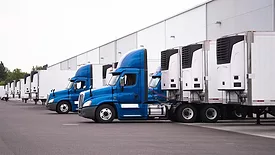
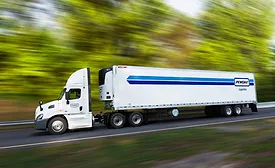
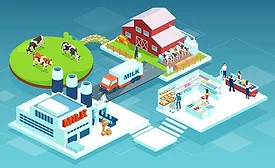
The dairy industry faces a complex challenge in moving products from farm to fork, with a growing demand for cheese and frozen items amid shifting consumption trends. Efficient distribution and strict safety standards are key to meeting this evolving landscape and ensuring quality delivery.
Uncover pivotal insights from IDFA’s DairyTech 2025 conference, where leaders emphasized the future of dairy supply chains. Focusing on artificial intelligence, resilience, and cost management, experts outlined strategies for navigating disruption and reshaping the industry for success.
Becky Rasdall Vargas, senior vice president of trade and workforce policy at the International Dairy Foods Association (IDFA), joins us for Episode 52 of the “Let’s Talk Dairy” podcast to discuss “Tariffs and Supply Chain Challenges.” Based in Washington, D.C., the IDFA, since 1990, represents the dairy manufacturing industry including cheese, milk and ice cream processors.
Supply chain disruptions are currently a highly frustrating reality for industries across the globe. In fact, an October 2021 quarterly report from CoBank’s Knowledge Exchange relays that supply chains are arguably in the most dire condition since the beginning of the pandemic.
Dairy processors can appeal to the large base of eco-conscious consumers by emphasizing sustainability throughout their supply chains, but compliance can be complex.
Taking steps to manage sustainability along the supply chain makes good business sense for dairy processors. Indeed, 2018 research by The Nielsen Co. LLC, New York, reveals that 81% of global consumers and 69% of those in the United States say that it’s very important or extremely important that companies implement programs to help the environment.