Inside the Plant
Delivery is big business for Smith Brothers Farms
Company milk delivery drivers maintain “legendary” status in the local area.

Our trip to Smith Brothers Farms included two stops: one was a visit to the Kent, Wash., plant, where the company processes milk. Following this visit, we traveled 20 minutes to Federal Way, Wash., to check out the company’s distribution center, the origin of all Smith Brothers Farms’ home delivery services.
Let’s start with the Kent facility, which exclusively processes milk. During the week we visited Smith Brothers Farms, the dairy processor was introducing new packaging for the first time in 10 years. About 10 employees work in the plant during each shift. The 55,000-squre-foot-facility resides on 3.5 acres. It offers 30,000 square feet of production floor, 10,000 square feet of cooler space, a 10,000-square-foot dry warehouse, and a 5,000-square-foot office. The facility exceeds 100,000 gallons of raw milk storage and 75,000 gallons of pasteurized milk storage.
Nicholas Pace recently began a new position as production manager. He was previously operations manager for the past seven months and has served the dairy industry for a total of five years. He started by showing us milk silos. A third silo was added about six years ago, which increased capacity from 66,000 gallons to more than 100,000 gallons. Pace said the new silo reflects growth in organic milk sales.
Smith Brothers Farms operates 24 hours per day, five days a week (Sunday night through Friday night). It processes 15 million gallons of milk per year at its Kent facility. "The goal in the next five years is to increase that to 20 million," Pace says.
We first visited the receiving bay, where Smith Brothers Farms conducts offloading and unloading. "We are able to roll out our personal cream tanker in order to sell conventional cream to other businesses. We receive about six trucks per day on the conventional side and two organic trucks," Pace states. "Our organic milk comes from Washington, Oregon and California and all of our conventional milk comes from within Washington State."
VIDEO | Inside the Plant: Smith Brothers Farms
He added that the truck that had just arrived during our visit housed milk from three different farms, all located within an hour’s drive from Kent. "The milk was picked up at 1:42 a.m. and received at our silos at 7 a.m. So, within six hours, the milk from the farm is directly in our plant," Pace proudly reveals.
"We are able to receive a truck within about 20 minutes," he continues. "We pump out 450 gallons a minute into our raw silos. After receiving the truck, we conduct a wash on it. We have a raw CIP (clean-in-place) system that is separate from our pasteurized CIP system. So, we can wash simultaneously on both the raw and pasteurized sides. The CIP system takes an additional 20 minutes. So, we test, receive and wash trucks all within an hour."
Moving on to pasteurization, Smith Brothers Farms uses two methods: High temperature short time (HTST), as well as vat pasteurization on lactose-free and buttermilk, which calls for smaller batches that are extremely accurate. Regarding HTST, the company pasteurizes at 181 degrees Fahrenheit for 26 seconds. We witnessed the conversion into different milk flavors, as 4.5% butterfat can be converted into 0% butterfat for skim milk. We also saw butterfat being reinjected into milk in a variety of fat levels, including 2% and whole milk.
"We can produce 4,500 gallons of milk an hour using our HTST. We can increase it if necessary," Pace suggests. "We are going to be exploring capacity throughput improvements because our primary bottleneck is the HTST. We want to run more milk through our fillers than the HTST is capable per hour."
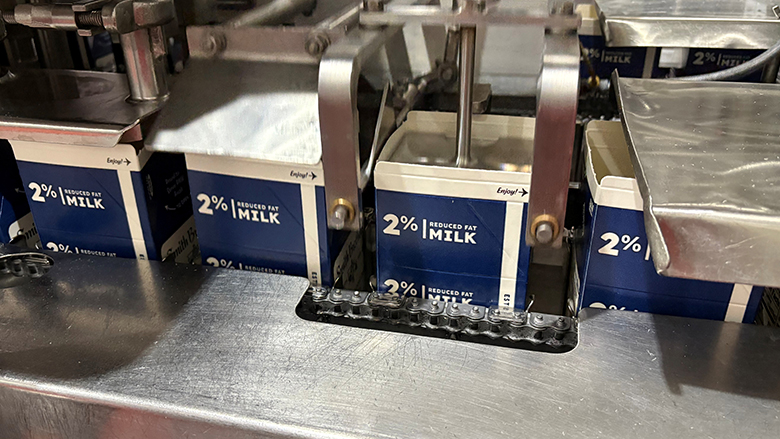
Smith Brothers Farms processes 15 million gallons of milk annually at its Kent, Wash., facility. The company has a goal in the next five years to increase production to 20 million gallons. Photo by Brian Berk
The homogenizer was the next step on the plant tour. Smith Brothers Farms homogenizes all products other than whip (heavy cream), because whip is designed to maintain a natural creaminess and texture. The plant operates efficiently, and the team responds to market demand. It produces all fat levels from skim through half & half every day, and layers in organic, buttermilk and heavy cream three days a week.
Stepping away from machinery for a minute, Pace also suggests Smith Brothers Farms is "leading the way" by utilizing digital charts for pasteurization equipment, which is required by Washington State law for record-keeping purposes. "In a lot of facilities, they are reliant on analog charts for all of their pasteurized charts and fillers. We have that all integrated onto one digital system," he stresses. "That allows employees to track the freshness of milk."
Following that brief sidestep, we witnessed the pasteurizing tanks. Smith Brothers Farms has six pasteurizing tanks that hold 8,000 gallons each for a total of nearly 50,000 gallons of pasteurized product. "One thing that sets us apart is we have a very advanced valve cluster, which allows routing to all the fillers and allows CIP simultaneously while running all other lines," Pace affirms.
Batch tanks followed on the tour. "This is our first week of eggnog season," Pace said at the time of our visit. "We did an extended strawberry milk run this year as well. We start with higher butterfat products and work our way down.
"We are also able to reclaim 3,000 gallons in our reclaim tanks, so we are able to recapture butterfat and use it to make half and half," he continues. "It keeps us from wasting butterfat."
Also, Smith Brothers has a pH tank, which allows the processor to reduce its wastewater discharge.
Fillers, manufactured by Evergreen, are 30 to 40 years old. But they are still effective, able to run about 35,000 units per day on one machine. "We take great pride in maintaining it. Evergreen is out here routinely to service it," Pace states. He stresses that all fillers have proximity switches "so you can only conduct CIPs and run the equipment if everything is hooked up properly. That is a significant automation step this facility has."

Smith Brothers operates 24 hours per day, five days a week. Photo by Brian Berk
Training is key
Smith Brothers has an extensive training program. It first trains for sanitation before operation. "That way, an operator can fully conduct a CIP before they operate," Pace says. "It takes about a month to be fully proficient. Our quality assurance teams must sign off before they can move forward."
The Evergreen N-5 gable top carton filler was next on our visit. "We used to have two N-5s side by side. But we upgraded to the N-8 and use the N-5 as a backup. For about four hours a day, we conduct a CIP. During those four hours, we get the N-5 up and running," Pace reveals.
Smith Brothers Farms’ newest filler is designed by Filler Specialties. It can achieve 100 gallons per minute, but the processor chooses to fill at a rate of 60 gallons per minute. "All of the lines feed into one bottleneck at the palletizer, so until that is upgraded, we run it a little slower than its capability," Pace relays.
We also witnessed half-pint milk containers coming out on the line. As expected, most of these products go to schools but Pace explained that despite their small carton size, customers do order these for home delivery as well. "We currently produce 1% milk and fat-free chocolate milk off of this line," Pace explains.
The next visit was to the casing room, where reducing plastic waste is a huge goal for Smith Brothers Farms. As we saw, all cases are stacked by a machine. "With a product changeover, the operator will conduct a visual inspection to make sure both the bottom and top are sealed. They also do a ‘squeeze’ check to make sure there is no leakage," he said. "That person also needs to make sure the dates on the milk are accurate."
The next visits were to the Kent warehouse; a production laboratory where butterfat tests were being conducted; and the loading dock, where Smith Brothers Farms averages eight transfers per day to the Federal Way facility, as well as eight or nine trucks going to wholesale distributors daily. "We rotate about 18 semis through these dock doors every day," Pace maintains.
Last was a look at the palletizer, wrapper and cooler room. "It is one of our oldest pieces of equipment, which we are in the process of upgrading. We could run everything faster if the palletizer could keep up," Pace says.
The cooler room spans 9,000 square feet. "All of the home delivery and most of the wholesale is loaded out within 24 hours. All inventory is rotated within 48 hours," Pace states.
Looking ahead, the company is looking to replace gable top half gallon and pint fillers soon. But much of the older equipment works well, confirms CEO Dusty Highland.
"These old machines are bulletproof as long as you keep the preventative maintenance up," he says. "They stay in good shape for a long time."
On the software front, Smith Brothers Farms uses Redzone software that quantifies overall equipment effectiveness and is intended to reduce worker turnover in a dairy manufacturing team by transforming them into a more engaged and collaborative group.

Smith Brothers' utilizes pasteurized charts to test the freshness of milk. Photo by Brian Berk
Where the home delivery magic happens
The Federal Way facility was built in 2023. Previously, the home delivery services were housed in Kent, but the company simply outgrew that space. "It was hard to find a place, because at the time, the industrial real estate market was hot. But during COVID, we were able to find this piece of property where we are in now. It took about 18 months to build the facility," Highland notes.
Being close to Interstate 5 so that delivery trucks could save time reaching their destinations was a huge draw of the Federal Way location, says Todd Behan, company vice president and Highland’s cousin, who has served the company for 13 years. Behan provided a tour of the distribution facility, where all of the food and beverages for Smith Brothers Farms’ home delivery service are housed, picked and placed onto milk trucks for delivery.
There was some 150 SKUs of dry storage encompassing 5,800 square feet. We witnessed a huge array of products, including bananas, Dave’s Killer Bread, tortilla chips and more.
Smith Brothers Farms’ most popular purchased products for home delivery are milk: 2.5 million gallons per year; eggs: 1.2 million dozen; produce: 1.5 million fruits and vegetables; yogurt: 1 million units; cheese: 700,000 pounds; meat: 400,000 units of bacon, sausage, beef, chicken and pork; juice: 400,000 bottles; and bread: 300,000 loaves.
"We have about 80 different vendors we use," Behan asserts. "We try to make sure we partner with as many local vendors as possible."
One of the most demanding aspects of food delivery is knowing how much inventory to have of each SKU. The company has demand planning, but with grocery items, spoilage is inevitable.
"Kefir is one thing we recently brought on board, which as you reported in your magazine, is growing in demand. What is most important to us is providing the customers with high-quality products," Behan relays. "For example, we will order 1,000 bananas, sell 800 and shrink out 200 to make sure our customers got the best items. We err on the side of making sure everyone gets what they want. We also do a lot of donating to food banks."
Prioritizing customer satisfaction has certainly worked, adds Michelle Hunt, Smith Brothers Farms chief growth officer and head of Home Delivery. "Our customers love the Smith Brothers brand and trust us to deliver a curated portfolio of products that emphasizes fresh, locally produced grocery staples, week after week," she states.
Produce is the biggest growth opportunity for Smith Brothers Farms’ grocery delivery business, Behan reveals. "With that being said, it is the toughest thing to deliver because customer expectations are so high," he says. "But from the pickers, loaders and milkmen and women, they live and breathe giving the customers high quality."
We then made our way to the refrigerated section of the facility, featuring 375 SKUs and 28,000 square feet of space, including ground beef, Chobani yogurt, Nancy’s kefir, strawberries, Applegate turkey slices, pineapples, lemons and limes, mushrooms, blueberries and a wide variety of Tillamook products. "We must have at least 50 SKUs of yogurt," Behan states.
We also checked out the freezer, which comprises 2,300 square feet, incorporating 105 SKUs. "In the freezer, we have a lot of frozen meals and high protein items," Behan suggests.
Lastly, we viewed one of the newer trucks in the Smith Brothers Farms fleet. In addition to expected items in the truck like freezers, it offers a TV screen describing all the items a customer wants in a particular order. Smith Brothers Farms has 69 trucks on the road daily, 46 of which run out of Federal Way, with the remainder originating from nearby Woodinville, Wash., as well as several in Portland, Ore., where the company’s Alpenrose dairy is located.
"Our milkmen and women work four 10-hour shifts, generally from about 4 a.m. to the early afternoon., and deliver to at least 175 customers daily," Behan notes. "We lease all of our trucks, so Penske handles the maintenance if anything happens to a vehicle."
Behan sees a future where robotics could assist in some areas of the delivery process. "Five years from now, I can see adapting some of our internal processes, just like we have moved from paper orders to our customers using an online app.," Behan suggests. "It will be interesting to see how everything plays out over the next decade."

Smith Brothers gets milk from farm to fridge in 48 hours or less. Photo by Brian Berk
Delivery logistics
Hunt explains, "Our Home Delivery customers enjoy a weekly visit from their milkman or milkwoman. There are no annual fees, you can skip deliveries, and there is no delivery charge on orders of $15 or more. That is all done through the app. Customers love the convenience of it. For example, they know they need milk, eggs and produce weekly," Hunt notes. "The actual delivery time is similar every week. We tuck dry ice in the porch box, which greatly helps for customers who can’t be home right away."
Porch boxes are provided by Smith Brothers Farms for free. "Customers know when the delivery will be every week and take part of the process. The great thing about that is predictability," Hunt says. "For many customers, our service is on ‘auto pilot.’ Many of them do not change their order. We call them ‘recurring orders.’ Of course, customers can add or take off items on the order as needed."
Hunt stresses that Smith Brothers Farms’ delivery service differentiates itself because of the relationships customers have with the drivers, which is difficult to replicate. "Most customers know their drivers personally. I always think of Rob (who was featured on The Today Show; see Processor Profile feature) who has been delivering since 1988," Hunt concludes. "This is not gig work. These are wonderful people who do yeoman’s work. It might be ‘old school,’ but it has worked for 105 years."
Looking for a reprint of this article?
From high-res PDFs to custom plaques, order your copy today!