Dairy Foods logo
search
cart
facebook twitter linkedin youtube
  • Sign In
  • Create Account
  • Sign Out
  • My Account
Dairy Foods logo
  • NEWS
    • DAIRY REGULATIONS
  • PRODUCTS
    • New Products
    • Butter
    • Cheese
    • Cultured Dairy
    • Frozen Desserts
    • Ice Cream/Novelties
    • Milk
    • Non-Dairy Beverages
    • Sales Data
    • Whey, Milk Powder
    • Dairy Alternatives
  • INGREDIENTS
    • Cocoa
    • Colors/Flavors
    • Cultures/Enzymes
    • Fiber
    • Gums, Stabilizers, and Texturants
    • Inclusions
    • Omegas/Lipids
    • Prebiotics
    • Probiotics
    • Sweeteners
    • Other
  • OPERATIONS
    • SUSTAINABILITY
    • Equipment
    • Processing
    • Packaging
    • Food Safety & Sanitation
    • Membrane Technology
  • MEDIA
    • Dairy Foods TV
    • Podcasts
    • Webinars
  • DIRECTORIES
    • Buyers Guide
    • Dairy Plants USA
  • MEMBRANE FORUM
  • MORE
    • Associations
    • Dairy Foods' News & Views Newsletter
    • Blogs
    • Case Studies
    • Classifieds
    • Custom Content & Marketing Services
    • Dairy Foods Store
    • Market Research
    • Supplier Spotlights
    • Tradeshows and Events
    • Strategy Guides
  • AWARDS
    • Dairy Plant of the Year Award
    • Breakthrough Award
    • Dairy Processor of the Year
  • EMAGAZINE
    • eMagazines
    • Archive Issues
    • Contact
    • Advertise
    • SIGN UP!
    • Columnists
    • Dairy 100
    • State of the Industry Report
    Dairy Foods & BeveragesDairy Foods ColumnistsSales Data

    Higher feed costs will ripple through dairy markets

    The elevated feed costs raise the floor for dairy prices.
    By Nate Donnay
    Higher feed costs will ripple through dairy markets
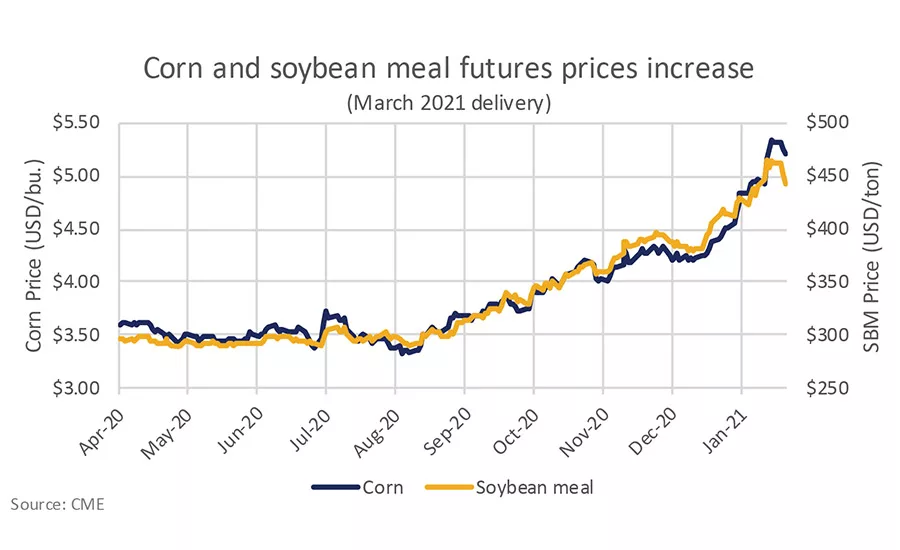
    Corn and Soybean meal futures prices increase
    March 4, 2021

    With all 10,000 of our lakes here in Minnesota currently frozen solid, this may be a strange analogy, but dairy prices move like the waves rippling out from a rock thrown in the water. The bigger the rock, the bigger the initial waves are, but they eventually get smaller and smaller until everything is back into balance. It takes only seconds for the waves to flatten out on the lake, but it can take one to two years for the dairy markets to find equilibrium after a large shock.

    I bet you think I’m going to talk about the pandemic, but I’m not. Another shock to the dairy market will be playing out into early 2022 and deserves some attention.

    Feed costs have shifted dramatically higher in the past six months. There wasn’t a large driving event that tightened feed supplies, but rather it has been a number of smaller issues all coming together at the same time. U.S. corn and soybean yields weren’t horrible, but they were below trend. Crops in parts of Europe and the Black Sea region also suffered some adverse weather this season.

    On top of the generally weak production, demand has turned out stronger than expected, particularly from China. The net impact is that expected carryout stocks of grain and oilseeds have been trending down for the past seven months, and feed prices have consequently been trending higher.

    Back in May, the corn and soybean meal futures were suggesting that the cost of feed to produce 100 pounds of milk in 2021 would be around $6.19, but with the rally, futures are now suggesting a price closer to $7.34. That means the cost of production for dairy farmers is up more than a dollar per hundredweight in the past seven months. That is nearly a 19% increase. In terms of individual dairy products, it adds about 12 cents per pound to the cost of cheese or 25 cents per pound to butter.


    Government purchasing holds steady

    The stone-in-the-lake analogy doesn’t exactly fit the current feed cost situation, though. Thanks to government purchasing programs, cheese prices hit record highs in the second half of 2020, and my expectation is that government purchases can probably keep cheese prices generally strong in the first half of 2021.

    The resulting milk prices should be high enough to keep farm gate margins at breakeven or slightly higher levels for U.S. dairy farmers despite the higher feed costs. The higher costs still impact the production and price outlook, but instead of pushing dairy prices higher, the elevated feed costs raise the floor for dairy prices.

    I don’t want to get overly optimistic on prices here. The pandemic is still depressing U.S. dairy demand. Government purchases are absorbing the currently expanding milk production. If milk production growth continues to run at 2.5% or more, it will be hard for the government to absorb all of it. Dairy prices will still be volatile as they bounce between the underlying bearish fundamentals and the bullish government purchases. But the increased feed costs mean that breakeven for dairy farmers is now somewhere around $16.00 for Class III milk or $1.70 for cheese.

    KEYWORDS: dairy demand dairy exports dairy supply feed prices

    Share This Story

    Looking for a reprint of this article?
    From high-res PDFs to custom plaques, order your copy today!

    Nate donnay headshot

    Nate Donnay is the director of dairy market insight at StoneX Group Inc. and has been applying his interest in large complicated systems and statistical analysis to the dairy markets since 2005. As a consultant, he has worked with clients at all levels of the dairy marketing chain from the farm level up to processors and packaged foods companies, food distributors and restaurants, as well as industries such as banks, private equity groups, government agencies and industry associations.

    Recommended Content

    JOIN TODAY
    to unlock your recommendations.

    Already have an account? Sign In

    • Lifeway Organic Kefir in different flavors inside a refrigerated grocery shelf.

      Dairy Foods names Lifeway Foods 2025 Processor of the Year

      Lifeway Foods donates $10,000 to wildfire victims,...
      Dairy Processor News
      By: Brian Berk
    • Two female farmers are standing in a field, holding a large milk canister, looking at several cows at dairy farm.

      Honoring Women Leaders Shaping the Dairy Industry

      For the fourth consecutive year, Dairy Foods is proud to...
      Innovation
      By: Barbara Harfmann
    • Main feature for State of the Industry with dairy products album cover with a gradient circular--patterned backgorund.

      2025 State of the Dairy Industry

      Welcome to the 2025 State of the Industry report. For...
      Cheese
    Manage My Account
    • eMagazine Subscription
    • Dairy Foods News & Views Newsletter
    • Online Registration
    • Manage My Preferences
    • Subscription Customer Service
    • Connect with Dairy Foods

    More Videos

    Popular Stories

    An overhead and close-up view of a bowl of cottage cheese topped with fresh blueberries.

    Cottage cheese sales top $2 Billion

    A young Asian mother holding her son and a sippy cup, an older woman is in the blurred background.

    Finding the right infant formula is crucial to a baby’s growth and development

    A row of Frios Gourmet Pops with a tie dye pattern as a background.

    How Frios Gourmet Pops delivers happiness

    Outlook Report: Women in Dairy

    Products

    Probiotic Ice Cream: Science and Technology

    Probiotic Ice Cream: Science and Technology

    See More Products
    Let's Talk Dairy podcast promo

    Related Articles

    • 2019 State of the Industry: US dairy exports lose their pass line bets

      Five factors will drive dairy markets over the next year

      See More
    • milkshakes

      A tale of two ‘parties’ for global dairy markets

      See More
    • The image shows a Holstein Friesian cow, a breed of dairy cattle known for its distinctive black-and-white markings.

      How changes in Federal Milk Marketing Orders are impacting dairy markets

      See More

    Related Products

    See More Products
    • 0470655844.jpg

      Sustainable Dairy Production

    • df emerging.jpg

      Emerging Dairy Processing Technologies: Opportunities for the Dairy Industry

    • GlobalData_Consumer.jpg

      Country Profile: Dairy & Soy Food Sector in the US

    See More Products

    Events

    View AllSubmit An Event
    • March 31, 2015

      Raising the bar with in-line mixing and blending technologies: high output with flexibility and low costs

      On Demand In this webinar, you will be introduced to advanced in-line blending, dosing and mixing technologies that offer high flexible productions, reduced product losses, shorter batch times, uniform products, and reduced ingredient costs. As a result, Food Manufacturers can optimize their productions and increase their profitability.
    View AllSubmit An Event

    Related Directories

    • EJ Dairy Marketing

    • E.J. Dairy Marketing

    ×

    Stay ahead of the curve. Unlock a dose of cutting-edge insights.

    Receive our premium content directly to your inbox.

    SIGN-UP TODAY
    • RESOURCES
      • Advertise
      • Contact Us
      • Directories
      • Store
      • Want More
    • SIGN UP TODAY
      • Create Account
      • eMagazine
      • Newsletter
      • Customer Service
      • Manage Preferences
    • SERVICES
      • Marketing Services
      • Reprints
      • Market Research
      • List Rental
      • Survey/Respondent Access
    • STAY CONNECTED
      • LinkedIn
      • Facebook
      • YouTube
      • X (Twitter)
    • PRIVACY
      • PRIVACY POLICY
      • TERMS & CONDITIONS
      • DO NOT SELL MY INFORMATION
      • PRIVACY REQUEST
      • ACCESSIBILITY

    Copyright ©2026. All Rights Reserved BNP Media, Inc. and BNP Media II, LLC.

    Design, CMS, Hosting & Web Development :: ePublishing