How dairy processors can reduce water waste
Dairy processors could look to new technologies to address water sustainability challenges

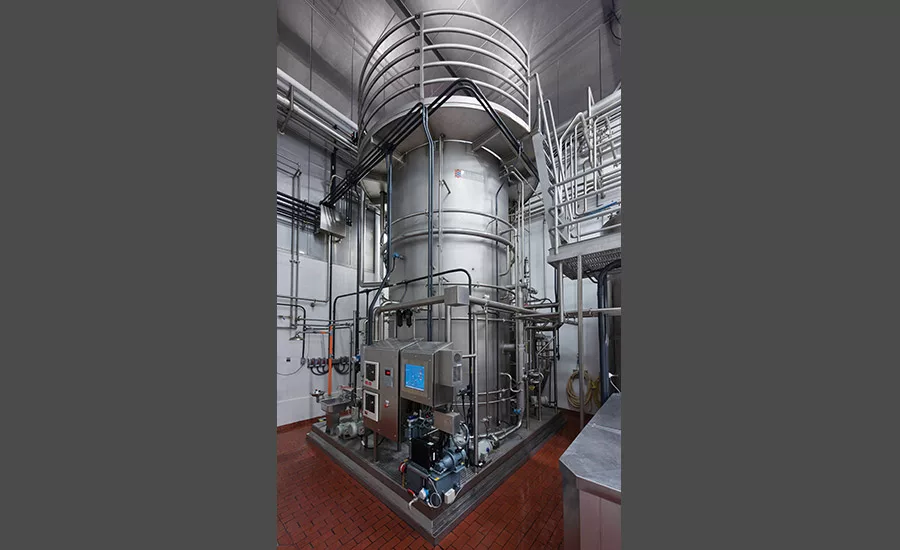
In a wastewater application, the Caloris Concentrix MVR evaporator reduces volume and creates a clean stream of water for reuse.
A 2015 report from the World Economic Forum said that water shortages will be the Earth’s biggest threat in the next decade. Meanwhile, data from UN-Water show that by 2025, 1.8 billion people will be experiencing water scarcity, while two-thirds of the world’s population could be living in still-concerning conditions of water stress.
The dairy processing industry has been among those investing heavily in developing technologies and processes to reduce the need for water and enable efficient recycling, according to a report from GEA Systems North America. Part of Dusseldorf, Germany-based GEA, the company is among the suppliers helping dairy plants to address water sustainability challenges.
Mark Braun, product manager – membrane filtration for GEA, notes that many larger new plant operations in the United States have been built in “semi-arid areas” such as Texas, Arizona and Idaho, where “they have to be very careful on their water usage in the plant.” And states such as California have pushed strongly toward greater regulations of wastewater treatment, moving in the direction of more regulated European countries.
“There has been a movement toward looking at cleaning up water for discharge but also reusing as much as possible,” he said.
Caloris Engineering LLC, Easton, Md., also expects to see growing water shortages in the United States. Dairy-producing areas in California are already experiencing periods of drought, and those in the Midwest are not far behind, according to the latest studies, noted Simon Zimmer, business development, water recovery.
“The future does not look good,” he said. “That means thinking about the future: How can customer ‘A’ make his or her plant more efficient regarding water usage, and what technologies can they implement to not use as much water, but also to not discharge as much water through wastewater treatment plants? There’s a huge cost, not only financially, but environmentally.”
Dairy plants also face more competition than they did two or three decades ago, when they were also typically smaller and produced less wastewater, Zimmer added.
“Now, for these plants to become more competitive, you have to produce more,” he said. “But now they’re using more water and also creating more wastewater. Those older treatment plants can’t handle the production.”
Dairy producer Fonterra Co-operative Group Ltd. does not face water shortages in its native New Zealand, and many of the company’s manufacturing sites — especially those that make milk powder — discharge more water than they draw in due to the evaporation process, said Robert Spurway, chief operating officer, global operations. But sites that were built three or four decades ago were not designed to be water-efficient, he noted.
“For example, they were not designed to capture, condense, clean and reuse steam before it is discharged,” Spurway said. “However, as we build new capacity and upgrade our current plants, we are investing in this type of resource-efficient technology.
“Our New Zealand manufacturing sites have set a target of reducing their water intensity — water used per cubic meter of milk processed — by 20% by 2020. We are also investing to ensure all of our sites treat wastewater to leading industry standards by 2026,” he added.
Sustainable processing technologies
To help dairy plants move their operations toward sustainable water practices, GEA Systems primarily offers membrane filtration systems that are used for a variety of different applications, including the recovering and recycling of condensate from the evaporation phase of milk processing, Braun explained.
“Anything we can do to reduce the water quantity we use to clean these plants is good,” he said. “Water that is recovered is extremely important. And the quality of the water we discharge is also extremely important.”
Three milk powder plants that GEA built for Fonterra and Yashili in New Zealand use water recovered from milk evaporation, achieving a 90% recovery rate and between 800 and 5,000 cubic meters of water per day, GEA reported. Spurway said that two recently upgraded Fonterra sites have, respectively, increased production 85% while using less water, and increased production by 80% while boosting water use by less than 20%.
Caloris uses a variety of technologies to reduce the volume of wastewater streams and to discharge them in a safer, more environmentally friendly manner, Zimmer said. In terms of evaporators, the Caloris Cubix can handle up to 5,000 pounds per hour of wastewater, while the company’s Concentrix can handle anywhere between 5,000 and 100,000. And the steam-heated FlexMode can be configured for a variety of different applications.
The company also can assist with recovering and reusing water that’s been used to wash down chemical-laden equipment or with reducing salt waste, he said.
“For a few-hundred-thousand-dollar investment, you can solve a pretty major problem. The ROI is fairly quick, and it costs money to discharge wastewater,” Zimmer added. “Oftentimes, wastewater solutions have been overlooked because people are looking for cookie-cutter, one-size-fits-all solutions.”
Caloris said it helped one company building a new milk powder production facility to conserve water resources by designing and installing the necessary treatment equipment to recover “cow water,” or vapor condensate, discharged from the evaporation system and to process it so it is usable as potable water. Using two reverse-osmosis polisher systems — which took 16 weeks to design, install and begin operation — the plant now produces more than 144,000 gallons of potable water a day.
Another Caloris customer, which operates a cheese plant, needed to reduce the “rinse water” it was discharging into its wastewater lagoon, which had caused increased hydraulic loading on the lagoon and reduced processing capacity. In addition to providing more efficient stream processing in the wastewater treatment system, the project was designed to produce a clean stream of water that could be reclaimed, the company noted. Caloris designed and installed a reverse-osmosis membrane skidded system in the customer’s chemical room. Completed within 12 weeks, the system can handle 30,000 gallons per day and could be expanded to 50,000.
“We would like to replicate this project all over the place,” Zimmer said. “It could help many, many dairy plants in the same predicament.”
Looking for a reprint of this article?
From high-res PDFs to custom plaques, order your copy today!