Three ways printing technology can reduce risk in dairy packaging
Dairy packagers face a major challenge: achieving durable, high-quality coding under tough conditions while keeping the packaging process efficient. And there’s a lot at stake for both large corporate brands and smaller producers. A single misprinted code can lead to costly product recalls, regulatory penalties, unplanned downtime and loss of consumer trust.
That’s why accurate, high-quality on-package printing – such as dates and lot codes – is critical for dairy product compliance and consumer information. Brands should take three critical steps to ensure high-quality code printing:
- Select the optimal printer for each application.
- Manage the data to be printed, keeping it accurate and reducing the risk of errors.
- Use inspection to verify code quality and remote systems to monitor printer maintenance
1. Choosing the Right Printer Technology
Dairy products encompass a wide range of packaging materials and selecting the right printing technology is essential. Here’s a look at the top solutions available.
Continuous inkjet
Continuous inkjet (CIJ) printing technology is well-known for its versatility and ability to print on a wide range of packaging formats, including plastic jugs, metal cans, Tetra Pak packages, glass, and pouches.
- A low per-print cost makes CIJ a cost-effective choice for high-volume production.
- When built to meet IP65 or IP66 environmental standards, these printers can stand up to the harsh conditions in dairy packaging plants. An IP66-rated CIJ printer can even withstand high-pressure water jets with no ingress.
Thermal inkjet
With a high print resolution – up to 600 dpi – and minimal maintenance requirements, thermal inkjet (TIJ) printers can print high-resolution messages including text, barcodes, and 2D codes onto cartons and flexible packaging. Their high print quality also makes them a good solution for brands looking to transition to 2D codes in compliance with GS1 Sunrise 2027 standards.
TTO printing
Thermal transfer overprinters (TTO) are a proven solution for adding variable information to flexible packaging, such as bags, pouches, and labels. While using heat to transfer ink to the packaging, TTO solutions can print at high speeds and accommodate various substrates and product changeovers.
When combined with the features below, TTO technology can help dairy brands avoid errors and streamline and speed production.
- Select TTO solutions include a built-in system for quickly detecting defects in printed codes.
- Available in various print widths, versatile TTO printers can handle a wide array of applications—from simple date and lot coding to printing linear and 2D codes, ingredient lists, and other detailed product information.
Laser marking technology allows for the creation of high-quality images on various materials without the use of inks or chemicals. These permanent, high-resolution marks can help meet traceability and regulatory requirements.
- Available with several different light wavelengths, ranging from infrared (CO2 lasers) to ultraviolet (UV lasers), as well as various power outputs, lasers can be matched to nearly any application.
- Laser marking systems can be configured to IP environmental protection standards, allowing for operation in harsh conditions.
Large character inkjet
Large character markers (LCM) can print text, logos, and barcodes directly on secondary packaging such as shipping cases.
- Available features include self-cleaning printheads, print heights over 70mm and up to four printheads managed by one controller.
- Ethernet and Wi-Fi connectivity allow for integration into production systems.
Print and apply labeling
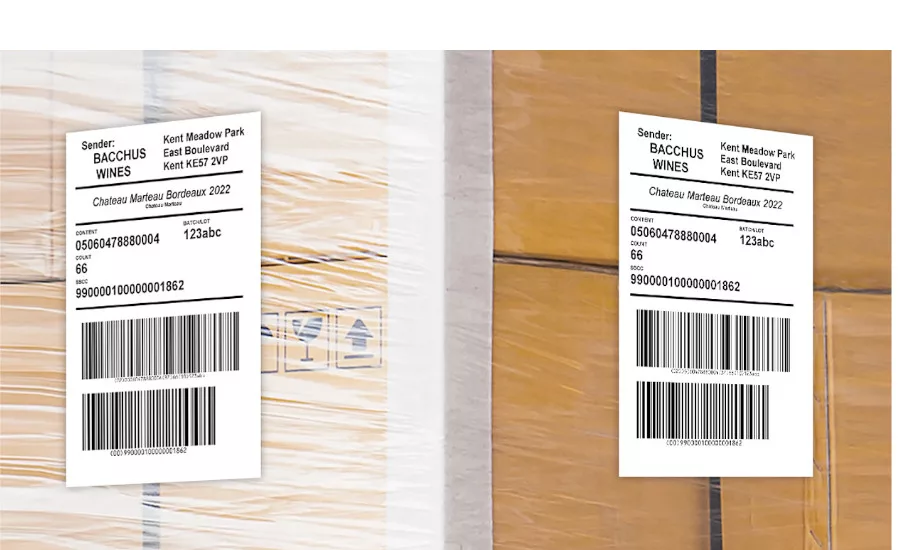
Print and apply labelers handle the demands of modern high-speed packaging lines while printing and applying labels to cases, boxes and shrink-wrapped trays. Advanced innovations can eliminate common causes of label jams and downtime to maximize the efficiency of secondary packaging operations.
Pallet labeling
Advanced pallet labelers can print and apply multiple labels on various sides of a pallet while operating at speeds suitable for high-volume production.
- Advanced technology can reduce the need for daily adjustments, maximizing uptime.
- Simple web paths enable quick label and ribbon replenishment.
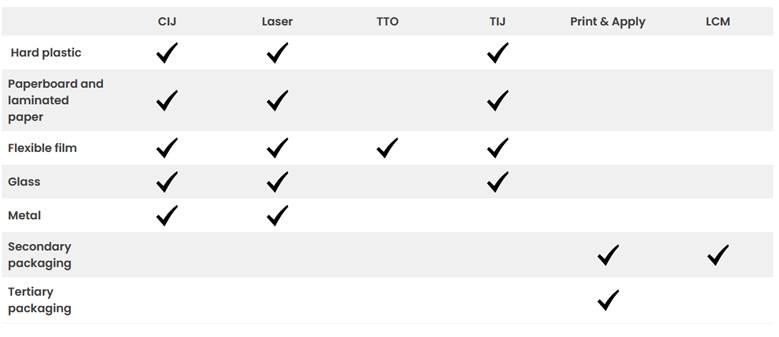
Dairy Package Coding Options at a Glance
Modern printing and marking technologies help dairy packagers ensure proper coding while improving efficiency.
2. Delivering Accurate Code Data
After selecting the optimal printer for the specific product and need, it’s essential to establish control over the data so that it’s always accurate for the current production run. When the printers in a facility are managed from a central message database, there is no need for production line staff to manually enter or change print messages. Integrating printing with centralized messaging and mitigating human error can reduce high-risk coding errors and readability issues and save on time and labor.
Some of these integrated systems can also manage label templates and printing on secondary and tertiary packaging, enabling end-to-end quality control of coding, marking, and print/apply data.
3. Monitor Code Integrity and Printer Performance
Code quality cannot be an afterthought when it comes to perishable consumer dairy products. Variable information on each package must comply with regulatory requirements while remaining easy to read for both retailers and consumers. And with 2D codes becoming part of the online coding process, an additional level of quality control is needed to ensure that these more complex codes meet or exceed minimum levels of data integrity and print quality.
Modern printing systems can help by supporting both fixed-mount barcode scanners (connected to a printer or networked) and integrated vision-based print inspection systems that can perform important tasks in a high-volume dairy operation, including:
- Scanning and validating each barcode
- Verifying that GS1 barcodes meet the standard for print quality and positioning
- Checking for the presence of printed codes, such as date and lot number
- Conducting OCR/OCV inspection on printed text to confirm that the data is correct
And then there’s the printer itself – what if it could tell you exactly what it needs? Remote, cloud-based systems allow for real-time monitoring of printers, tracking consumable levels, detecting errors, and sending alerts when action is needed – all aimed at reducing unplanned downtime. Users can remotely access the printer’s operating system to troubleshoot, modify settings, and back up or transfer configurations. Additionally, expert support is often available remotely to enable quicker service responses.
Don’t Overlook the Importance of In-line Printed Codes
In the dairy industry, every printed character matters. Taking key steps to leverage the power of advanced printing technologies can reduce errors, minimize downtime and maintain traceability across every product, even in harsh conditions. Investing in these solutions not only safeguards brand reputation but also streamlines production, helping dairy businesses stay efficient and competitive.
Looking for a reprint of this article?
From high-res PDFs to custom plaques, order your copy today!