An upgrade to dairy handling technologies
Conveyor and palletizing systems are becoming more functional and effectual.
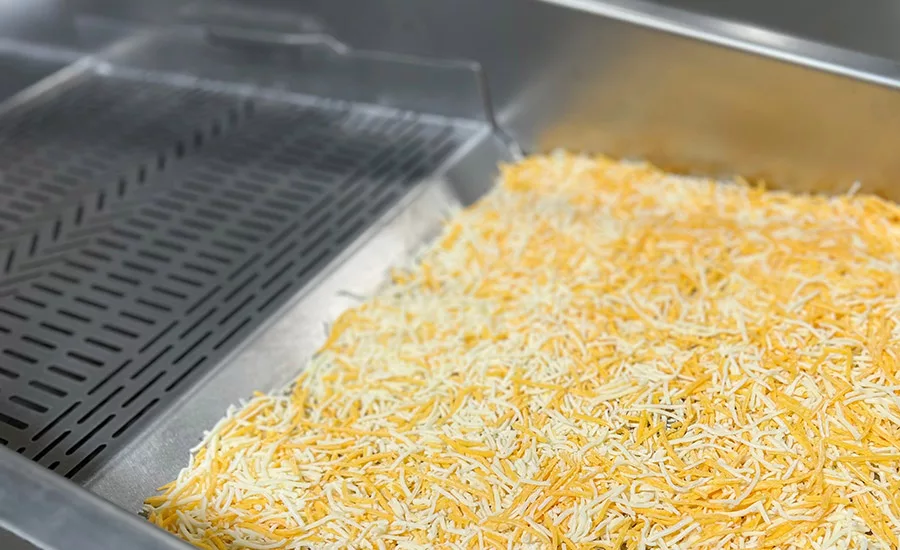
Effective sanitizing of conveyors is crucial for maintaining food safety.
Photo credit: Key Technology Inc.
Ongoing enhancements to conveyors and palletizers are creating a plethora of operational improvement opportunities for dairy processors.
By utilizing innovative technologies that developers create to enhance production while reducing labor expenses and boosting food safety, processors can achieve strong returns on investment (ROI) while strengthening performance, analysts note.
This includes the use of conveyor systems that provide greater hygiene measures, says Andrew Roloff, North American dairy specialist for Intralox LLC USA, a New Orleans-based developer of conveyance equipment. “Modern conveyor systems are designed for easy cleaning and to meet stringent food safety standards, ensuring the quality and safety of dairy products while reducing the risk of foreign material contamination,” he notes.
Such elements are vital as “badly designed conveyors are often either difficult to clean, allow bacteria to harbor, or their design makes thorough sanitation challenging,” states Ken Lento, manager of SBU West, for FlexLink Systems Inc., an Allentown, Pa.-based based supplier of conveyor and palletizing systems.

Automated palletizers can help processors cut operating expenses. Photo credit: A-B-C Packaging Machine Corp.
Conveyors with polished finishes will help prevent bacterial growth by creating a smooth, non-porous surface, and devices with solid leg supports can eliminate the niches and flat surfaces where contaminants can accumulate, he states.
“The belting or chains also should be made from materials that do not leach chemicals into food and are easy to clean, making routine maintenance straightforward and effective,” Lento says. “A removable or liftable belt allows for thorough cleaning access and prevents buildup of debris or bacteria.”
He adds, however, that “operating a truly hygienic conveyor involves more than just meeting a checklist; it requires a commitment to good design principles and thorough testing.”
Ease of use, sanitation enhancements, product quality protection, and equipment integration are further benefits from utilizing sophisticated conveyor technologies, says Rudy Sanchez, food handling systems product manager at Key Technology Inc., a Walla Walla, Wash.-based developer of vibratory conveyors.
“Fully integrating processing lines and enabling data collection by sensors on one machine to automatically trigger all the necessary adjustments to other machines on the line without human intervention will maximize conveyor system efficiencies,” Sanchez states.

The most effective palletizers will meet stacking requirements. Photo credit: Delkor Systems Inc.
Processors, for instance, can integrate a vibratory conveyor that collects products from a cheese shredder or cubing device with an optical sensor that inspects product size, color, and other characteristics, he adds. “This sensor would allow early detection of product conditions that suggest an issue with the shredding or cubing equipment, in addition to detecting any foreign materials in the product stream,” he states.
Furthermore, a metal detector on a vibratory conveyor that monitors bulk product can activate a dump gate to discard the section of product that contains a contaminant, Sanchez notes.
Cleanliness is crucial
Operators will benefit too from hygienic designs with radiused corners and smooth and well-placed welds that limit bacteria harboring, Roloff says, adding that sloped surfaces also can drain water and limit condensation build-up.
“Systems that can be quickly disassembled without tools for effective sanitation are ideal,” he states. “This minimizes downtime and ensures the conveyor is 100% accessible for cleaning.”
Effective conveyor designs also will withstand such external influences as heat, friction, and vibration, Roloff says, adding that processors also need to consider ease of maintenance and the availability of replacement parts when making purchasing decisions. “Total cost of ownership should play a factor as the conveyor might cost more upfront but can pay for itself several times over during the life of the equipment,” he states.
While product developers can help processors pinpoint the most effective conveyors, operators should also educate themselves on the top options for best results, Sanchez states. This requires learning about a system’s transporting, distributing, spreading, aligning, and feeding features; knowing how to maintain necessary throughput with maximal reliability and uptime; and comprehending the strengths and weaknesses of different systems, he notes.
“Ask about sanitary design features, such as polished finishes, ground and polished welds, open frame construction, oil-free drives, minimal laminations, screens that are easy to remove and clean, and capacity,” Sanchez says.

Robotic palletizers can be a powerful solution for labor shortages. Photo credit: Delkor Systems Inc.
It is important, too, for processors to conduct roundtable conversations with the employees that will be managing the equipment to learn their needs and recommendations before incorporating technologies, Roloff says.
“Some workers might prioritize durability and maintenance, whereas others could favor hygienic design and cleanability,” he states. “Once the team comes up with a plan, the processor should request their suppliers to design equipment around those priorities.”
Purposeful palletizing
Upgrades to palletizers also are providing processors with a wider array of devices that suppliers design to meet specific needs, analysts state.
“The palletizers market is evolving with advancements such as robotic and automated palletizing systems,” states Data Bridge Market Research, a Pune, India-based research and consulting firm. “Companies are increasingly adopting automated systems to enhance operational efficiency, reduce labor costs, and improve accuracy.”
Artificial Intelligence (AI)-powered vision systems, for instance, are enabling palletizers to manage irregularly shaped items with accuracy, while robotic arms equipped with machine learning are adapting to different packaging types and sizes, Data Bridge states. “These innovations streamline processes and are driving demand for advanced palletizing solutions,” the firm notes.
By reducing human contact, the systems also lower the risk of inadvertent food safety breaches, Data Bridge reports.
The optimal palletizers can enable processors to simplify operations and provide precise placement and stacking of products, which helps reduce operational errors and ensures that each pallet consistently loads according to specifications, says Megan Pickett, engineering team leader for Zepnick Solutions Inc., a Green Bay, Wis.-based engineering and design firm that supports palletizing systems.
“Improved pallet stack consistency also reduces damaged or spoiled products when the palletizing system maintains package integrity during transportation,” she notes. Automating the process will enable operators to focus on more complex and higher-value tasks while avoiding ergonomic issues or workplace injuries that result from strenuous manual palletizing, Pickett states.
Such automation can increase production capacity and enable the palletizing of a range of package styles without needing to train employees on new methods, says Bryan Sinicrope, vice president of marketing and integrator sales for A-B-C Packaging Machine Corp., a Tarpon Springs, Fla.-based palletizing system supplier.
Robotic palletizing can further enhance operations through greater ergonomics and cost savings, says Dan Altman, vice president of sales for Delkor Systems Inc., a St. Paul, Minn.-based developer of automated packaging systems.
“Processors that eliminate labor and reduce repetitive motion injuries will save money on all fronts,” he notes, adding that robotic palletizing also can compensate for the labor shortages that are making it difficult for operators to attract and retain employees. Many potential dairy workers, Altman adds, are reluctant to work in a cold processing environment. “It is a job few people want,” he says.
Options abound
Palletizing options include high-level systems that can generate faster throughputs while more effectively using vertical space, and low-level systems that occupy additional floor space and have a lower capacity but support a wider range of applications, analysts note.
Plant conditions also will dictate palletizer selection, Sinicrope says. Corrosion-resistant stainless-steel units, for instance, may be necessary for a wet or damp environment while space limitations can influence equipment size, he states.
Processors should consider product mix and processing rate when evaluating technologies as well, Pickett says. “Robotic palletizers offer flexibility and can handle a variety of products and packaging types, while conventional palletizers enable higher throughput, but typically are dedicated to one or two product sizes,” she states. “Assessing the necessary level of automation is key to providing a system that will deliver the best return on investment.”
However, along with the benefits from utilizing automated palletizers are system drawbacks. Advanced palletizers, for instance, often require specialized maintenance and repairs that can lead to increased downtime and higher operational costs, Data Bridge notes.
“The need for expert technicians and potential delays in obtaining spare parts can disrupt production schedules and contribute to additional expenses,” the firm states. “This complexity in upkeep poses a challenge for businesses, particularly those with limited technical resources, and can hinder market growth by adding financial and operational burdens.”
The need to make a higher initial investment for advanced technologies also can delay or prevent adoption, Data Bridge reports.
Indeed, having an acceptable return on investment is the top challenge when considering robotic palletizers, Altman says. “It is hard to justify robotic palletizing if a processor is only running one shift of production with one person performing that task,” he states.
There is greater justification for such higher-end technologies “if there is more than one person and more than one shift, or if plants have had costly injuries,” Altman says, adding that the need for fewer employees is also an attraction. “Processors may not be able to find workers, but the palletizers will be there day in and day out,” he states.
Dairy operators will further benefit by being flexible and creative when situating their palletizing systems, Altman notes, which might include running multiple lines to a single robot to “utilize a robotic palletizer to its fullest. There are many options, so look at all available designs.”
Pickett concludes: “Processors that are struggling with return on investment, which can be due to only running one shift per day, can overcome those funding challenges by selecting a system with scalability that allows them to add automation to the system over time.”
Looking for a reprint of this article?
From high-res PDFs to custom plaques, order your copy today!