What do added sugars add up to?
Consumer confusion, perhaps. But declaring added sugars on Nutrition Facts panels will be required by July 2018. Here are ways to cut down on sugar declarations without sacrificing sweetness.

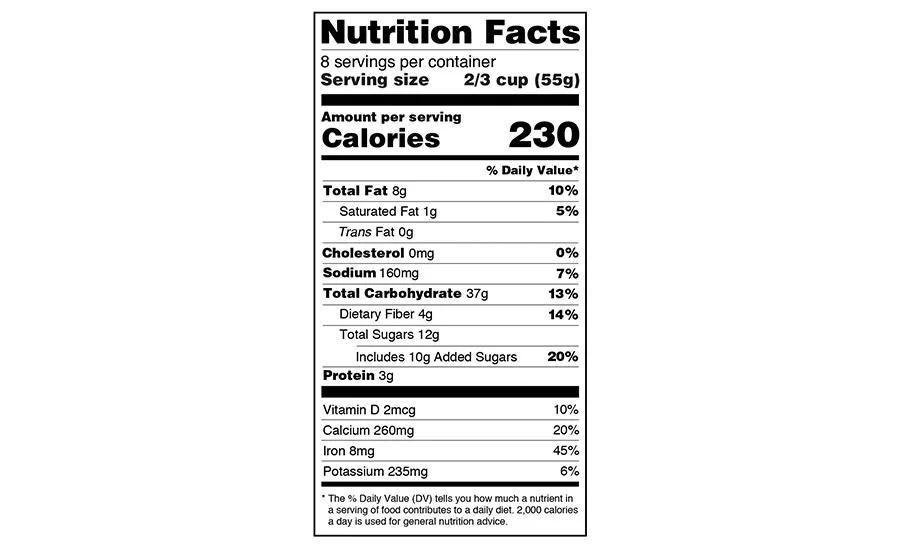
Beginning in the summer of 2018, all food manufacturers must declare added sugars on the Nutrition Facts statement.

“Dramatic improvements in sweetness quality of next-generation stevia sweeteners are enabling dairy manufacturers to achieve deeper sugar reductions than ever before,” says an executive from Cargill. Photo courtesy of Cargill
When Stonyfield, America’s leading organic yogurt manufacturer, announced a comprehensive plan to reduce added sugars across its product line by 25% before this autumn’s end, Nichole Cirillo, the Londonderry-N.H. company’s mission director, stated in a press release that the mission is “to continually provide healthier food both for our consumers and the planet.”
Left unmentioned was the Food and Drug Administration’s impending mandate that an “added sugars” line appear on Nutrition Facts panels. Still, it would be hard to imagine that the coming label change didn’t shape the company’s decision — for if consumer experts are right, once the declarations start appearing en masse, shoppers will be breaking out their magnifying glasses to sleuth out added-sugar excess wherever it lurks. Or not.
Either way, as dairy formulators confront the new labeling reality, their challenge will be to lower added sugars without:
- dramatically changing product taste,
- compromising quality, stability or shelf life or
- replacing them with scary-sounding “chemical” sweeteners that are just as objectionable as a surfeit of “real” sugar.
In other words, dairy processors will have to do more with less. And it looks as if ingredient suppliers have just the right tools to let them do so. For, as Veronica Cueva-Beach, a vice president at Tate & Lyle, Hoffman Estates, Ill., said, “having an extensive portfolio of solutions to meet labeling goals without impacting functional properties helps empower manufacturers with the right solutions to deliver healthier and tastier dairy products to their consumers.”
By July 26, 2018, Nutrition Facts panels will have to disclose not only the total quantity of sugars contained in a product serving, but how many grams of those sugars are “added.” The new panels must also bear an established Daily Reference Value (DRV) and a percentage-based Daily Value (DV) declaration for added sugars.
Given that about 13% of the average American’s calories come from sugars added to just about everything they eat, the agency rolled out the label change in the hopes that it would open consumers’ eyes to just where their added sugars were coming from, and perhaps shift their behavior as a consequence.
The FDA explains that “added sugars” are those “that are either added during the processing of foods, or are packaged as such, and include sugars (free, mono- and disaccharides), sugars from syrups and honey, and sugars from concentrated fruit or vegetable juices that are in excess of what would be expected from the same volume of 100% fruit or vegetable juice of the same type.”
This excludes 100% fruit or vegetable juice concentrate sold to consumers, as well as some sugars found in fruit and vegetable juices, jellies, jams, preserves and fruit spreads. Also, and crucial to dairy brands, it excludes the lactose naturally present in milk.
Included sweeteners are brown sugar, corn sweeteners, invert sugar, malt sugar, molasses and trendy “natural” sugars like turbinado, cane-juice extract, brown-rice extract, agave nectar, rapadura, barley malt extract, sucanat and palm and coconut syrups.
Cause and effect
Whether the FDA’s decision will improve public health, however, remains debatable. Thom King, CEO and president of Steviva Ingredients, Portland, Ore., acknowledged the new label’s virtues and conceded that “added sugars are the No. 1 contributor to diabetes, obesity and what we call diabesity.”
Carol May, president of Wisdom Natural Brands, Gilbert, Ariz., which makes SweetLeaf stevia sweetener, said “the impact of added sugars on the human body is now well documented for children and adults.” Such sugars do more than contribute excess calories and exacerbate obesity, she claimed, saying “there is actually a powerful and direct effect of added sugars themselves.”
Yet others aren’t so bullish on the declaration’s vaunted benefits.
Jon Peters, president of Beneo Inc., Morris Plains, N.J., pointed out that if we’re concerned about nutritive sugars’ effects on the body, “the discussion of ‘added’ versus ‘intrinsic’ doesn’t take us anywhere.” Why? Because the body treats both the same. Food labels reflect a food’s chemistry, he said, not our physiological response to it. “And the two often don’t go hand in hand.”
Consumers care
Even so, consumers are paying more attention to sugars, added or otherwise, and adjusting their perceptions accordingly. Proprietary Beneo research conducted by Ipsos and released in 2016 showed that 57% of U.S. consumers polled try to limit sugar intake to maintain a healthy diet or manage weight. Data from Google Trends, which tracks web searches, revealed that consumer searches for “low sugar” were on track to surpass those for “low fat” in early 2016.
“Many popular dairy products, such as flavored milks and flavored yogurts, will be affected by the new labeling regulations,” said Jessica Vogel of Kerry, a Beloit, Wis.-based supplier. “Consumers may choose to consume these products less as the amount of added sugar they contain becomes more apparent.”
Marketing Director Ivan Gonzales of Ingredion Inc., Westchester, Ill., agrees. “Once the new label regulations get in place, I feel people will first wonder about the difference between ‘total’ and ‘added’ sugars,” he said. “Then once they develop a level of understanding, I anticipate that consumers will start comparing dairy products and taking this factor into consideration.”
Holistic solutions
No one grasps this more than dairy formulators themselves who have been slogging through sugar reductions and replacements for years.
“Dairy manufacturers have proactively taken a holistic look at their products to truly understand how the change might impact them,” Cueva-Beach said.
And “holistic” is key. As Pam Stauffer of Minneapolis-based Cargill pointed out, “no single ingredient can replace all sugar’s functionality.”
Beyond conferring sweetness, those functionalities encompass moisture control, mouthfeel generation, freezing-point depression, microbial suppression and more. As a result, dairy developers will need to use multiple tools to create a successful reduced-sugar product, Stauffer said.
Sweetener synergies
Consider what happens when substituting high-intensity sweeteners for sugar in frozen dairy. Because the former appear at significantly lower formulation volumes than sugar, the resulting lower-sugar mix will lack the absent sugar’s solids, or bulk. With fewer solids, freezing point rises. As a remedy, Cueva-Beach suggested pairing high-intensity sweeteners with non-sugar bulking agents like polydextrose and soluble fibers to make up for the loss, depress the freezing point and enhance texture.
Deploying these “sweetener synergies” lets formulators “deliver the best of both worlds,” Cueva-Beach continued: “healthier and tastier dairy products.” High-intensity options like sucralose, stevia and monk fruit extract can pick up sucrose’s or even allulose’s slack and “reduce calories and sugar without compromising consumer acceptance.” (Allulose still counts as “added” sugar as far as label declarations are concerned, she said.)
For his part, King hails the clean-label sweetening synergies of stevia, monk fruit extract and erythritol blends. The system reduces sugar levels by 90%, he said, “while maintaining deliciously sweet flavor profiles and a brilliant mouthfeel that consumers have come to expect from dairy.”
Next-gen solutions
To the extent that sweeteners like stevia are showing up more in reduced-sugar dairy, much of the credit goes to evolutions in the ingredients themselves. Cargill’s Wade Schmelzer said, “dramatic improvements in sweetness quality of next-generation stevia sweeteners are enabling dairy manufacturers to achieve deeper sugar reductions than ever before.”
Exhibit A is chocolate milk. As recently as a few years ago, interactions between the product’s protein and fat suppressed sweetness to the extent that sugar reductions deeper than 2% to 3% “resulted in bitter aftertastes and shifts in sweetness onset” when using “traditional” stevia sweeteners, Stauffer noted. New stevia technologies let processors strategically tailor steviol glycosides better to achieve a desired taste and flavor profile and permit more significant sugar reductions in the process. Using such ingredients, “we’ve been able to develop great-tasting reduced-sugar chocolate milks replacing over 6% sugar,” Schmelzer said.
As for polyols, or sugar alcohols, like erythritol, they represent another family of products with a sweetness effect at lower caloric content. Depending on their composition, they can replicate some of the texture and stability attributes of sucrose, Gonzales said.
No wonder they’ve been a hit in no-sugar-added ice cream for years. And when blended with complementary sweeteners, they let formulators cost-effectively maximize each component’s benefits.
Alternative options
But while it’s logical to turn to alternative sweeteners in a bid to replace or reduce added sugars, formulators and ingredient suppliers are increasingly discovering that some tools and tactics achieve the same end, but have little to do with sweeteners themselves.
Take chicory root fiber. As a soluble, prebiotic dietary fiber, it has built-in advantages like not scanning as added sugar, clocking in at only 2 kcal/g and being a soluble, prebiotic dietary fiber (a good-for-you nutrient that consumers want).
Making matters better, it shares much of sugar’s functionality, said Scott Turowski of Sensus America Inc., Lawrenceville, N.J. It incorporates easily into dairy, improving texture, supplying bulk and depressing freezing point where appropriate. Being as much as 65% sucrose’s sweetness, it needs help restoring a product’s full-sugar taste. But even here, Turowski said, chicory root fiber can mask high-intensity sweeteners “and has been used quite successfully with stevia to create excellent sweetness profiles in dairy.”
Another route for reducing dairy’s added sugar is to leverage the sugar it already contains. And by using the lactase enzyme to lyse the milk sugar lactose into its constituent glucose and galactose monomers (with 74% and 60% sucrose’s sweetness, respectively, according to DuPont’s Hopkinson), formulators are finding that they can lower sugar levels without losing sweetness or resorting to “artificial” ingredients.
Using lactase in chocolate milk and yogurt allowed Kerry to lower added sugars by as much as 25%.
“When paired with flavor modulators and taste solutions, we can further reduce sugar and deliver reduced-sugar dairy without an impact on taste or texture,” said Stephen Cobbe, the RD&A director at Kerry.
Flavor modulators — often labeled simply as “natural flavors” — come in quite handy in sugar-reduced dairy in general. Cobbe called them “one of our most important tools because they help us build back taste and maintain flavors characteristics throughout shelf life.”
Even classic dairy flavors like vanilla and chocolate can boost the perception of sweetness, Hopkinson added.
“It’s important to realize that calculated sweetness and perceived sweetness can be different,” he said. “Often, the context of the formulation can have a big effect on how people perceive product sweetness.”
Knowledge is power
And perception, as any dairy formulator knows, is reality. “It’s always surprising how slight shifts in sweetener and flavor concentrations can have a dramatic impact on sweetness perception and flavor,” Schmelzer said. “Product developers need patience to make incremental adjustments to identify the right sweetness level for their products.”
As they do, they may find themselves wondering whether all their efforts will have the intended effect — that is, to help consumers make wiser dairy decisions vis-à-vis added sugars. Hopkinson isn’t placing his bets yet, noting that “while more information in consumers’ hands is always a good thing and some small health effect may result from this, we’ve seen these kinds of actions fail in the past.”
Cobbe is more sanguine. “If we can help consumers reduce sugar consumption while still enjoying the wholesome dairy foods they love and that have many health benefits,” he said, “we may hope to see a decrease in obesity.”
In any event, the label change offers dairy processors an opportunity.
“It’s easy to envision product innovation paralleling the approach in the snacks category of a few years ago when manufacturers targeted 100-calorie packs at consumers,” Schmelzer said. “In the end, successful new dairy products will effectively identify nutritional changes that resonate with consumers and deliver the great taste they expect.”
Looking for a reprint of this article?
From high-res PDFs to custom plaques, order your copy today!


