On-site dairy labs are the first line of defense
Keeping bad milk out of a processing plant is just the first step. Labs also test products as they come off the processing line. Environmental tests assess that proper CIP and sanitation procedures have been followed.
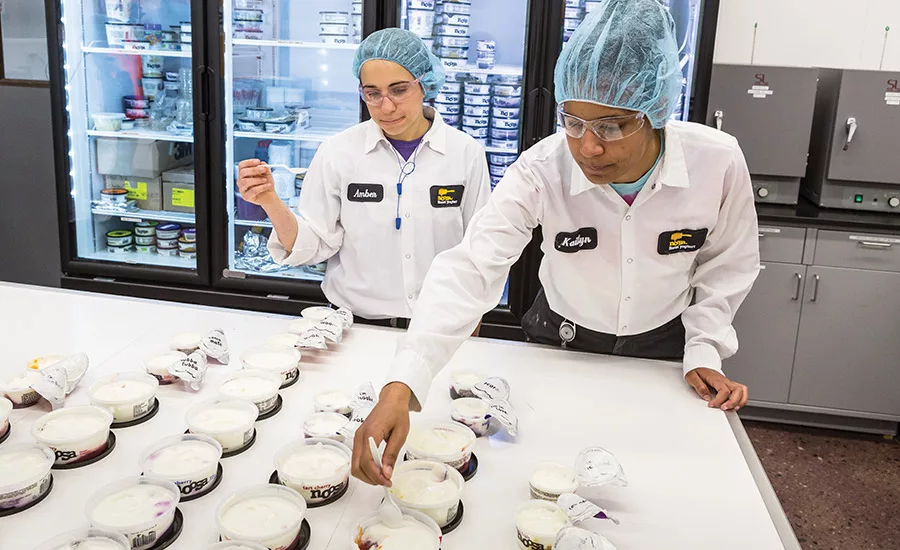
Lab technicians at Noosa Yoghurt perform sensory evaluations.
To make foods and beverages that are safe to consume, dairy processors must handle and test raw milk with the utmost precision. Some tests are required by law, while the results from others yield results that can tell a dairy a great deal about their milk supplier and about their in-house handling practices.
The first line of defense in food safety is testing the tanker of raw milk that just pulled into the receiving bay. There are several tests to perform. All milk must be tested for the presence of antibiotic residues in accordance with Appendix N of the Pasteurized Milk Ordinance, noted John Faragher of DSM Food Specialties. Dairies can choose to do more extensive testing for antibiotic residues to meet specific customer or export requirements, he said.
A lab manager might test for other classes of antibiotics, such as tetracyclines or sulfonam.
Before accepting a load, the lab should perform a direct microscopic count, or DMC, test which indicates the microbiological quality of raw milk, said Nancy Eggink, the director of business development for Merieux NutriSciences. Two other quality indicators are a preliminary incubation (PI-SPC) count and coliform count.
Standard plate counts (SPC) are widely used to monitor farm milk quality, said Matthew W. Sawyer, a market development manager for dairy and foodservice at Neogen. He said dairies also should evaluate quality characteristics, such as fat and protein, as well as somatic cell counts.
Passing the ‘sniff’ test
Sensory and organoleptic tests don’t require anything more than a nose and taste buds, but their results can be revealing.
“Just smelling the tanker when the sample is taken could provide an indication of various issues that could affect the products made with that milk,” said Eggink. An organoleptic evaluation identifies potentially bad flavors or odors, which she described as malty, bitter, salty, fruity or barny.
Bob McGregor of Brookfield Ametek said viscosity testing is an important part of milk certification.
“The measured value correlates with customer mouth feel,” he said. Measurement is typically performed on a sample in coaxial cylinder geometry with the spindle rotating at a defined speed, he said.
The viscosity value provides a quality control check prior to packaging the product, he noted, adding that improvements in instrumentation reduce the measurement time cycle for each test and provide a graphical image on the display screen to show the test data.
Work in process
Testing continues after receiving raw milk and separating, heating and homogenizing it. Dairies have to assure themselves that their foods are safe to eat and that they taste the way they should. That’s why testing of work in process and finished products is so important. Dairy plant managers tell Dairy Foods that they typically pull product from the beginning, middle and end of processing runs for testing.
Yeast, mold and coliform counts are indicators of sanitary conditions and verification there were not microbiological problems during processing.
Results from environmental testing
Besides analyzing raw milk and finished goods, dairies need to test for pathogens in the processing and packaging rooms. The results show if a facility is being cleaned and sanitized properly.
“Less than stellar results of testing should be shared right away,” said Bulthaus. “A well-trained cleaning crew is one of your best assets.”
Dairies perform environmental monitoring and finished product testing for pathogens, such as Listeria, E. coli, and Salmonella, as well as for coliforms, which indicates how sanitation in the area is maintained as the line runs, Sawyer said.
By setting up a site map of the plant and mapping the results over time, a plant manager can easily identify trends and problem hot spots. For example, tests can show where uncontrolled foot traffic may be, or aging surfaces may need to be resurfaced, Sawyer said.
Many dairy operations engage in juice co-packing and make ice cream. That opens up the possibility for cross-contamination and undeclared allergen residue in final product, Sawyer said.
“Having an allergen control program is now part of the Pasteurized Milk Ordinance due to the assimilation of the preventative controls rule (HARPC) into the PMO. Testing for specific allergens and having a proper allergen validation and verification program is key for many dairies,” Sawyer said.
Eggink noted that pathogens enter dairy plants via multiple paths, including materials, people, equipment and even the air.
“If a facility is not getting a few presumptive positive lab results, they should assume they are not looking hard enough,” she said. Dairies should check swabs/sponges and the material they are hydrated with. Swabs should be used for smaller hard-to-reach areas. Sponges should be used to sample a larger surface area.
“The hydrating liquid is a neutralizing component to neutralize any residual sanitizer on a surface so any organisms that may be sampled are not killed as the sample is transported to the lab,” she said.
In addition to food contact surfaces, it is important for dairies to look for possible areas where pathogens can be introduced. Floor drains are hot spots for Listeria, for example, Sawyer said.
“Dairies can work with equipment manufacturers to better understand difficult to clean areas on the equipment and ensure sanitation SOPs [standard operating procedures] are written clearly to effectively clean equipment. Consultants are another resource to use in assessing if the dairy is looking in the right places for environmental pathogens.”
Dairy science professionals at nearby universities can be an asset for trouble shooting and process improvements, Bulthaus said.
Bacteria are some of the most adaptable living organisms on the planet, said Bulthaus. “Their ‘job’ is to live, grow and reproduce. Sometimes regimens need to be changed to accommodate adaptive modifications in the organisms within the facility,” she said. “If something doesn’t look quite right, it may not be. Check it out. If it turns out to be a false alarm, don’t let that stop the questions the next time.”
What to look for when testing raw milk
- Temperature and age of the milk (date). Ideally, the temperature should be less than 5 C or 41 F.
- Drug residue test. The presence of antibiotics indicates one or more cows were treated for mastitis. Milk from treated animals is not allowed or expected to be part milk offered for sale or delivered to dairy facility.
- Odor. Good quality milk should smell “clean,” pleasant and “sweet.”
- Standard plate count. Ideally, the count should be <25,000 (or less) even though the regulatory limit is much higher. Higher counts indicate potential temperature abuse and/or poor sanitation.
- Somatic cell count. The value is an indicator of herd health. Values greater than 300,000 on co-mingled raw milk indicate that some milk in supply has mastitis.
- Preliminary incubation counts. PI counts more than twice that of the baseline standard plate count (see above) indicate poor sanitation or temperature abuse of the supply.
- Lab pasteurized counts. Counts >200 per mL indicate poor sanitation, poor cow preparation or both.
- Coliform count. While raw milk may be expected to have some coliform bacteria, counts of >100/ mL indicate poor practices.
- Composition. A cryoscope or an instrument calibrated to provide a value for FPD (freezing point depression) can indicate if the milk has added water. Abnormally high fat values can contribute to abnormally high values for bacteria and somatic cells (which may not truly represent the milk supply).
- pH and titratable acidity. These tests determine whether adequate temperatures for storage and transport have been maintained. Unusual values for both suggest that temperature abuse has occurred and bacterial fermentation has occurred. Very high values not accompanied by high bacteria counts could indicate chemical lowering of the normal pH values, possibly because of too much or too concentrated acid sanitizer or a failure to adequately rinse and drain the truck when washed.
- Examine the milk. Look in the truck prior to sampling. Foreign objects (dirt, for example) or coagulated milk indicate poor milking practices, poor storage conditions or both.
Source: Mary Bulthaus, Eurofins DQCI
Looking for a reprint of this article?
From high-res PDFs to custom plaques, order your copy today!


