International name calling
Dairy slips through the looking glass
In the truly bizarre world of international trade regulations and negotiations, U.S. dairy processors could be forbidden to describe their products as "American cheese."
 When I use a word," Humpty Dumpty said in rather a scornful tone, "it means just what I choose it to mean — neither more nor less." Our ovate friend was talking to Alice in Lewis Carroll's "Through The Looking-Glass."
When it comes to cheese names, the European Union takes a decidedly "more" approach. Some would call it "monopolistic."
Never mind that most of the world freely uses and understands the word Parmesan as it applies to cheese. To the EU, however, Parm means only Parmigiano-Reggiano. And feta is a cheese made only in Greece. The EU is trying to force its approach to food names on every country in the world. It already has gummed up the South Korean market for non-EU makers of Asiago, feta, fontina and gorgonzola. The EU's free trade agreement with the Koreans forbids the use of those names by anyone except EU processors.
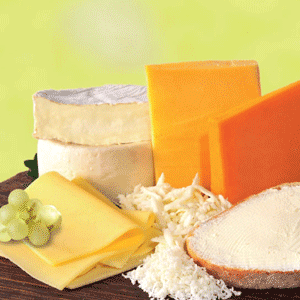
Welcome to the issue of geographical indication, now playing in trade talks between the United States and the EU. If our nation's trade negotiators fail to represent the dairy industry's point of view, U.S. cheesemakers won't be able to use common cheese names like brie, camembert, Cheddar and Swiss. Even the term "American cheese" is at risk.
Sound far-fetched? Not if you've been following the flap over common food names. The situation is absurd, restrictive and anti-competitive. And it could be law if the European Union bullies U.S. trade negotiators in a series of trade talks called the Transatlantic Trade and Investment Partnership, or T-TIP.
Dairy interests in the United States are livid (and rightly so) about the potential naming grab by the Europeans.
"The EU's attempt to claw back generic cheese names from the United States domestic market is an absurdity," Clay Hough, a senior group vice president and general counsel of the International Dairy Foods Association, told me this month.
Geographical indications are a barrier to trade
When he spoke to the Trade Policy Staff Committee in May, Hough said the IDFA views "these claw back efforts by the EU as de facto barriers to trade. They are a clear effort to limit competition and to bestow upon EU producers a considerable portion of the valuable markets that our companies have devoted time and resources to help build."
This is much, much more than an IDFA issue. Dairy producers, too, are fighting geographical indications. The National Milk Processors Federation, the U.S. Dairy Export Council and IDFA "are strongly united" on their views of geographical indications, Hough told me.
Neither is this strictly a United States issue. Most of the Parmesan cheese is made by non-EU processors. The IDFA estimates Latin American processors make 25% of the world's Parm. Do you think these countries support restrictive naming practices?
Nor is this strictly a dairy issue. Prosciutto, salami and other meat names risk getting swept up in this.
Geographic indications are a form of intellectual property. Producers in a specific region have the exclusive right to use a particular product name, and no one outside that region is allowed to use a GI registered name. The EU enforces this in the free trade agreements they sign with nations. These FTAs don't expire, so once a country (like South Korea) signs on the dotted line, the GI restrictions are forever. And that hurts U.S. cheesemakers who export.
The Consortium for Common Food Names, Arlington, Va., is a coalition of interests trying to protect the use of what it considers generic names. The CCFN sees value in the use of some specific names; Parmigiano-Reggiano and Camembert de Normandie pass the sniff test, so to speak. Closer to home, the consortium supports the use of Washington State Apples and Idaho Potatoes. CCFN Senior Director Shawna Morris told me she welcomes allies to the cause. (Go to CommonFoodNames.com for more information.)
But when it comes to the single name: there's the rub. If it helps, think of botany's Genus and Species naming system. The U.S. dairy industry wants to be able to freely use the Genus (Parmesan, for example). The EU wants to monopolize the Genus and the Species by forbidding the use of Parmesan by everyone and allowing only Parmigiano-Reggiano by producers in that region.
Geographical indications also hit retailers, restaurateurs
Not only would non-EU processors be prohibited from using certain names, but also retailers and restaurateurs would be restricted. You wouldn't be able to find Gruyere cheese on a fondue menu outside of the European Union. And good luck trying to exhibit certain cheeses at Anuga, SIAL or other European trade shows. As for entering a European cheese competition, no dice. The CCFN reports the Global Cheese Awards eliminated the Parmesan category in favor of a Parmigiano-Reggiano category.
By all accounts, the T-TIP talks are going to go on for months. The talks started in early July in Washington, D.C., and the next round is in Brussels in October. The dairy industry will be pressing its point of view to United States Trade Representative Michael Froman. IDFA's Hough already has termed the EU's proposal as "anathema to the spirit and goal of trade liberalization."
In his remarks kicking off the talks, Froman said, "We have the opportunity to complement one of the greatest alliances of all time with an equally compelling economic relationship. And we have the opportunity to work together to establish and enforce international norms and standards that will help inform and strengthen the multilateral, rules-based trading system."
He's diplomatic, I'm not. I'd tell the EU to kiss my Asiago.