Cheese Doctor
Boosting cheese yield: Small tweaks, big gains
Why is protein recovery lower than casein recovery?

John Lucey, Ph.D., is the Owen R. Fennema Professor in Food Chemistry at the University of Wisconsin-Madison’s Center for Dairy Research.
Cheese yield — the amount of product that you obtain from your starting milk — is vitally important for plants to understand and optimize. Even small differences in cheese yield result in a significant impact on plant revenue. Additionally, with the prevalent use of concentrated milk, monitoring plant efficiency is more important than ever.
More than 100 years ago, Lucius van Slyke in New York analyzed the output at Cheddar cheese plants and came up with one of the first predictive yield equations to help estimate how much Cheddar cheese they should be making from their milk (this equation can be adjusted for other cheeses as well). This equation recognized that the two major milk components that are recovered in cheese are the fat and casein. Moisture content of cheese is another key factor influencing yield.
So, when making cheese, why don’t we recover all the milk fat and casein? What causes some losses? For Cheddar cheese, typical fat recoveries are in the 90-93% range, and casein recoveries are in the 94-96% range (protein recovery values can typically range from 72-76% and are lower than casein recoveries due to the loss of whey proteins in the whey drainage step). Most of the casein loss is due to coagulant activity at clotting (i.e., loss of the glycomacropeptide) but additional loss occurs during the initial stirring process and subsequent damage to the curd particles. Higher protein recoveries are observed in cheese made from microfiltered milk as a higher proportion of the initial protein is casein.
One of the major factors that influences fat loss is the design of the cheese vat. With older open style cheese vats, fat levels in cheese whey could often be 0.3-0.5% but in modern enclosed vats with well-optimized systems, the whey fats can be potentially as low as 0.15% (representing <5-6% of total fat losses). Homogenization of milk (not widely used for cheesemaking) can reduce whey fats. This difference in fat loss between older and modern vats seems to be due to an improved cutting process in these modern systems. Routine testing of whey fats should be performed to monitor losses.
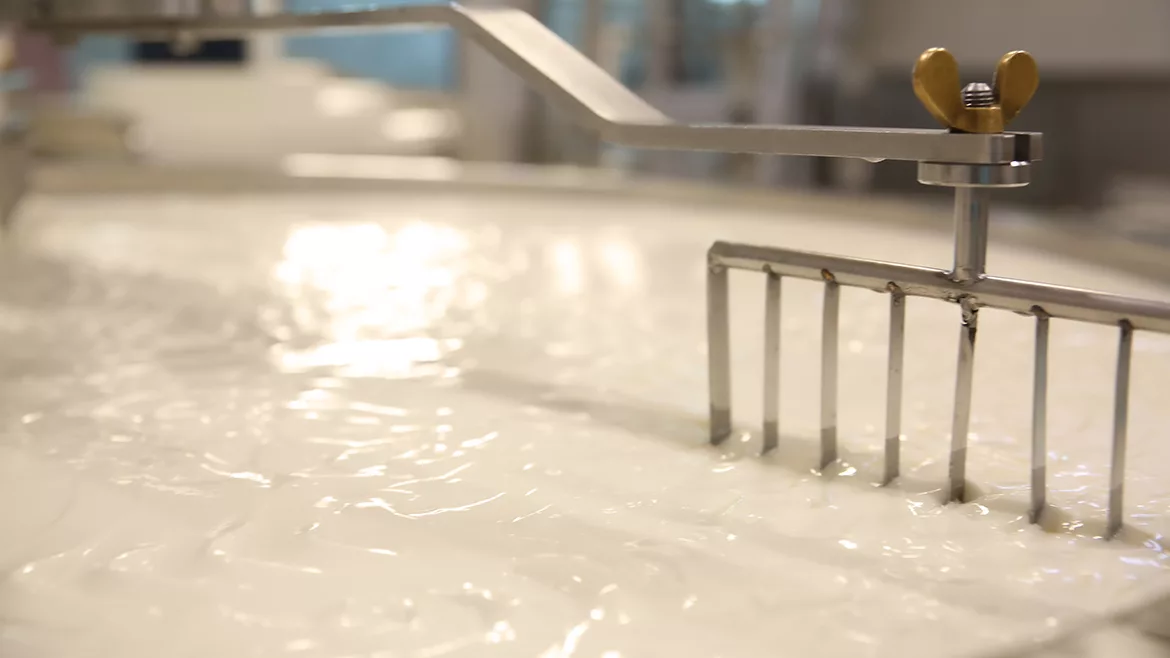
Why do we lose fat during the cutting step? Fat particles are very large compared to the other components in milk and they are just physically trapped within the initial rennet-induced network. These fat particles can be similar in size to the pores in the network. During the cutting process, the blades/knives expose pores/gaps on the newly cut gel surfaces and some of the fat particles fall out of the pores and are lost in the whey.
Making a clean cut (not tearing the gel and causing more damage) and allowing the initial gel surface in these curd particles to “heal” (the outer layer to shrink and strengthen as it rapidly loses moisture), are variables that can improve fat recoveries. Excessive agitation of these initial soft/weak curd particles causes more damage to the curd particles and therefore more losses of fat and casein (these small curd particles are called fines).
In recent years, many U.S. cheese plants have started to use concentrated milk (often increasing the total solids in milk by >5%). With an increase in the casein content of milk, the coagulation process is greatly impacted with a higher initial rate of gel firming. This results in a smaller window of opportunity for successfully completing the cutting process before the gel firms so much that cutting is hard to complete without tearing. When using higher solids cheese milk here at the Center for Dairy Research (CDR), we have found that we need to make several adjustments to the cheesemaking process. For example, reducing the coagulation temperature can slow down the initial rate of gel firming, which could provide a larger time window for completing proper cutting.
Cheese made from concentrated milk can also have a lower moisture content so adjustments to the cooking/stirring conditions can help to retain more moisture. When the initial milk contains more fat and casein (higher solids) then obviously more cheese (i.e., yield) is produced but often there is little change/difference in the efficiency of the process (i.e., percentage fat or casein recoveries); sometimes the percentage of fat recovery is even reduced if the cutting process becomes challenging.
Optimizing moisture levels can also help increase cheese yield. For example, if a plant is able to consistently produce high quality Cheddar at 38.0% moisture level, compared to 37.5% moisture level, they have increased their yield by around 0.8%. The challenge is that a plant must be able to consistently hit those upper-level moisture percentages, without going over specifications mandated by customers or the standards of identity. That type of compositional consistency requires an operation that has a very tightly controlled milk composition (not just protein/fat ratio but the actual concentrations as well) and a coagulation/cutting process that is similar every day.
Finally, while the van Slyke predictive yield equation is still useful, the Center for Dairy Research (CDR) and others have developed more advanced prediction equations. Here at CDR, Dr. Mark Johnson and Dr. Rani Govindasamy-Lucey have developed a calculation method that allows plants to calculate their own percentages for protein and fat recovery without needing to do the complex mass balance experiments routinely done by scientists (e.g., in batch processes at the university). Inputs for these calculations include the detailed milk and cheese composition. This allows cheese plants to better understand the fat/casein recoveries they actually have, and if below typical levels, explore methods to improve these recoveries.
The overall goals for many cheese plants include increasing output, maximizing efficiency and producing high-quality cheese that still has the expected shelf life. Making careful adjustments and optimization of the process can result in improved yield and better cheese quality.
Looking for a reprint of this article?
From high-res PDFs to custom plaques, order your copy today!