Dairy Foods logo
search
cart
facebook twitter linkedin youtube
  • Sign In
  • Create Account
  • Sign Out
  • My Account
Dairy Foods logo
  • NEWS
    • DAIRY REGULATIONS
  • PRODUCTS
    • New Products
    • Butter
    • Cheese
    • Cultured Dairy
    • Frozen Desserts
    • Ice Cream/Novelties
    • Milk
    • Non-Dairy Beverages
    • Sales Data
    • Whey, Milk Powder
    • Dairy Alternatives
  • INGREDIENTS
    • Cocoa
    • Colors/Flavors
    • Cultures/Enzymes
    • Fiber
    • Gums, Stabilizers, and Texturants
    • Inclusions
    • Omegas/Lipids
    • Prebiotics
    • Probiotics
    • Sweeteners
    • Other
  • OPERATIONS
    • SUSTAINABILITY
    • Equipment
    • Processing
    • Packaging
    • Food Safety & Sanitation
    • Membrane Technology
  • MEDIA
    • Dairy Foods TV
    • Podcasts
    • Webinars
  • DIRECTORIES
    • Buyers Guide
    • Dairy Plants USA
  • MEMBRANE FORUM
  • MORE
    • Associations
    • Dairy Foods' News & Views Newsletter
    • Blogs
    • Case Studies
    • Classifieds
    • Custom Content & Marketing Services
    • Dairy Foods Store
    • Market Research
    • Supplier Spotlights
    • Tradeshows and Events
    • Strategy Guides
  • AWARDS
    • Dairy Plant of the Year Award
    • Breakthrough Award
    • Dairy Processor of the Year
  • EMAGAZINE
    • eMagazines
    • Archive Issues
    • Contact
    • Advertise
    • SIGN UP!
    • Columnists
    • Dairy 100
    • State of the Industry Report
    Membrane Technology

    University membrane project targets sustainability, affordability in separation science

    New membrane technology aims to reduce the amount of energy needed to produce food and other products.
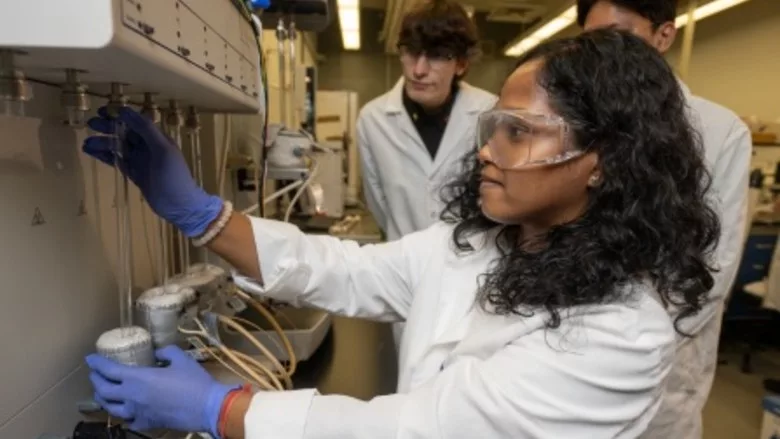
    Students from Miao Yu's lab working
    Credit: Onion Studio

    Credit: Onion Studio

    January 21, 2025

    A University at Buffalo-led research team has been awarded $3 million to develop new membrane technology that could greatly reduce the amount of energy needed to produce food, chemicals and other products.

    Funded by the US Department of Energy, the membranes could ultimately reduce production costs and greenhouse gas emissions, which could make everyday goods more affordable and lessen their environmental impact.

    “The main objective of our work is to develop cost-effective solvent- and heat-resistant membranes that can withstand the harsh industrial conditions associated with creating many common products,” said the grant’s principal investigator Miao Yu, SUNY Empire Innovation Professor in the Department of Chemical and Biological Engineering in the School of Engineering and Applied Sciences.

    Yu, a core faculty member in the UB RENEW Institute, will work with students and three companies: GTI Energy of Des Plaines, Ill.; Marquis Energy of Hennepin, Ill.; and Media and Process Technology Inc. of Harmar, Pa.

    Lower-cost, eco-friendly alternative to industry standard

    To create ingredients used in food, chemicals and other products, industry regularly uses energy-intensive processes, such as distillation and crystallization.

    These processes, which often require an extraordinary amount of heat, change the composition of raw materials and unlock molecules needed for commercial products. An example of this is soybean oil processing, which requires several steps including heating the beans up to 190 degrees Fahrenheit, to properly extract the oil.

    With rising energy costs and concerns about climate change-inducing greenhouse gases, industry is working to supplant these processes with lower-cost and eco-friendly alternatives.

    Membranes are attractive because they can separate molecules without heat, complex chemical solvents and other time-consuming and costly steps. Unfortunately, most are made from plastics that easily degrade, making them impractical.

    That’s where Yu and his collaborators come in. They are creating new, sturdier membranes –made of titanium oxide and carbon – that can withstand harsh industrial separation processes.

    Tests focus on soybean oil processing

    These membranes, which are 50 to 80 centimeters long, are combined into modules. Researchers can precisely control the size and shape of the nanopores to allow different-sized molecules to pass through. Also, the membranes can endure temperatures up to 250 degrees Celsius.

    To test their viability, the researchers will demonstrate a prototype system in which they attempt to process up to 20 kilograms of crude soybean oil per day. They will continue the experiment nonstop for 500 hours, or roughly three weeks.

    If successful, the membrane could have important consequences. For example, it could potentially eliminate the need to heat the soybean oil, which is the current industry standard for removing impurities. In turn, this could reduce the energy required to produce soybean oil by as much as 70%.

    “Because we can tune the size and shape of the pores in the membrane, we believe this system could be applicable for other industries – such as chemical and pharmaceutical companies – that rely upon separation science,” said Yu.

    UB’s Technology Transfer office has filed a preliminary patent for the technology, and efforts are underway to commercialize it.

    The funding comes from the Energy Department’s Industrial Efficiency and Decarbonization Office. It is among 16 projects representing $38 million that were recently announced.

    Source: University at Buffalo

    KEYWORDS: eco-friendly membrane systems separation technologies

    Share This Story

    Looking for a reprint of this article?
    From high-res PDFs to custom plaques, order your copy today!

    Recommended Content

    JOIN TODAY
    to unlock your recommendations.

    Already have an account? Sign In

    • Lifeway Organic Kefir in different flavors inside a refrigerated grocery shelf.

      Dairy Foods names Lifeway Foods 2025 Processor of the Year

      Lifeway Foods donates $10,000 to wildfire victims,...
      Innovation
      By: Brian Berk
    • Two female farmers are standing in a field, holding a large milk canister, looking at several cows at dairy farm.

      Honoring Women Leaders Shaping the Dairy Industry

      For the fourth consecutive year, Dairy Foods is proud to...
      Dairy Foods & Beverages
      By: Barbara Harfmann
    • Main feature for State of the Industry with dairy products album cover with a gradient circular--patterned backgorund.

      2025 State of the Dairy Industry

      Welcome to the 2025 State of the Industry report. For...
      Ingredients for Dairy Processors
    Manage My Account
    • eMagazine Subscription
    • Dairy Foods News & Views Newsletter
    • Online Registration
    • Manage My Preferences
    • Subscription Customer Service
    • Connect with Dairy Foods

    More Videos

    Popular Stories

    Close up of man adding Greek yogurt while preparing healthy smoothie in the kitchen.

    An expert guide to dairy and GLP-1 receptor agonists

    Splash of milk in form of arm muscle. 3D illustration.

    Protein: The Powerhouse of Health and Wellness

    Grilling foods

    Dairy’s Enduring Moment: Why Resilience and Renewal Define Today’s Dairy Story

    Nominate your product for the 2026 Dairy Foods Product of the Year!


    MTF webinar


    Food Safety webinar

    Events

    July 8, 2026

    Membrane Purification Enables Clean Beauty Actives

    The global cosmetics market is undergoing a major shift towards the use of natural bioactive ingredients as consumers grow more skeptical of traditional formulations and demand greater transparency and sustainability.

    July 8, 2026

    Advancements in RO for Dairy Processing

    Reverse osmosis (RO) membranes are well established in dairy processing but continue to evolve to improve performance, reduce energy use, and increase operational longevity. 

    View All Submit An Event

    Products

    Probiotic Ice Cream: Science and Technology

    Probiotic Ice Cream: Science and Technology

    See More Products
    health and wellness


    plant of the year

    Related Articles

    • TetraPak

      Tetra Pak on pace to meet 2030 sustainability targets

      See More
    • Rice University logo

      Rice University opens center dedicated to membrane materials, separation technologies development

      See More
    • Service Is Key in Filtration Separation

      See More

    Related Products

    See More Products
    • tech inv.jpg

      Technological Interventions in Dairy Science: Innovative Approaches in Processing, Preservation, and Analysis of Milk Products

    • 9781771887656.jpg

      Nanotechnology Applications in Dairy Science Packaging, Processing, and Preservation

    See More Products

    Related Directories

    • Kovalus Separation Solutions

      Kovalus Separation Solutions (KSS) provides innovative separation technology for the food, beverage, and dairy industries. Together with RELCO®, we offer membrane filtration and thermal separation technologies for a variety of concentration and purification applications to produce high-quality products, as well as sustainable water and wastewater treatment solutions.
    • Food Science Dept. Dairy Pilot Plant, University Of Manitoba

    ×

    Stay ahead of the curve. Unlock a dose of cutting-edge insights.

    Receive our premium content directly to your inbox.

    SIGN-UP TODAY
    • RESOURCES
      • Advertise
      • Contact Us
      • Directories
      • Store
      • Want More
    • SIGN UP TODAY
      • Create Account
      • eMagazine
      • Newsletter
      • Customer Service
      • Manage Preferences
    • SERVICES
      • Marketing Services
      • Reprints
      • Market Research
      • List Rental
      • Survey/Respondent Access
    • STAY CONNECTED
      • LinkedIn
      • Facebook
      • YouTube
      • X (Twitter)
    • PRIVACY
      • PRIVACY POLICY
      • TERMS & CONDITIONS
      • DO NOT SELL MY INFORMATION
      • PRIVACY REQUEST
      • ACCESSIBILITY

    Copyright ©2026. All Rights Reserved BNP Media, Inc. and BNP Media II, LLC.

    Design, CMS, Hosting & Web Development :: ePublishing