Byrne Inc. is the 2022 Dairy Foods Plant of the Year
Byrne Inc., our 2022 Dairy Plant of the Year, continues to plan for tomorrow, while continuing tremendous success today.
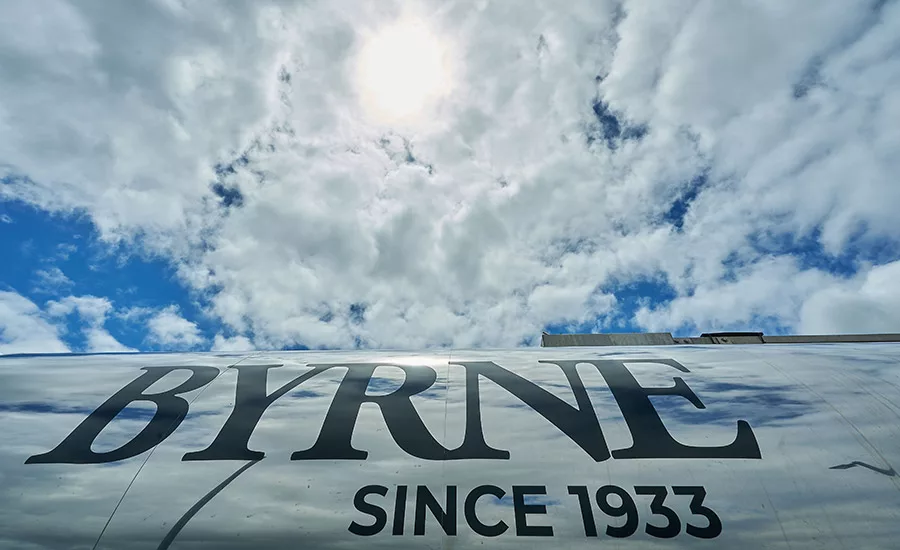
Photos by Charles Wainwright
Byrne Dairy Inc.’s Dewitt, N.Y., plant is our 2022 Dairy Plant of the Year for its many accomplishments in aseptic production, food safety, sustainability, and much more.
The 89-year-old, fourth-generation company opened the plant in 2004 when the facility spanned 40,000 square feet following an initial $13.5 million investment. The plant has undergone an expansion approximately every four years since. The Dewitt plant now spans approximately 200,000 square feet, not including the just-constructed wastewater facility. It employs 210 people, including plant staff, those in the front office, and engineers.
More than 60 percent of the plant’s business entails producing cream products, but it is also expanding milk lines, thanks in large part to a new, state-of-the-art aseptic filling and packaging room, where production began in mid-April 2021.
Byrne Dairy’s plant currently has 10 production lines on-site, seven of which fall under the Extended Shelf Life category. Also offered is a PET bottling line that can produce any mold, including for eight-ounce, 12-ounce, 14-ounce, 16-ounce, 32-ounce, and 50.7-ounce bottles, as well as two aseptic lines: quart and 8-ounce.
“What we have done in the last year is phenomenal,” Eric Stone, Byrne Dairy’s chief operating officer, tells Dairy Foods during an interview at the plant. “We added 30,000 square feet during that time. We hired more than 60 new employees. And from a percent of volume increase that the plant produces, we added about 20 percent more additional annual volume.”
Byrne Dairy is not stopping there, however. The company expects the plant to offer an additional 10 percent volume and add 15 more employees by the end of the year.

Aseptic aspirations
Byrne Dairy identified aseptic as a great growth opportunity. The new facility increased its product offerings from one SKU to 20, and the addition features two Tetra Pak fillers, which were built to accommodate future expansions.
“The reason we got into it is all businesses need to reinvent themselves,” Carl Byrne, who has served as company CEO for the past 16 years, says. “Years ago, you may have had to reinvent yourselves every 20 years. Now, with the global economy being so competitive, you need to reinvent your business every 10 years.”
Aseptic can be stored and shipped at ambient temperature, making it a good fit for Byrne Dairy. Perhaps more important is growing U.S. consumer acceptance of aseptic, Carl Byrne adds. Although the plant was prepared for aseptic processing dating back to 2004 with sterilizers and homogenizers, aseptic offerings never took off in the United States like it did in Europe until the COVID-19 pandemic came about.
During the pandemic, consumers increasingly purchased larger quantities of products at places like club stores, and became familiar with purchasing a dairy product and placing it in the pantry instead of the refrigerator, Carl Byrne notes.
“We try to swim upstream when we can. Everyone was just treading water [during the pandemic],” Carl Byrne says. “We were in a good position financially and were able to run the facility. We decided to make some investments in a space we really wanted to get into.”
“What we have done in the last year is phenomenal. We added 30,000 square feet during that time. We hired more than 60 new employees. And from a percent of volume increase that the plant produces, we added about 20 percent more additional annual volume.”
— Eric Stone, Byrne Dairy’s chief operating officer
However, the decision to add aseptic came well before the onset of the pandemic.
“It was about having the people ready,” Carl Byrne relays. “It took a number of years. One thing about Byrne is there are 50 or 60 employees of the 200 who have expertise in the manufacture of dairy products. We were able to take that step up to make aseptic.”
Byrne Dairy began hiring employees six months prior to aseptic equipment arriving and invested heavily in its training program and its onsite production support, Ryan Elliott, operations manager, adds.
“Even our monitoring equipment comes with advanced PLC readouts that go on an internet-based platform, so I can sit at home or in my office and see in real-time what is happening,” Elliott states. “It has been a plant-wide effort to support these lines. We brought on 30 dedicated people just for these two lines.”
Bringing aseptic on board was challenging during a pandemic and an international supply chain problem, Stone stresses.
“That is a task in itself,” he says. “And bringing in new people and training them along with keeping them safe and having the contractors on site and keeping them safe is a tremendous accomplishment.”

Safety for food
Regarding day-to-day operations, safety is of utmost importance. This is certainly evident in Byrne’s achievements in the category of Food Safety. Following the completion of the aseptic expansion, its aseptic process was included in the GFSI/SQF audit, achieving an “excellent” rating — a score of 97 — during an unannounced SQF audit in February that covered the entire facility.
Food safety success starts with hiring high-caliber employees and training them upfront, Stone says. Nearly 50 people were trained specifically in aseptic, which continues today.
“We worked with quality and regulatory agencies throughout the certification to bring aseptic online,” Stone says. “My philosophy is we put peoples’ safety and food safety first. It is on our mission statement in our facility. When you have that, efficiency, productivity, and cost all fall into place.”
Byrne Dairy also brought on a process authority, Dover Brook Associates, which determines any solutions the plant may need to put in place to meet regulatory safety requirements.
“We try to swim upstream when we can. Everyone was just treading water. We were in a good position financially and were able to run the facility. We decided to make some investments in a space we really wanted to get into.”
— Carl Byrne, CEO
“One thing we learned with our aseptic program is we needed to bring on the Better Process Control School. About 20 of us went to a Cornell [University] program, but what we learned is we needed someone to have that certificate on site continuously,” Elliott recalls. “We trained all of our filler operators through web-based programming to receive that certificate.”
Beyond training, food safety is achieved through excellent relationships with farms, some of whom Byrne Dairy has had a relationship for 50 years or more, Carl Byrne adds.
“We have our own drivers and our own trucks that are going out to pick up milk from the farm,” he says. “The quality group here looks at everything. They receive the milk. They look at the samples from the farm. They take a sample from the tank. They do testing before it is brought in.”
The fresher the product is as it goes through the plant, the better, Carl Byrne continues.
“You are not going to improve upon what Mother Nature delivered to you,” he stresses.
Safety for employees
Safety for employees has perhaps never been more important. This is truly a place where Byrne Dairy excelled during the COVID-19 pandemic, and which continues today.
The pandemic was a new problem to all businesses, and Carl Byrne acknowledged that the supply chain disruption could be enough to seriously cripple its business. Immediately, Byrne Dairy considered worst-case scenarios, such as what would happen if it lost any of its big customers or its employees got sick. The company also added an expert in virology and immunology to its board of directors.
“Before the six-foot [distancing] rule came in, we had a three-foot rule, where we said employees cannot eat at the same table. We also put masks on early,” Carl Byrne says. “We did everything we could to keep our employees safe and get product through the facility.”
Specifically, Byrne Dairy created a cross-functional crisis management team in early 2020, which continues to meet today. This multi-disciplinary group involved every core function including operations and finance, safety, quality, human resources, and warehousing. This team implemented Interim Operating Procedures (IOP) focused on the health and safety of all employees, allowing its facility to remain open throughout the most critical stages of the pandemic when many other manufacturers were forced to temporarily halt production.
“We met every day for the six months. We did not wait around to see what happened,” Carl Byrne relays.
The team looked at everything going on in the world and how it impacts the company and its customers.

“We had a million options on the table and using a simple matrix method, determined which solutions would have the most impact with the least amount of pain and suffering,” states Dan Wood, vice president of operations. “We are on revision No. 19. Fortunately, we are very well connected with the medical industry and have many partners who gave us great insights.”
The team further made sure to educate employees about COVID-19 and stressed that good practices would not only work well inside the plant but outside of it as well.
Although there were COVID spikes in Onondaga County, where the Dewitt plant operates, Byrne Dairy would see COVID cases only slowly increase or decline due to the practices it implemented, Wood notes.
“We also significantly controlled the people that came into our facility. A lot of people come and go in any kind of business. We controlled that very tightly with protocols and approvals in advance or telling people they could not come inside,” he says.
Unfortunately, other companies did not take this same approach and had to shut down their businesses for months during the depths of the pandemic.
“We knew we could not end up in that position,” Carl Byrne stresses. “We did not have the wherewithal to withstand being out of business for months. We had to get it right the first time.”
There are some things in life people get a second chance at, but making mistakes during the pandemic was not one of them, Carl Byrne continues.
“The State of New York came in and said we have a model program,” he mentions. “They saw what we were doing to keep our employees safe and started to apply it across the state.”
Beyond safety for employees, Byrne Dairy focused on its employees’ financial wellbeing. With schools becoming virtual during the pandemic, that provided a huge strain on some employees, who had the extra expense of daycare for their children.
“There were people who said, ‘It is not worth of it for me to go to work,’” Carl Byrne recalls. “We raised wages for our 140 hourly employees by $5 per hour in many cases. We felt we needed to make that shift to keep the plant staffed and so that employees could pay their bills."

Focus on sustainability
Sustainability is another main Byrne Dairy focus. Byrne manages and maintains its own fleet of 90 vehicles, including 10 straight trucks, 22 tractors, 56 semi-trailers, and two converter dollies for tandem operations. There are 40 CDL drivers that logged a total of 1.14 million miles across New York State in 2021.
The company constantly purchases more fuel-efficient trucks. It also invested in programming that allows it to track idle time.
Currently, Byrne Dairy is looking at the next generation of truck purchases to make even further environmental improvements.
Regarding its new wastewater facility, Byrne Dairy was able to discharge about 300,000 gallons per day prior. That figure has now risen to 1 million gallons per day.
“We had been working on this for two years. We put in a system that will deal with our wastewater needs until we are done expanding this plant,” Stone says. “We brought it online only a couple of months ago, and it is working flawlessly.”
Fourth-generation business
On Feb. 2, 2023, Byrne Inc. will celebrate its 90th anniversary, which is known within the company as Founder’s Day. Carl Byrne’s grandfather, Matthew V. Byrne, borrowed money from family and friends during the Great Depression to found Byrne Dairy Inc., which bottled milk and sold it within a half-mile radius of its downtown Syracuse, N.Y., plant. In fact, the company operated from the Byrne Square Building, which Matthew built in the early 1920s to conduct business as a tire distributor for the Miller Rubber Co.
Carl’s father and his uncles became involved in the business after World War II. Carl’s father remained active in Byrne Dairy until 2008. Carl Byrne’s father and his brothers took the business from just selling milk near the plant to a much larger business, including a retail operation.
“We were a bottler from the 1930s to the late ‘70s,” Carl Byrne recalls. “We then opened an ice cream plant and this plant in 2004. We also got in the cultured business in 2014. We exited that business earlier this year. That plant, located in Cortland, (N.Y.), is being retooled and will open in October to be a sister plant to this plant.”
When Carl Byrne joined the business in 1986, it mostly sold milk within a 30-mile radius in upstate New York. Now, Byrne Dairy sells milk and cream in nearly 40 states. In fact, 92 percent of its milk is shipped out of state, much of it private brand. The Byrne brand accounts for about 10 percent of the plant’s sales, reveals Carl Byrne.
Byrne Dairy’s future growth plan includes adding five more filling lines in the next 12 months. One of those lines will be at the Dewitt plant, with the other four coming to Cortland.
“The plan in 2024 is to add another four lines,” Carl Byrne states. “We expect to have 19 lines within the next 24 months, 11 here in Dewitt and eight in Cortland.”
Byrne Dairy must work 18 to 24 months ahead at all times, adds Stone, due to the fact it takes one year to receive equipment and an additional six months to install it.
Byrne Dairy’s future also involves the next generation. The fourth generation — comprising six family members — is already heavily involved in the business and is expected to be at Byrne Dairy for many years to come.
“My dad’s only agenda was to pass the business on and make it successful year after year,” Carl Byrne concludes. “I have the same ambition my father had. I want to see the business carried on.”
Looking for a reprint of this article?
From high-res PDFs to custom plaques, order your copy today!