Avoid common QA and QC mistakes
Suppliers reveals best practices and common errors in QA/QC testing.
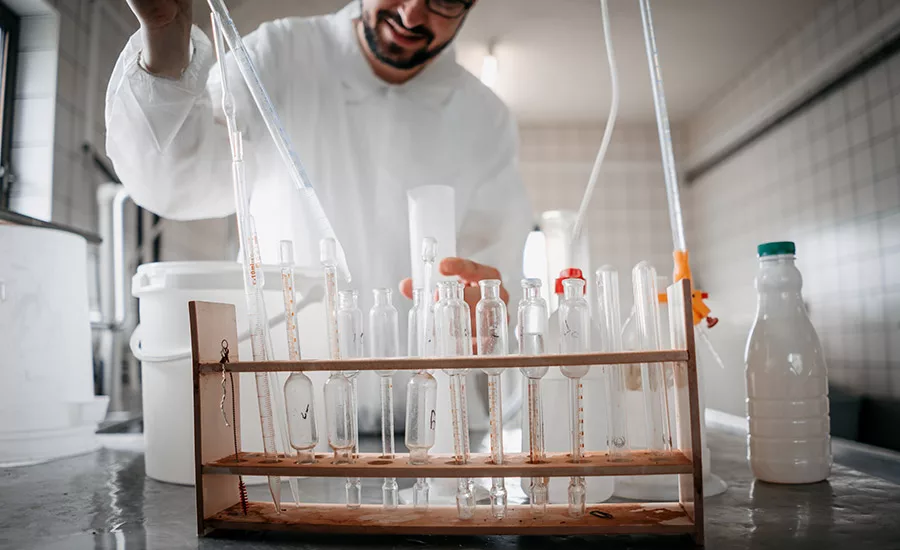
Quality assurance (QA) and quality control (QC) testing are essential parts of any dairy production process. These tests confirm any products leaving a dairy plant meet the company’s standards and food safety requirements — helping to ensure customer satisfaction and avoid any costly product recalls.
Dairy Foods spoke with Devin Darrell, international process account manager for Matthew, N.C.-based CEM Corp., and Sharad Tripathi, global market manager, dairy for Waltham, Mass.-based PerkinElmer Inc., about common mistakes and best practices in QA/QC testing processes in the dairy industry.
Dairy Foods: What are the biggest mistakes that dairy processors make in terms of QA/QC testing?
Devin Darrell: Recently we have seen a lot of dairy labs forget about the importance of accuracy in testing. As new technologies constantly come out to make tests faster, cheaper and simpler, which are all hugely beneficial to labs, lab managers must remember the original reason for each analysis and how better accuracy leads to better quality product and better profit for producers.
Sharad Tripathi: One of the most common mistakes that the dairy processors [make] is not providing adequate routine training to their staff — [especially] to the newly hired employees — and largely depending on their seasoned employees. … If any of these senior staff member[s] has developed a bad habit, that’s passed on from one to another and becomes a trend. [Other common mistakes include] allowing unrestricted access to the laboratory by nonlaboratory personnel and misunderstanding of the products’ specifications and quality standards.
... Dairy processors could enhance their QA/QC efforts by addressing some common purchase-decision mistakes. One of those mistakes is selecting an instrument based solely on price. Another common challenge at a typical QA/QC instrumentation lab is to manage all of the data produced by these instruments.
Dairy Foods: What steps could processors take to avoid these issues?
Darrell: The first step is making sure there is clear communication between the lab performing the test and the manufacturers who rely on its results. This will ensure that both groups understand the importance of the data they provide and receive, as well as better setting expectations for which technology benefits — like speed, accuracy and ease of use — should be prioritized.
Tripathi: Labs should develop a structure to offer training to its staff [on a] routine basis, [especially in] new-hire training programs, that document exactly what are the SOPs … and what they are required to learn.
Travel in and out of the lab increases the risk of environmental contamination, hence access to the lab should be restricted to authorized staff. And when lab personnel bring in samples, they should follow a strict set of protocols to eliminate the risk of tracking in contaminants.
Ensure that all members of the team understand the standards of quality and products’ specifications through a briefing and do routine inspection, as well as team rotation, to make sure the teams involved are … meticulous enough … .
When lab managers buy … equipment or an instrument, they also need someone for application and technical support. Buying the products without proper post-sales support can complicate … things. Of course, the instrument cost is one of the important parameters [that] affects the purchase decision, but many dairy processors look only at the initial cost of the instrumentation or system, failing to think about operating and integration costs, as well as ROI.
Oftentimes these laboratories work under a strict regulatory environment and [follow] guidelines like GLP/GMP, etc. And as a good manufacturing practice, these industries [want] to follow the compliance policy similar to FDA’s 21 CFR Part 11, which is an indispensable feature. Having an automated electronically controlled data management system is very essential for such labs, as they no longer have to manually archive data from all the desktops attached to analytical instruments. [An] electronically controlled data management system can work as an automated archival system for all the analytical data generated in the laboratory and ensures against theft or data loss from crashed hard disks.
Dairy Foods: What is the “ideal” QA/QC testing protocol for dairy processors? Is there a certain order of operations that you recommend?
Tripathi: State and local regulatory agencies are responsible for the enforcement of sanitation requirements on dairy farms and in processing plants. Maximum handling of products takes place during the storage and transportation stages, which may increase the chances of contamination. Hence, dairy processors conduct quality and safety tests of the procured raw milk to ensure that they are of standard quality. Safety and quality tests are also performed after the end product is ready and before final packaging to prevent early spoilage and deliver quality products to consumers.
[My] suggestion [is] that dairy processors … strictly adhere with the guidelines suggested by various regulatory bodies and quality and food safety management system[s] such as ISO 22000 or ISO 9001, with HACCP certifications from certifying bodies shortlisted by the International Accreditation Forum and other regulatory bodies.
Darrell: With the variety of dairy products being produced, there is no single protocol to follow. But each processor must be sure to follow sample preparation techniques to ensure every test is performed on a sample that is well representative of the large batch. Without proper sample storage and preparation, any result should be considered questionable and suspect.
After that, each parameter required for testing should be prioritized and considered individually. Even if using multi-component analysis technologies, higher emphasis must be applied on the parameters that are most critical to production quality and profitability. Finally, finding technologies that are capable of testing at every stage of production with efficacy allows producers to maintain more control of their product, ensuring best testing practices and true quality control.
Looking for a reprint of this article?
From high-res PDFs to custom plaques, order your copy today!