Natural colors have staying power
Keep ‘natural’ colors strong and stable in dairy


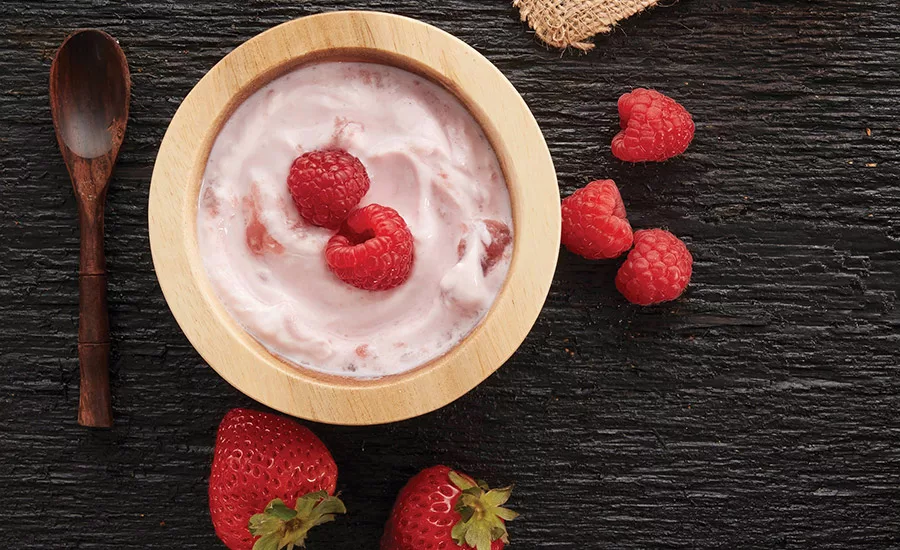

We’re almost two decades into the 21st century and knee-deep in a near mania for all things “natural.” At this point, is there any reason why a dairy developer would continue formulating with synthetic dyes?
From a consumer-perception standpoint, there sure isn’t. Ever since FDA approved spirulina extract as a blue colorant for use in most applications, the argument that synthetics alone can produce the shades consumers seek carries less weight.
So if anything’s holding back formulators from fully embracing natural color ingredients, it’s likely their reputation for instability relative to certain synthetic colorants. But is that unstable reputation deserved?
Not nearly as much as it used to be.
“There’s a widespread misconception that natural colorants are less stable than synthetics,” said Nathalie Pauleau, natural colors category director, Naturex, Avignon, France. “And while some colorants are naturally more stable than others in certain product matrices, significant progress has been made over the past few years to increase natural color stability in a greater number of applications.”
Naturally speaking
That natural colorants have won out over synthetics is easy to intuit even without cold, hard data. But cold, hard data exist, and they tell us that 78% of new products launched in North America in 2017 used colors from natural sources, according to market research firm Mintel.
Credit consumers’ health concerns surrounding synthetics — founded or otherwise — plus their general preference for “cleaner” labels for driving the shift. And credit food and beverage manufacturers for responding with naturally colored reformulations.
“Under growing pressure from consumers and health interest groups,” Pauleau pointed out, “food giants like Hershey, Nestlé and Mars have recently announced moves away from artificial colors.”
And this isn’t just a stateside phenomenon.
“Everywhere in the world, natural food colorings are no longer a future trend but today’s reality,” Pauleau noted. “The question for food companies isn’t whether it’s necessary to switch from synthetic to natural, but how worried they should be if they haven’t already made that transition.”
What’s in a name?
It’s worth stepping back for a moment to review the regulatory status of the colorants those companies are switching from, and transitioning to. For as far as FDA is concerned, “natural” colors — even if they’re extracted from “natural” fruits, vegetables, spices or, in the case of cochineal, dead bugs — aren’t, technically speaking, natural at all.
That’s because Title 21 Section 73 of the Code of Federal Regulations (CFR) defines what would be popularly considered “natural” colors as “color additives exempt from certification.” The upshot: No matter how cleanly or “naturally” they’re extracted from their animal, vegetable or mineral sources, these color additives cannot appear as “natural” colorants on labels unless they occur naturally in the product they’re coloring (for example, elderberry juice used to color an elderberry jam.)
By contrast, synthetic colors are listed in 21 CFR 74 as subject to FDA certification for use in foods, drugs and cosmetics — and identified by their familiar “FD&C” numbers. And while outside observers might find it ironic that the synthetic colorants that so excite consumers’ safety concerns are the ones that undergo FDA certification — whereas “natural” colors are exempt — that certification has less to do with the ingredients’ safety than with their adherence to the CFR’s standards.
And as for those “natural” color additives exempted from certification in 21 CFR 73, have no fear: Their safety gets thorough FDA vetting when the agency issues premarket approvals through its Color Additive Petition process.
Why stability matters
Regulatory status aside, the mere sight on labels of exempt colorants such as “beet juice color” or “purple carrot extract for color” sets consumers’ minds at ease and affirms the wholesomeness of their choices.
But for food and beverage formulators, exempt colorants don’t trigger nearly the same warm-and-fuzzy sentiment for the simple reason that such colorants have proven notoriously unstable in application.
As Megan Longhi, technical service manager, dairy and beverage for Sensient Colors LLC, St. Louis, pointed out, “Because visual appearance is the first determinant of overall liking in most instances, color stability is vital to a product’s success.”
In its absence, the color might fade, shift hue, separate from the broader product matrix, migrate to parts where it doesn’t belong, interact with other ingredients or just prove incompatible with the overall formulation environment.
And this has been a common complaint dogging natural colorants for years. Unlike dyes synthesized in labs — the chemical composition and concentration of which manufacturers can largely manipulate — colors extracted from natural sources rest somewhat outside of their extractors’ control. Pigment quality can fluctuate from harvest to harvest; non-pigment compounds can sneak past extraction to come along for the ride; and pigment concentrations can be so weak that larger quantities of colorant are needed to achieve the desired effect.
Adapting to the environment
And don’t forget the toll that the product environment and processing conditions can exact on naturally sourced colorants.
“Because each colorant has its own unique chemical composition, each responds to its environment differently,” explained Jody Renner-Nantz, applications manager, DDW Color, Louisville, Ky. “But as a group, carotenoids like paprika and beta carotene are stable to most light, pH, heat, moisture and oxygen conditions, as long as vitamin C is added as an antioxidant to prevent fading.”
In contrast, anthocyanin pigments, which generate red, pink, purple and blue hues, grow unstable and fade in vitamin C’s presence. Further, they shift from red to purple to blue as the surrounding pH moves up the scale from an acidic level of roughly 4 to a more basic level.
On the other hand, betalains — responsible for the red color of beet extracts — are stable across a wide pH range, Renner-Nantz noted, “but are susceptible to degradation when exposed to elevated temperature for extended time.”
And though turmeric extract is solidly temperature- and pH-stable (outside extreme alkaline conditions), it fades when exposed to light.
Oxygen can also destabilize some naturally sourced colorants, said Deepti Dabas, lead scientist, Kalsec, Kalamazoo, Mich. Metals, salts and other oxidizing agents pose yet more danger.
“The presence of minerals and ions is detrimental to natural pigments,” Dabas noted. “The addition of antioxidants and chelating agents helps the stability of these pigments.”
The dairy challenge
While it’s common knowledge that pro-oxidants, light, heat and pH put natural colorants at risk, “less known is the fact that homogenization or shear stress during processing can also change the color of a product simply by changing the particle size of the emulsified colorants,” said Kevin Snyder, technical services manager, food & beverage for DSM Nutritional Products Inc., Parsippany, N.J.
In dairy, where homogenization is standard operating procedure, that adds another layer of complexity to natural color reformulations — and it underscores the challenges dairy developers confront in moving toward a greater reliance on natural coloring options.
“For a number of colored dairy products, homogenization processes and intense temperatures are both typically used, which can affect the final color,” Snyder noted.
Longhi agreed, adding that flavored milks pose hurdles because ultra-high-temperature/high-temperature short-time processing conditions are necessary to create a refrigerated or shelf-stable milk with an acceptable shelf life.
“Heat- and pH-stable colors from natural sources would be necessary here,” she said.
Flavored milks also have a near-neutral pH, which precludes the use of anthocyanins to create attractive pink “strawberry” shades. (Recall that anthocyanin colorants appear purplish-blue or even gray at milk’s neutral pH.)
That said, anthocyanins’ tolerance for acidic conditions makes them “ideal candidates” for use in fruit preps for fruit-on-the-bottom yogurts and fruit-swirls in ice cream, Renner-Nantz said.
Instead of anthocyanins, Dabas suggested using pH-stable colorants extracted from paprika and beets to create pink-red shades in neutral dairy matrices such as milks and ice creams.
“The stability and performance of red beet can be improved by adding antioxidants and stabilizers,” she noted. “And paprika can also be used by adding an emulsifier for uniform dispersion, which enables a uniform appearance in the product and prevents separation in storage.”
Meanwhile, although pH- and temperature-stable turmeric oleoresin produces the perfect hue for, say, a lemon gelato, if that gelato is stored in a container with a transparent window on the lid, the patch of product exposed to light will fade. Naturally colored processed cheese may also fade under grocery store lighting, Renner-Nantz said, but processors can manage this issue, too, through protective packaging.
Getting better all the time
So, yes: “Natural” colors have their drawbacks. But in each of the above examples, some sort of work-around makes their use not only possible, but also practical.
“Through proper formulation and use, some natural colorants can have a comparable stability to FD&C certified colors,” Snyder said.
As an example, he pointed to carotenoids, which overcome their susceptibility to oxidation through accompaniment in formulation with antioxidants such as ascorbates and tocopherols. And when oil-soluble carotenoids are formulated into beadlets or spray-dried powders for water dispersibility, “this opens up the potential for using such carotenoids as beta carotene and apocarotenal as colorants for innovative flavored dairy-based beverages,” Snyder said.
Dabas also lauds carotenoids’ stability. She cited annatto, a carotenoid extracted from the seed coats of the achiote plant, as suitable for coloring cheese products. Specifically, bixin, annatto’s oil-soluble form, works well in processed cheese and some snacks, while water-soluble norbixin is a wise choice for natural cheeses.
“If the correct product isn’t added, however, pinking or color precipitation may occur,” she advised. “Product knowledge and correct application methods are critical to annatto’s successful performance in applications.”
Longhi noted that her company’s line of botanical alternatives to titanium dioxide — a natural colorant that nevertheless has its detractors — “is looking very promising for use in white cheeses, in addition to its current success in coffee creamer powders.”
And her colleague Brittany Lichius, content marketing manager at Sensient Colors, added that through its agronomy, process engineering and research and development efforts, Sensient is working to maximize pigment and optimize performance of natural colors for the creation of more stable, eye-catching results at a better long-term cost in use.
Vertical integration is helping this effort by knitting the color manufacturer more tightly into the seed-to-shelf process. For example, in February, Sensient acquired GlobeNatural, now Sensient Peru, which lets the company participate earlier in the process flow for annatto and carmine while expanding its suite of anthocyanin sources, Lichius said.
The company also recently acquired Mazza Innovation, a pioneer in clean extraction technology for botanicals.
“This technology will enable us to provide ultra-clean ingredients that don’t sacrifice performance,” Lichius said. “And at the end of the day, sensory performance is still the most important factor for consumer products, whether in terms of taste or appearance.”
Looking for a reprint of this article?
From high-res PDFs to custom plaques, order your copy today!


