Food safety
Signs, labels and tags protect dairy products in the plant
Matching the proper labeling supply to the application takes an understanding of the hundreds of chemicals used at chemical washdown sites.
By Jack Rubinger, Graphic Products Inc.
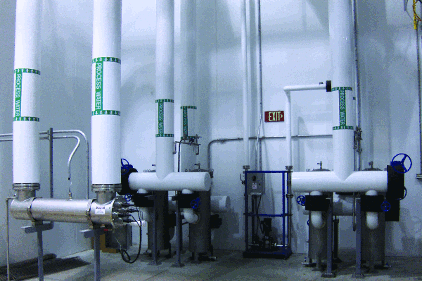 Washdown areas in the dairy industry are among the most difficult areas to maintain OSHA compliance for food handling (1910.141(h)) because bacteria can be found in almost any food handling scenario. The standard specifies that, “In all places of employment where all or part of the food service is provided, the food dispensed shall be wholesome, free from spoilage, and shall be processed, prepared, handled, and stored in such a manner as to be protected against contamination.”
The food industry -- from production to processing -- relies on chemical washdown processes to eliminate bacteria. Signs and labels communicate safe plant procedures for these requirements. Because of the harsh environment, standard signs have a tendency to bleed or simply peel right off.
The International Dairy Foods Association and the National Milk Producers Federation have introduced guidelines to ensure dairy products are protected and signs, labels and tags play an important role communicating these guidelines.
General Guidelines
1. After a milk tanker is unloaded and washed, the wash station/plant seals all potential points of access to the interior of the tank with an appropriate sealing device such as a plastic tie or wire with a pressed metal seal. Each seal should have an identification number for traceability purposes. Access points that require sealing include inlet/outlet valves, manhole cover, vent tube, CIP connections, and other points at which one could access the inside of the tank.
2. After washing the tanker and installing seals, each seal is inspected and its number is recorded. Numbers may be recorded on the wash tag, on the manifest, or on a log specifically carried by the driver.
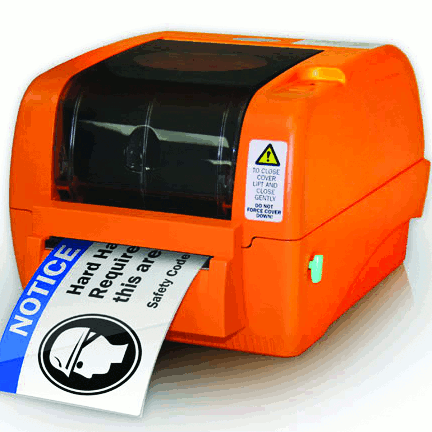
3. If wash tags are used as the seal record, they should be printed with unique identifiers such as company logo and plant ID number. Wash tags should be accounted for and kept in a secure place by receiving personnel.
 So what exactly takes place during the washdown process? While the process varies from plant to plant, here is a rough picture of the procedure.
Workers use pressure washers to spray down equipment with a variety of chemicals at about 1000 gallons per minute. As the equipment is sprayed with tremendous pressure at close-range -- typically at a distance of about 6-8 inches -- chemicals are disbursed into the air.
Exposure to these chemicals is dangerous. Signs and labels become essential tools to communicate critical info, such as how hot the solution must be, or which part or parts of the machine require which chemical. You don’t want the printed image on the sign or label to run like mascara at a wedding.
Matching the proper labeling supply to the application takes an understanding of the hundreds of chemicals used at chemical washdown sites.
Look for supplies that comply with FDA standards for indirect food contact and are resistant to strong solvents, chemicals and acetone.
Stainless Steel: A Practical Surface for Food Processing Equipment
In many cases, stainless steel containers, vessels, pumps and scales are the preferred equipment in the dairy industry.
“Stainless steels have a proven record of being inert (they leach very, very little or no metal components into the food product) and are easily cleaned and sanitized. These properties combined with the ease of fabrication make the stainless steels well suited for food processing applications. Typically other materials such as aluminum, copper alloys and coated carbon steels do not have the same resistance for food processing and cleaning environments,” said Dr. James D. Fritz, TMR Stainless.
Preparing stainless steel for labeling
Avoid using cleaners with halogen content when prepping the surface. Also, avoid using abrasive cloths as they could damage the stainless steel surface.
“When labels are used, the adhesive must be free of chlorides. When chloride-containing adhesives are used, the stainless steel surface under the label can suffer crevice corrosion which pock-marks the stainless steel,” said Fritz.
Ideal Supplies for Stainless Steel
Low-halogen tape supplies are ideal for labeling stainless steel pipes in facilities where long-lasting adhesion is critical.
Halide ions can penetrate and break down the protective layer of stainless steel, making it prone to corrosion. With low-halogen tape, the likelihood of corrosion is minimized. Intended for use on smooth surfaces, this tape has a service temperature range of -40°F to 300°F.
Testing Supplies
Every application requires supplies suited to its unique conditions. To assure supplies will perform within their expected environs, look for label suppliers who:
• Test to determine suitability for use on specific warehouse surfaces and (when appropriate) simulation of outdoor weathering, to assure the supply can withstand outdoor conditions
• Utilize ASTM G155, an industry-wide standard for weather testing which uses UV exposure (an important predictor as to how colors fade and labels age), visible light exposure, water spray and controlled heat
• Conduct chemical rub tests to give an expectation of the ink and tape’s chemical resistance
• Immerse supply in typical agents such as alcohol, acetone, Windex, mineral spirits and trisodium phosphate
• Conduct abrasion tests to verify the abrasion resistance of inks and overlaminates
Keeping chemical washdown areas safe is a major responsibility for employers and workers who risk exposure to chemicals and unsafe food. Generating awareness about chemical washdown safety is also important to share with the millions of food consumers, who may not be aware of these behind the scenes processes at the thousands of dairy processing plants around the world.
For more information, visit www.DuraLabel.com, call 800-788-5572 or email jarubinger@graphicproducts.com.
Jack Rubinger works at Graphic Products Inc., Beaverton, Ore.
Looking for a reprint of this article?
From high-res PDFs to custom plaques, order your copy today!