There is a growing mandate from health authorities to reduce consumption of sugars (i.e., mono- and di-saccharides). For example, the current Dietary Guidelines for Americans call for significant reduction in calories from “added sugars.” Excluding lactose (which could eventually be included), current frozen desserts can contribute up to 22 grams of added sugars per serving, representing approximately 80% of total calories. The numbers will surge as serving sizes are increased to reflect the amounts typically consumed by Americans.
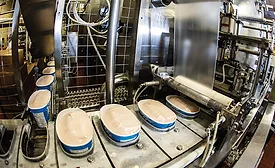
Extremely cold ‘cryobits’ accelerate temperature reduction of the packaged product. Ice crystals and air bubbles are significantly smaller with partial cryogenic hardening compared to traditional hardening methods.
The cryogenic freezing of ice cream is appealing because the very rapid temperature drop it produces generates extremely small ice crystals that promote smooth texture and extended textural shelf life. To date, technical, operational and economic factors have limited its use in conventional production to a few value-added products such as novelties and ice cream cakes/pies.
With the FDA mulling a requirement to label ‘added sugars,’ now is the time to look at various sweetening systems, and the ramifications of using them.
Stabilizers control the movement of water, the growth of ice crystals and the size of air bubbles. The right blend of stabilizers (and emulsifiers, too) can make all the difference in the end product.
It is not a simple matter when you add nuts, cookies or ribbons to ice cream mix. Pay attention to formulas, overrun, food safety, processing and economics. Proceed carefully and you’ll end up with a great product.
The principles for producing nondairy frozen desserts from vegetable “milks” are the same as for conventional ice cream. However, the challenges are uniquely different. (In this article “milk” will refer to plant-based milks.)
To formulate a quality product, you must understand the properties and attributes of cocoa and chocolate. Then you can achieve the desired flavor, body, texture and color.
Chocolate is second only to vanilla as the most popular ice cream flavor in the United States. Therefore, it is a major component of the product portfolios of most ice cream companies, representing on average of 8% to 10% of the volume of a typical portfolio.