Byrne Dairy extends its reach with ESL fluid milk products
The benefits of extended shelf life processing include opportunities in product innovation and extending the distribution area for dairy products.
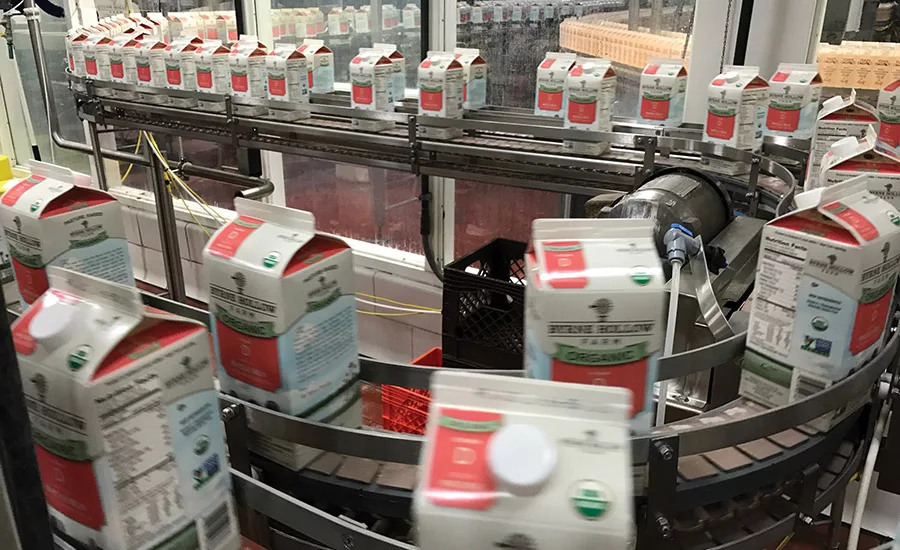
At its Ultra facility near Syracuse, N.Y., Byrne Dairy manufactures various extended shelf life milk products with code dates ranging from 70 to 180 days.
Byrne Dairy is a family-owned, 84-year-old dairy processor that has kept up with the times. The Syracuse, N.Y.-based company started in 1933 with fresh milk in glass bottles. Today at its Ultra facility, Byrne manufactures various extended shelf life milk products with code dates ranging from 70 to 180 days.
In addition to milk, Byrne Dairy makes ice cream and cultured dairy products using conventional, organic or grass-fed milk. It also produces nondairy products. In addition to its own brands (Byrne Dairy and Byrne Hollow Farms), the milk processor co-packs for customers that include dairy brands, grocers and foodservice accounts. Byrne also provides dairy ingredients for other manufacturers.
Byrne Dairy operates four plants in and around Syracuse. The original plant in Syracuse does fresh HTST (high temperature short time) processing. Ultra Dairy in nearby DeWitt manufactures ESL products. The newest plant, called Byrne Hollow Farms, opened in 2014. It makes cultured dairy products, including sour cream and Greek yogurt. The ice cream and bakery facility opened in 1978. The dairy processor also operates a chain of 57 convenience stores.
In 2004, Byrne Dairy opened the $72 million Ultra Dairy facility to manufacture ultra-pasteurized, extended shelf life dairy products. Since then, the company has expanded the plant and added new lines. The ESL products are commercially sterile products that need to be refrigerated. They carry production date codes of up to 180 days.
Benefits of ESL processing
Ultra Dairy is a sustainable high-tech, high-efficiency dairy processing facility with very low operational costs, said Nick Marsella, Byrne’s chief technology officer. The benefits of ESL processing include opportunities in product innovation and extending the dairy’s distribution. The plant is located in the lowest freight-cost lanes east of the Mississippi River, and 80% of the products are shipped outside of New York state. There are 80 million consumers living within six hours of delivery.
Building the Ultra Dairy plant required filling machines that provided sterile zones along with sterile packaging. The dairy also has to maintain clean room specifications. The fillers and ultra-high temperature (UHT) processing systems needed to be designed to sterilize at a temperature of 250 F then cool in a sterile condition. The same held true for the lines, valves and tanks.
When the Ultra Dairy plant opened in 2004, it processed ESL/UHT products with a 70-day code. In 2008, a new PET single-serve line allowed for a 180-day code.
The contributions of suppliers
Equipment suppliers were critical to the company’s success.
“We qualify our suppliers before we place any orders. We want suppliers as partners who can help us innovate and grow,” Marsella said.
Byrne required equipment that was first-in-class for design, operational safety, quality and efficiencies. Once the equipment was in place, commissioning and training were key. Developing a strong workforce is critical.
“We measure success not on the operational results while the OEMs and our engineering team are on site. We evaluate once they leave,” Marsella said. “Success is when our people are knowledgeable and skilled to maintain, run and consistently deliver high-quality products and meet safety and efficiency standards.”
The Ultra Dairy plant has 202 employees. (Company-wide there are 1,890 employees.) Byrne made the decision to have a separate ESL facility rather than to install a line in the HTST plant. The UHT and the HTST plants have separate production crews.
“The technologies and requirements are different. We felt a dedicated workforce would ensure high quality and safety for our employees and customers,” said Marsella.
Byrne Dairy invests systemwide
Over the years, Byrne has invested in production lines and storage facilities throughout its system. In 1988, it expanded and added capacity to the Oneida Street plant so it could fill plastic bottles. In 1997, there was a 32,000-square-foot expansion of a high turnover cooler. In 2011, Byrne opened a 110,000-square-foot refrigerated storage facility offering 15,000 pallets of storage and full third-party logistics (3PL) services.
Byrne continues to look for new opportunities. The R&D Team develops new products at its thermoduric pilot plant. The processing system can run small, 5-gallon batches of product to test new formulas and ingredients. The pilot plant can be configured to mirror processing technologies at the fresh-milk, ESL and culture plants.
“We are able to use the pilot plant and our R&D team to develop products requested by our customers and consumers quickly and efficiently. The formulation can then be upsized to commercial runs in our plants,” Marsella said.
What you should know before installing an ESL line
Dairy Foods turned to Merieux Nutrisciences, a food safety and quality firm, for advice about installing an extended shelf life (ESL) line and UHT (ultra-high temperature) equipment in a dairy processing plant. Gerald Witherington and Nancy H. Eggink shared these thoughts.
Employee safety
Safety is of the utmost for all employees to be aware of when around this processing equipment. “You are dealing with a system that is pasteurizing above 275 F and washing at almost 310 F,” said Witherington.
The UHT system should be off-limits to non-processing personnel because of the process piping that carries high-heat product throughout the system. Limiting access does depend upon the design of the system, Witherington noted, because some skid-mounted units are compact enough that the hazardous area is within the confines of the skid itself.
Employee training
Make a check list for items that need to be inspected and signed off on prior to production.
- Are sanitizer nozzles operational (typically these can be manually activated)? Are the nozzles spraying sanitizer in the fill area of the machine?
- Make checks of the steam sterilization procedure during the pre-startup phase.
- Operators must understand that these are sterile machines; that includes the interior environment of the machine.
- Maintain the HEPA filters on the machine to protect the internal environment.
The nature of ESL processing
Because ESL products are in commerce for a longer period of time, any contaminant organism has a longer time to grow in the product, said Eggink. These products are also in the supply chain for a longer period of time, meaning there are more opportunities for temperature abuse.
This is only an issue if there is a contaminant organism in the product. Keep in mind that many school milk products are UHT/ESL. Children are a vulnerable population. The hazard analysis should take that into account when developing a food safety plan.
Typically, dairy processing facilities use an ATP system (adenosine triphosphate) for release testing of UHT products. This includes a pre-incubation of the product for 48 hours. Thus, dairies need a larger room for the incubation period. Also, dairy labs need a large amount of counter space to manage the size and volume of finished product samples that will be tested.
Storage needs
Because UHT/ESL products have a longer shelf life, dairies need a larger storage area to keep these samples. If a facility is co-manufacturing, they may also need to keep samples from every production run and every label, Eggink said.
Do not store or retain shelf life samples in the cooler that holds general inventory. While the temperature is controlled, there are opportunities for damage and employee consumption. The samples should be stored and controlled as laboratory samples.
Working with suppliers
Witherington said dairy processors need close relationships with the machine manufacturer, the container supplier and the chemical supplier. A dairy’s maintenance department needs to be trained by the machine manufacturer in all aspects of maintenance on the machine, including:
- Normal maintenance and adjustments
- Preventative maintenance issues
- Sanitation training
- Trouble-shooting techniques regarding all aspects of the filler operation. This includes drive system, electronics (sensors, electric eyes, pressure switches, etc.) and a full understanding of the HMI (filler control panel) and its various modes of operation.
Looking for a reprint of this article?
From high-res PDFs to custom plaques, order your copy today!