Dairy Foods logo
search
cart
facebook twitter linkedin youtube
  • Sign In
  • Create Account
  • Sign Out
  • My Account
Dairy Foods logo
  • NEWS
    • DAIRY REGULATIONS
  • PRODUCTS
    • New Products
    • Butter
    • Cheese
    • Cultured Dairy
    • Frozen Desserts
    • Ice Cream/Novelties
    • Milk
    • Non-Dairy Beverages
    • Sales Data
    • Whey, Milk Powder
    • Dairy Alternatives
  • INGREDIENTS
    • Cocoa
    • Colors/Flavors
    • Cultures/Enzymes
    • Fiber
    • Gums, Stabilizers, and Texturants
    • Inclusions
    • Omegas/Lipids
    • Prebiotics
    • Probiotics
    • Sweeteners
    • Other
  • OPERATIONS
    • SUSTAINABILITY
    • Equipment
    • Processing
    • Packaging
    • Food Safety & Sanitation
    • Membrane Technology
  • MEDIA
    • Dairy Foods TV
    • Podcasts
    • Webinars
  • DIRECTORIES
    • Buyers Guide
    • Dairy Plants USA
  • MEMBRANE FORUM
  • MORE
    • Associations
    • Dairy Foods' News & Views Newsletter
    • Blogs
    • Case Studies
    • Classifieds
    • Custom Content & Marketing Services
    • Dairy Foods Store
    • Market Research
    • Supplier Spotlights
    • Tradeshows and Events
    • Strategy Guides
  • AWARDS
    • Dairy Plant of the Year Award
    • Breakthrough Award
    • Dairy Processor of the Year
  • EMAGAZINE
    • eMagazines
    • Archive Issues
    • Contact
    • Advertise
    • SIGN UP!
    • Columnists
    • Dairy 100
    • State of the Industry Report
    Dairy Foods Columnists

    How to maximize cheese shelf life
    By John A. Lucey Ph.D., Director, Center for Dairy Research
    cheese shelf life
    January 11, 2016

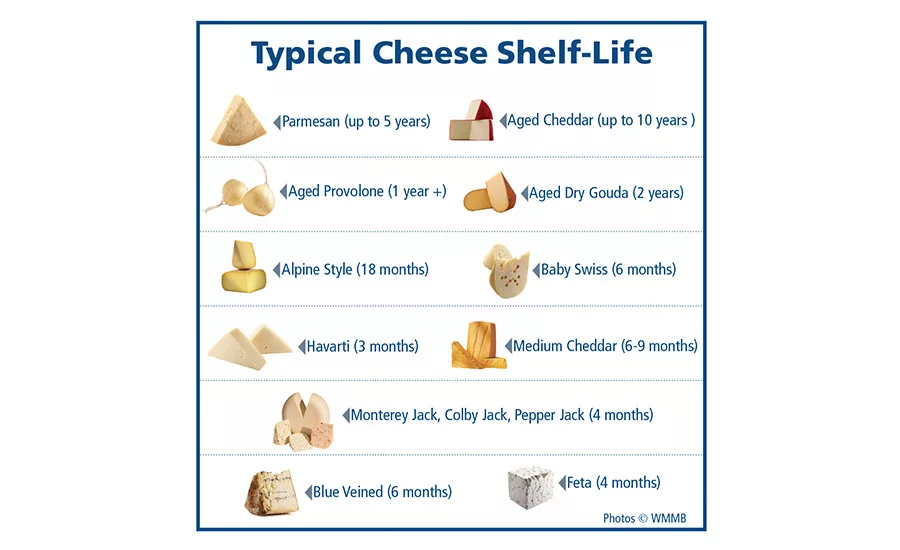
    The shelf life of cheese can vary from a few weeks to multiple years depending on its composition and how it is packaged.  In general, high moisture cheese varieties have a shelf life of only a few weeks, although processing innovations, such as hot-pack cream cheese can extend this. Low-moisture, hard cheeses (like Parmesan) have a shelf life that can range from 10 months to several years. The accompanying table outlines some other examples. So, while the type of cheese has the greatest impact on shelf life, two factors limit a cheese’s shelf life potential: development of microbial-related defects and deterioration of the expected texture/flavor.

    In order to extend the shelf life of a cheese, it’s important to first have a clear understanding of the issues that affect the product’s viability. Of course, starting with high-quality milk is paramount in manufacturing a product that retains its quality on the shelf. Outside of that, however, each concern requires a slightly different solution. By determining the area of concern, you will be better able to find a solution and extend your cheese’s shelf life.

    Avoiding mold and yeast growth

    The first area of concern for many cheese manufacturers is the growth of yeast and mold. The first step in containing this is to reduce cheese contamination by yeast and mold, which involves careful control of process equipment sanitation as well as excellent air quality in the manufacturing and packaging environment. Vacuum packaging of cheese (blocks and chunks) is commonly used to remove oxygen and inhibit the growth of yeast and mold. Modified atmosphere packaging, or gas flushing, is used for shreds or slices where oxygen is replaced with other gases including carbon dioxide, which is inhibitory to various spoilage microorganisms. Some cheeses respire during ripening so they require permeable packaging to avoid blowing.  Natamycin is also commonly used in shredded cheese as an antimicrobial agent that is effective against yeast and molds, and is also not influenced by pH. Additionally, sorbate and propionates are used as mold inhibitors in several types of cheese.

    It’s also worth noting that while many of the solutions listed above have been used regularly for many years, consumers are becoming interested in clean labels, i.e. cheese without added preservatives. For this reason, new technologies, like high-pressure processing (HPP) and pulsed-light treatment, are being explored as approaches to inactivate spoilage microorganisms in packaged cheese or to decontaminate the surface of cheese without the use of additives. There is also interest in using natural food preservatives (antimicrobials), such as essential oils from certain plants or microbial fermentates. 

    Avoiding texture, off-flavors issues 

    Deterioration of the cheese texture can also damage a cheese’s viability. This is especially true for higher-moisture cheeses like Mozzarella that can soften significantly over time. Strategies for slowing down these textural changes in cheeses include the use of less proteolytic rennets, higher curd-stretching temperatures and low storage temperatures. A third limiting factor to shelf life is the development of off-flavors during ripening. Strategies for reducing the risks of developing these unwanted off-flavors include use of high-quality milk and milk products, careful selection of ingredients (type of starter culture, adjunct and rennet) and a reduction in contamination by undesirable microorganisms.

    Finally, it’s important to discuss how shelf life can be affected by the distribution chain. Mold, yeast and microbial contaminants are not the only things that affect the texture and flavor of the cheese. Intense lighting, warm temperatures (which can cause the cheese to sweat) and compromised packaging can all lead to a decreased shelf life or inferior product. For many types of semi-hard/hard cheeses, retailers are looking for a shelf life of between five to six months, which requires a cheese to be free from any microbial contamination that might contribute to the deterioration of shelf life.

    Thanks to recent innovations, it’s becoming easier to extend shelf life and avoid the development of microbial-related defects and deterioration of the expected texture/flavor. Ongoing research is continually looking for new technologies that improve and extend shelf life, but such research needs to be supported in order to ensure that these technologies are available. Thankfully, current innovations offer a number of solutions, and such research has provided cheesemakers with a range of safe and effective methods for extending shelf life.

    KEYWORDS: cheese ingredients cheese processing

    Share This Story

    Looking for a reprint of this article?
    From high-res PDFs to custom plaques, order your copy today!

    John lucey phd

    John Lucey, Ph.D., is the Owen R. Fennema Professor in Food Chemistry at the University of Wisconsin-Madison’s Center for Dairy Research.

    Recommended Content

    JOIN TODAY
    to unlock your recommendations.

    Already have an account? Sign In

    • Lifeway Organic Kefir in different flavors inside a refrigerated grocery shelf.

      Dairy Foods names Lifeway Foods 2025 Processor of the Year

      Lifeway Foods donates $10,000 to wildfire victims,...
      Dairy Processor News
      By: Brian Berk
    • Two female farmers are standing in a field, holding a large milk canister, looking at several cows at dairy farm.

      Honoring Women Leaders Shaping the Dairy Industry

      For the fourth consecutive year, Dairy Foods is proud to...
      Innovation
      By: Barbara Harfmann
    • Main feature for State of the Industry with dairy products album cover with a gradient circular--patterned backgorund.

      2025 State of the Dairy Industry

      Welcome to the 2025 State of the Industry report. For...
      Innovation
    Manage My Account
    • eMagazine Subscription
    • Dairy Foods News & Views Newsletter
    • Online Registration
    • Manage My Preferences
    • Subscription Customer Service
    • Connect with Dairy Foods

    More Videos

    Popular Stories

    Close up of man adding Greek yogurt while preparing healthy smoothie in the kitchen.

    An expert guide to dairy and GLP-1 receptor agonists

    Close up of a whipped frozen dessert with a light green color.

    The keys to high-protein dairy formulations

    Grilling foods

    Dairy’s Enduring Moment: Why Resilience and Renewal Define Today’s Dairy Story

    Nominate your product for the 2026 Dairy Foods Product of the Year!

    Products

    Probiotic Ice Cream: Science and Technology

    Probiotic Ice Cream: Science and Technology

    See More Products

    Outlook Report: Women in Dairy

    Related Articles

    • How to estimate the shelf life of fluid milk

      See More
    • on ice cream

      Maximize the shelf life of ice cream and related products

      See More
    • Culturally Speaking: Aspects of Shelf-Life

      See More

    Related Products

    See More Products
    • GlobalData_Consumer.jpg

      Cheese (Dairy & Soy Food) Market in North America - Outlook to 2022: Market Size, Growth and Forecast Analytics

    • public role.jpg

      The Public Role In The Dairy Economy: Why And How Governments Intervene In The Milk Business

    • icecream.gif

      Tharp & Young on Ice Cream: An Encyclopedic Guide to Ice Cream Science and Technology

    See More Products

    Events

    View AllSubmit An Event
    • September 18, 2018

      Extended Shelf Life: Adding Value to Pasteurized Milk

      ON DEMAND: Non-thermal technologies and more Milk is changing. As consumer preferences shift, new technologies are giving dairy processors fresh opportunities to differentiate themselves. Dairy plants are looking at the benefits of Extended Shelf Life (ESL) milk to add value to their products and give themselves an edge in a competitive marketplace.
    View AllSubmit An Event

    Related Directories

    • Whey To Go

    • Codex-ing Biotech Ingredients

      Codex-ing Biotech Ingredients supplies dairy cultures, rennet and coagulants, enzymes, natural antimicrobials, and flavor systems for cheese, yogurt, cultured dairy, and frozen dessert manufacturing. Solutions support fermentation control, shelf-life management, flavor and texture development, and production consistency across industrial dairy applications.
    ×

    Stay ahead of the curve. Unlock a dose of cutting-edge insights.

    Receive our premium content directly to your inbox.

    SIGN-UP TODAY
    • RESOURCES
      • Advertise
      • Contact Us
      • Directories
      • Store
      • Want More
    • SIGN UP TODAY
      • Create Account
      • eMagazine
      • Newsletter
      • Customer Service
      • Manage Preferences
    • SERVICES
      • Marketing Services
      • Reprints
      • Market Research
      • List Rental
      • Survey/Respondent Access
    • STAY CONNECTED
      • LinkedIn
      • Facebook
      • YouTube
      • X (Twitter)
    • PRIVACY
      • PRIVACY POLICY
      • TERMS & CONDITIONS
      • DO NOT SELL MY INFORMATION
      • PRIVACY REQUEST
      • ACCESSIBILITY

    Copyright ©2026. All Rights Reserved BNP Media, Inc. and BNP Media II, LLC.

    Design, CMS, Hosting & Web Development :: ePublishing