Dairy Foods in the New Dietary Guidelines
The Dietary Guidelines for Americans 2005 (Dietary Guidelines) is the sixth and latest science-based dietary guidance document to be released since first published in 1980. The Dietary Guidelines provide diet and health recommendations for choosing a nutritious diet, maintaining a healthy weight, getting adequate exercise, and keeping foods safe to avoid foodborne illness. Given the recognized importance of a balanced diet for good health, growth and development, the purpose of the Dietary Guidelines is to synthesize the science about individual nutrients and food components into recommendations for an overall healthy diet that can be adopted by all Americans. This is the job of the Dietary Guidelines Advisory Committee [DGAC], an appointed group of expert nutrition scientists. The DGAC recently reviewed the most current data on diet, health, and disease relationships and produced a report that was the basis for the Dietary Guidelines 2005. Importantly, the guidelines form the basis of all nutrition recommendations for federal food, nutrition education, and information programs including the National School Lunch Program and the School Breakfast Program. Thus, unlike previous guidelines, the 2005 Dietary Guidelines are oriented toward federal and state policymakers, nutrition educators, nutritionists and healthcare providers rather than directly to the general public.
Meeting Recommended Nutrient Intakes
The DGAC report identified seven nutrients that have current intakes by Americans low enough to be of concern. The ‘nutrients of concern' are:- For adults: vitamins A, C, and E, calcium, magnesium, potassium, and fiber; and
- For children: vitamin E, calcium, magnesium, potassium, and fiber.
As a result, efforts are warranted to increase the intakes of vitamin E, potassium, and fiber regardless of age; increase intakes of vitamins A and C, calcium, and magnesium by adults; and increase intakes of calcium and magnesium by children age nine years or older, especially adolescent females.
Milk and milk products are the major sources of calcium in the U.S. diet, providing more than 70% of the calcium consumed. The calcium crisis may be attributed, at least in part, to the trend toward consuming less milk and more soft drinks. In 1945, Americans consumed more than four times as much milk than soft drinks. In contrast, in 1998, 2 1⁄3 times more soda was consumed than milk. After age eight, the intake of soft drinks increases dramatically and by age 18, adolescents drink approximately 19 oz/day, whereas milk consumption decreases to less than one serving per day.
Americans also need to increase their potassium intakes. The most recent recommended intakes for potassium established by the Institute of Medicine in 2004 are substantially higher (4,700 mg/day) than previous recommendations (3,500 mg/day), based on the recognized benefits of potassium to lower blood pressure, blunt the effects of salt, and reduce the risk of kidney stones and bone loss.
A basic premise of the Dietary Guidelines is that recommended foods and appropriate eating patterns should allow individuals to achieve the recommended levels of all nutrients established by the Institute of Medicine called the Dietary Reference Intakes. A second premise is that nutrients and optimal nourishment are best met through naturally nutrient-dense foods. Nutrient-dense foods are high in vitamins and minerals and relatively low in calories. This is important because foods contain not only the well-known vitamins and minerals, but also numerous naturally occurring compounds that may protect against chronic diseases, including heart disease, hypertension, type 2 diabetes, some cancers, and other conditions. Researchers have estimated that about 16% and 9% of all deaths in men and women, respectively, could be avoided by adhering to an eating pattern consistent with the Dietary Guidelines. Lowfat and fat-free milk and other dairy food equivalents (e.g. cheese and yogurts) are examples of nutrient-dense foods as each serving contains ‘good' to ‘excellent' sources of nine essential nutrients.
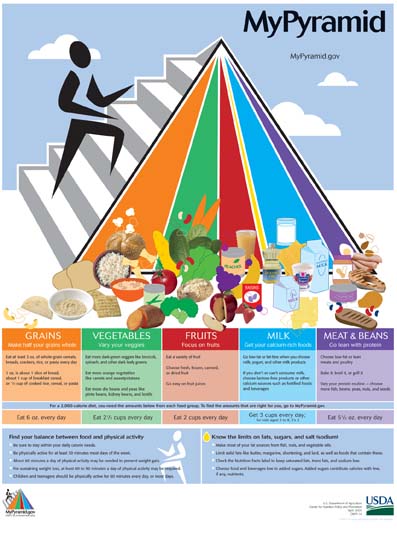
Examples of nutrient-dense eating patterns that incorporate the Dietary Guidelines recommendations are the USDA ‘My Pyramid' system and the DASH (Dietary Approaches to Stop Hypertension) Eating Plan. These are examples of healthy food-based eating patterns designed to fit most peoples' calorie needs with specified servings from nutrient-dense foods from the major food groups. The DASH diet is an established government-recommended eating pattern, consisting of three servings of lowfat dairy foods and eight to 10 servings of fruits and vegetables.
Dietary Guidelines Recommend More Dairy
The Dietary Guidelines recognize that increasing the intakes of certain food groups have long-term health benefits. To this end, the new Dietary Guidelines have endorsed the conclusion by the 2005 Dietary Guidelines Advisory Committee [DGAC] that "Consuming three servings of milk and milk products each day can reduce the risk of low bone mass and contribute important amounts of many nutrients. Furthermore, this amount of milk product consumption may have additional benefits and is not associated with increased body weight. Therefore, the intake of three cups of milk products per day is recommended."This new recommendation is based on scientific evidence showing the high value of dairy as a nutrient-dense food, as well as dairy's health benefits related to optimal growth and development and for reducing the risk of chronic diseases.
- Milk and Nutrient Adequacy - The consumption of milk and other dairy foods has been associated with overall diet quality and for satisfying the recommended intakes of many nutrients including calcium, potassium, magnesium, zinc, iron, riboflavin, vitamin A, folate, and vitamin D in children and adults.
- Milk and Bone health - The daily consumption of three cups of milk or other dairy product equivalents is important to bone health during childhood and adolescence for the development of peak bone mass. Research has shown a positive relationship between intake of milk and other milk products (e.g. yogurt and cheese) and bone mineral content and density at various skeletal sites.
- Milk and Cardiovascular Health - The DASH diet has been shown to significantly lower blood pressure and to have other health benefits. Additionally, emerging research suggests that three or more servings of milk products per day may help reduce the risk of the metabolic syndrome.
- Milk and Weight Control - The Dietary Guidelines stress that there is no reason why people should avoid milk and dairy foods because of concerns that these foods lead to weight gain. There is no evidence that three daily servings of dairy foods increase body weight. In fact, studies indicate that consuming three servings of dairy foods per day as part of a calorie-restricted diet reduces body weight and body fat better than just limiting calories alone.
Taken together, a strong body of science shows that milk products provide good nutrition for all Americans and may reduce the risk of certain chronic diseases. Dairy Management, Inc., in conjunction with dairy industry partners, are promoting 3-A-Day of Dairy, a nutrition education and marketing campaign that promotes the benefits of dairy directly to the consumer. The clear and actionable messages of this campaign are consistent with the new Dietary Guidelines that strive to motivate consumers to consume three servings of dairy foods each day.
The future for dairy foods and nutrition in the American diet holds substantial opportunities for the dairy industry and consumers. Research, sponsored by America's dairy farmers and managed by the National Dairy Council, is continuing to unlock the health attributes of dairy foods and dairy ingredients. These research programs are targeted to create health and wellness business opportunities that result in increased consumer demand for U.S. dairy products. n
To learn more about the 3-A-Day of Dairy program, visit www.3aday.org or contact Sherie Swiontek, Dairy Management Inc., 847/627-3314, sheries@rosedmi.com.
Looking for a reprint of this article?
From high-res PDFs to custom plaques, order your copy today!