Nutrition Claims on Dairy Products: What Can We Say?
Over the past 20 years, nutrition research has greatly expanded our understanding of the role that nutrients, foods, and ingredients play in health and disease. This has led to an increasing trend of health-related claims on food labels as a marketing tool to communicate diet and health information to consumers. The new Dietary Guidelines for Americans that represent the latest scientific consensus about the role that foods and diet play in a healthy lifestyle encourages the use of labeling claims. They point out, "the food label and the Nutrition Facts panel provide information that is useful for implementing the key recommendations in the Dietary Guidelines and should be integrated into educational and communication messages." This is a tremendous opportunity for dairy products in light of the new Dietary Guidelines recommendations to consume three servings of dairy foods per day.
Nutrition Claims on Product Labels: Do They Make A Difference?
A growing number of nutrition-conscious consumers indicate that they are examining nutrition labels to make food product choices. According to a 2004 Food Marketing Institute survey, more purchasing decisions are being made on the basis of health-related benefits. Forty-two percent of respondents said they had purchased foods claiming to reduce their risk of developing heart disease, and 26% said that they had purchased foods claiming to reduce the risk of cancer.This trend is also evident from a 2005 survey conducted by the International Food Information Council (IFIC), which found that consumers overwhelmingly believe food and nutrition play "a great role" in maintaining or improving overall health.
Clearly, more food manufacturers are placing their bets on health and wellness strategies for category growth, and claims on food labels are fundamental to communicating product benefits to consumers. There are several examples of product categories that have reinvented themselves based on health positioning and the use of food label claims, including whole grain cereals, nuts, and fortified orange juice and juice products. In many cases, innovative nutrition research on a product's core ingredients (e.g. oats, barley, nuts,) have led to health related claims and health positioning. In other cases, recognition of unmet nutritional needs for nutrients such as folate, calcium, vitamin D and dietary fiber have led to successful product fortification strategies that communicate their benefits through labeling claims. Dairy products hold an enviable nutrition position for labeling claims since they contain significant levels of many known essential nutrients. Examples of the successful use of claims on dairy products include the 3-A-Day of Dairy marketing and education program (www.3aday.org) that promotes the health benefits of consuming three servings of dairy products each day for "Stronger Bones" and "Healthy Weight Loss." These claims and the 3-A-Day logo have been used on over 2.5 billion dairy product packages and, in 2004, the program was recognized by more than half of mothers surveyed. Label claims present an opportunity to remind consumers of the many nutrients found in dairy foods, while educating them on the traditional and more recently discovered health benefits.
What are the Different Types of Nutrition Label Claims?
Claims that can be used on conventional food labels include: 1) health claims, 2) nutrient content claims, and 3) structure/ function claims.
-
Health Claims- Describe a relationship between a food or food substance and reducing the risk of a disease or health-related condition. Health claims must be pre-approved by the FDA before use and can be authorized in three ways (www.cfsan.fda.gov/~dms/hclaims.html):
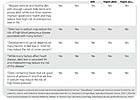
- Authorized Health Claims. These claims are based on a rigorous scientific analysis using a significant scientific agreement standard. They are sometimes referred to as unqualified health claims because qualifying statements about the state of the science are not required. Table 1 shows examples of five approved health claims that are appropriate for use on qualifying dairy products.
- Authoritative Statements. These claims are based on authoritative statements in reports by a scientific body of the U.S. Government or the National Academy of Sciences. An example claim, based on a report from the National Academy of Sciences is: "Diets containing foods that are a good source of potassium and that are low in sodium may reduce the risk of high blood pressure and stroke."
- Qualified Health Claims. These claims must be qualified based on FDA-approved language to indicate that the science supporting the claim has not yet reached significant scientific agreement.
- Dietary Guidance Statements (DGS). A DGS label claim describes the health effects of a broad category of foods (e.g. fruits, vegetables, dairy, grains) rather than a specific nutrient or substance. An example of a DGS given by the FDA includes: "Diets rich in fruits and vegetables may reduce the risk of some types of cancer and other chronic diseases."
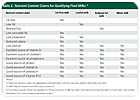
- Nutrient Content Claims (NCC)- Define how much of a specific nutrient or dietary component is in a serving of that food. These claims can only be made if the product contains an FDA-designated amount of the nutrient per standard serving size. Examples of language used for nutrient content claims include: ‘excellent source of [nutrient],' ‘good source of [nutrient],' ‘fat-free,' ‘low fat,' ‘low sodium,' and many more. Table 2 shows some examples of nutrient content claims for qualifying fluid milk products.
- Structure/Function Claims (SFC)-Describe the role of a nutrient or dietary ingredient intended to affect normal structure or function of the human body, for example, "calcium builds strong bones." SFC do not need pre-approval by the FDA, but the manufacturer is responsible for ensuring that the claim is truthful and not misleading. Dairy products contain many nutrients at "good" (> 10% of the Daily Value) or "excellent" (> 20% of the Daily Value) levels that may be amenable to the development of a SFC.
What Claims Do Consumers Prefer?
To better understand how nutrition claims on food labels effectively promote consumer awareness and how they are helpful in making purchase decisions, consumer research by IFIC was undertaken to determine how consumers perceive and differentiate between health claims, dietary guidance and structure/function claims.
In both qualitative and quantitative surveys:
- Consumers indicated that the scientific evidence for a structure/function claim was as equally compelling as an unqualified health claim. This may be related to consumer's desire for simpler language as seen in structure/function claims compared to health claims that were seen as too wordy and disease specific.
- Consumers were just as likely to purchase a product with a structure/function claim as they were to purchase a product with an unqualified health claim or dietary guidance claim.
The trend towards health and wellness in the food industry is unmistakable and the future holds great promise for unraveling additional health benefits of dairy foods and dairy ingredients through innovative national and international nutrition research programs that are supported by America's dairy farmers and industry partners.
To learn more about the 3-A-Day of Dairy program, visit www.3aday.org or contact Meredith Griffin, Dairy Management Inc., 847627-3335, meredithg@rosedmi.com.
About the authors: Peter Huth, Director, Regulatory and Research Transfer, and Gregory Miller, Senior V.P. Nutrition and Product Innovation, are with the National Dairy Council, a part of Dairy Management Inc., Rosemont, Ill.
Links
Looking for a reprint of this article?
From high-res PDFs to custom plaques, order your copy today!