Fruity and Nutty
Research suggests that consumers are seeking foods and beverages with
added value in terms of increased nutrition, so fruity and nutty dairy foods can
have "real" appeal.

Photo source: McDonald’s Corp.
Healthier food choices
The 2005 Dietary Guidelines, and subsequently issued MyPyramid food guidance system, are designed to encourage consumers to make healthier food choices. These nutritional tools convey messages such as eat more and varied types of fruit and include nuts occasionally. Foods formulated to contain fruits and nuts are an attractive option to health-conscious consumers.According to The 2005 HealthFocus Trend Report: National Study of Public Attitudes and Actions Toward Shopping and Eating, food companies may want to rethink the way they are currently marketing their products to consumers.
"Many of the trends concerning health and wellness that have evolved over the years or emerged in recent years are converging today to reshape how consumers think about their health and the healthy choices they make for themselves and for their families," says Linda Gilbert, president of HealthFocus International, St. Petersburg, Fla., and author of the report. "This is a critical time for brands and companies to consider their strategies and how they align to where shoppers are headed in their thinking and behavior toward health."
Indeed, research indicates that consumers are willing to pay for the real thing. Walnut-flavored ice cream and blueberry-like cream cheese spread does not cut it any more.
The aforementioned recently released HealthFocus report is the culmination of 16 years worth of trend data collected by Gilbert. She says, "Not only are consumers redefining what ‘being healthy' means, but they are also rethinking how they determine whether a product is healthy and how they approach changes to their diets and lifestyles."
Her work, as well as studies by other U.S. analysts indicates that consumers are aware of the healthful halo surrounding fruits and nuts. They understand that highly colorful fruits possess some great health benefits, and that variety in the diet is important. They are even willing to try exotic fruits, particularly those recognized as being high in heart-healthy ingredients and antioxidants. Consumers also get the fact that some fats can be good for you, such as the fat in nuts.
Take a look at the pomegranate. Whoever thought pomegranate juice would be the hit that it has become? Interestingly, the pomegranate is one of the earliest cultivated fruits, dating back to around 4000 BC. The challenge in the modern world has always been how to eat the pomegranate without staining everything in sight, as the fruit's juicy interior squirts a distinguishing blue-red color with every bite. Pomegranate juice alleviates this problem (unless one is a dribbler).
With an extremely high level of polyphenol antioxidants, pomegranate juice can benefit the heart, as it has been shown to prevent the formation of plaque-forming, oxidized, low-density lipoprotein in the arteries. Research further indicates that the high level of antioxidants found in pomegranate juice is effective in combating free radicals that may cause a number of afflictions, including heart disease, stroke, hypertension, premature aging, Alzheimer's disease and even cancer.
Pomegranate juice has become so trendy, it is being used as a mixer at bars and nightclubs. It is also available in concentrated bulk form as an ingredient. Recently, Lifeway Foods Inc., Morton Grove, Ill., added Lowfat Pomegranate Kefir to its cultured dairy beverage line.
Pomegranates are just the beginning. The franchised Smoothie Bar and Nutritional Lifestyle Centers chain now offers "Smoothies Around the World." The drinks are made from exotic fruits and herbs, providing the opportunity for customers to experience unique flavors native to far-off locales, including the Amazon, China, Indonesia and the Himalayas.
"With ‘Smoothies Around the World,' we're taking our knowledge of blending the perfect smoothie and incorporating exotic fruits and herbs to create a taste that goes beyond the ordinary," says Steve Kuhnau, Smoothie King founder. "In addition to the fresh taste, each of the new smoothies are all-natural and nutrient-dense."
New smoothie flavors include: Acai Adventure, Green Tea Tango, Passion Passport, Go Goji and Mangosteen Madness. Smoothie King is the first smoothie bar to offer goji and mangosteen on its menu.
What are the purported benefits of consuming these fruits?
Goji, which tastes like a mix of cherries and cranberries, is a good source of antioxidants, minerals and amino acids, and is said to help improve metabolism and increase energy levels. Mangosteen, which is described as having a hint of strawberries, kiwi, pomegranate or grape, contains a high number of xanthones. These are very powerful antioxidants that can help support and strengthen the immune system and improve digestion.
Acai, too, is not an ordinary smoothie ingredient. It is extremely high in antioxidants and an excellent source of omega-6 fatty acids, which are said to help increase stamina and improve concentration. Acai has a taste similar to a combination of berries and chocolate.
Both the Green Tea Tango and Acai Adventure smoothies incorporate a dairy component. Green Tea Tango is made with frozen vanilla yogurt, as well as a proprietary protein blend, which includes whey protein. Acai Adventure incorporates the same protein blend.
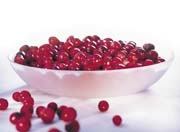
Photo source: The Cranberry Institute
Native North American wonder berry
Exotic and tropical fruits are definitely trendy, but the North American blueberry is the fruit that has been dubbed the miracle fruit of the 21st century. "Blue" berries are loaded with phytochemcials. They are grown both wild, also called wild lowbush (Vaccinium angustifolium), as well as cultivated, also known as highbush (V. corymbosum and V. ashei).What makes them a miracle fruit? Blueberries rank number-one in antioxidant activity. Of all berries, blueberries are the lowest in carbohydrates and the lowest on the glycemic scale, making them attractive to specialty formulations. They are also a good source of fiber, another nutrient that the Dietary Guidelines encourages Americans to consume more of. For example, one cup of blueberries contains about 80 calories, 21g carbohydrates and 3g fiber. That one cup also has a mere glycemic score of 59.
Because of the many healthful properties associated with blueberries, this fruit is becoming increasingly popular with dairy foods developers exploring innovative ways to incorporate blueberries into their formulations. Consumers also love the flavor and color of blueberry-containing foods.
Industry leaders speak
Dairy Foods talked with leading fruit ingredient suppliers to find out what are the innovative fruit requests coming from dairy customers. (See list of respondents above.) Here's what they had to say:Phillips: I think that some of the flavor trends of today are being driven by the desire of consumers to eat healthier foods. Therefore, the more popular fruit trends are for those that taste good and contribute a health benefit to the product. Berries, in particular, are becoming very popular additions to new products because of the health benefits that they can give to foods.
Hilburn: In addition to blueberry, tropical fruits such as guava, mango, papaya and pineapple, are very popular in both variegate and fruit prep form. There's also a lot of interest in blending fruits and nuts into chocolate, sort of like making a bark.
Jagenburg: Many customers are asking for products with probiotic qualities and fruits with low-glycemic index. Organic products continue to garner interest, as well as antioxidant-value fruits such as blueberries, caneberries, pomegranate, etc.
Maggion: A lot of what we see from the innovation side is looking at antioxidants-blueberry, pomegranate, pomegranate-blueberry, etc. In addition, we continue to work on bringing the bottled drink business together with dairy smoothie drinks. What's old is new again-everyone wants to put juice in a dairy beverage. In the frozen arena, we see more restaurant-style dessert concepts being worked on and, not surprisingly, the addition of some chilies (they are technically a fruit) creeping in, especially in variegates. Formulators also seem to be getting back to basic flavors and making them taste new again.
Payne: A number of recently introduced products combine blueberries with pomegranates. The flavors of these fruits are especially complementary and, equally important, they appeal to the interest in foods that are high in antioxidants. Herbs and spices are synergistic with blueberries, particularly aromatic and floral notes, such as lavender, for an appealing blue-on-blue effect. Chocolate and blueberries are another increasingly popular duo. Blueberries are also finding a welcome home in many Hispanic dishes, with their vibrant colors and flavors. In helados and licuados (ice creams and milk shakes), the jewel-blue berries add sparkle and zest; their color shimmers through the luscious fruit-flavored drinks called ponches. They work in rum raisin combinations and mojito variations. From another perspective, blueberry ice creams have become the dairy indulgence of choice throughout Asia, especially Korea, Japan and China. Blueberry bubble drinks are especially appealing when the tapioca balls are made from real blueberries.
Is it possible to incorporate enough fruit into a dairy product to tout on labels that the product contains a serving of fruit?
Phillips: First of all, it is important to differentiate between real fruit components and artificial color and flavors that imply real fruit to consumers who are expecting a healthy benefit from the finished product. I have sent letters and have had discussions with regulators regarding labeling laws and how consumers are being tricked into thinking that they are getting benefits from fruits that are not in the products that they are purchasing. Many products have pictures of fruit on the package and are called by the name of the fruit but contain none of the fruit.
Maggion: Adding real fruit is a great way to get consumers' attention. A fruit serving is 4-oz of whole fruit. Formulators might be able to add the equivalent of 4-oz of certain fruits through use of fruit purees, concentrates and some diced fruit.
Jagenburg: Indeed, it may be physically possible to incorporate sufficient fruit to meet dietary serving claims, but economics and package size of the ultimate consumer product could negate.
Phillips: It is probably easiest with fluid products, such as smoothies and flavored milks and shakes. There has been a lot of interest in blueberry milk. The combination of the health story of blueberries and the desire to get children and adults to drink more milk creates a great opportunity when the two are combined.
Payne: For example, 1/8th cup of dried blueberries combined with 1/4 cup frozen blueberries makes a serving of fruit. This amount could work well as an ingredient in smoothies or drinkable yogurts. It would also be appealing and practical as a swirl effect in ice creams, yogurts and parfaits.
Please describe some innovations from your company.
Jagenburg: We have created aseptic, fruit-feeder-ready products featuring whole or large-sized fruit pieces (strawberries, peaches and other delicate fruits) to provide incredible fruit show and delicate flavor (rivaling fresh frozen), with no microbiological concerns. We also offer fanciful flavor combinations for cultured dairy and frozen dessert products. Examples are Bananas Foster, Black Forest, Peach Melba, Apple Pie a la Mode, Piña Colada, Blackberry and Creme, Mango Passion, Tiramisu, etc.
Phillips: We have developed an intermediate-moisture wild blueberry for frozen items such as ice cream. These berries have an intense all-natural flavor and do not get hard in the frozen product. They remain soft and tender.
In the past five years, as a supplier to the dairy industry, what are some of the changes you have experienced regarding product development?
Hilburn: There has been a great deal of reformulation of product to meet specific health concerns in terms of allergens and nutrition, as well as more decadent-type products that still meet these specific health concerns.
Oringer: I hate to say it, but in an effort to keep prices down, dairies have become somewhat complacent in their evaluation and purchase of quality ingredients.
Payne: Indeed, quality is paramount. But discerning consumers are starting to reject imitation fruit ingredients. There's also been increasing interest in fruits with extra benefits, such as providing fiber. For examples, aging consumers are drawn to raisin-containing products and dishes because of their healthy profile-not only are they high in antioxidants, they are a good source of both soluble and insoluble fiber. The soluble fiber-inulin-is a prebiotic, as it stimulates the growth of beneficial bacteria in the gut. Raisins also contribute important minerals including iron and potassium. Besides Rum Raisin ice cream and rice pudding, raisins have typically not been a fruit associated with American dairy foods. That is changing with the increase in ethnic foods-particularly Asian, Hispanic and Indian-all of which use raisin ingredients.
If there was one bit of formulating advice you would provide your dairy customers, what would it be?
Maggion: Use more fruit! Also, be careful that development cycles coincide with availability. If a product launch is scheduled during a crop shortage or after the harvest, it can be difficult to control the quantity and quality of the product.
Payne: Make it real! Consumers respond to visually appealing food whether it is the plating in a restaurant or the packaging of a product. Increasingly, consumers are seeking out real, nutritious, wholesome ingredients.
Oringer: Pay more attention to the quality of ingredients used in your manufacturing processes. Consumers are noticing the decline in quality and sales are suffering.
Hilburn: Focus on trends and keep an open mind.
Jagenburg: If you wouldn't feed it to your children, don't try to feed it to the rest of us!

Sidebar: Get a Little Nuts
With about 75% of the calories in nuts coming from fat, these flavorful and crunchy mix-ins had been eschewed by the fat gram-counting culture of the latter end of the 20th century. The good news is that researchers have learned that people who eat nuts several times a week have a lower risk of heart disease and of dying from heart attacks. The health benefits come from the high levels of monounsaturated fats.Studies show that eating nuts even once a week can reduce one's risk of heart disease. And, emerging research suggests that nuts can help in weight control, as the protein content of nuts provides satiety.
The message going out to consumers is to eat about 1oz of nuts around five times a week. Dairy products, particularly ice cream and yogurt, can act as a carrier for consumers' daily dose of nuts.
Once considered a foreign fruit, mango has become mainstream. Mango readily complements a variety of dairy foods including ice cream, yogurt and milk.
Looking for a reprint of this article?
From high-res PDFs to custom plaques, order your copy today!