Dairy Foods logo
search
cart
facebook twitter linkedin youtube
  • Sign In
  • Create Account
  • Sign Out
  • My Account
Dairy Foods logo
  • NEWS
    • DAIRY REGULATIONS
  • PRODUCTS
    • New Products
    • Butter
    • Cheese
    • Cultured Dairy
    • Frozen Desserts
    • Ice Cream/Novelties
    • Milk
    • Non-Dairy Beverages
    • Sales Data
    • Whey, Milk Powder
    • Dairy Alternatives
  • INGREDIENTS
    • Cocoa
    • Colors/Flavors
    • Cultures/Enzymes
    • Fiber
    • Gums, Stabilizers, and Texturants
    • Inclusions
    • Omegas/Lipids
    • Prebiotics
    • Probiotics
    • Sweeteners
    • Other
  • OPERATIONS
    • SUSTAINABILITY
    • Equipment
    • Processing
    • Packaging
    • Food Safety & Sanitation
    • Membrane Technology
  • MEDIA
    • Dairy Foods TV
    • Podcasts
    • Webinars
  • DIRECTORIES
    • Buyers Guide
    • Dairy Plants USA
  • MEMBRANE FORUM
  • MORE
    • Associations
    • Dairy Foods' News & Views Newsletter
    • Blogs
    • Case Studies
    • Classifieds
    • Custom Content & Marketing Services
    • Dairy Foods Store
    • Market Research
    • Sponsor Insights
    • Supplier Spotlights
    • Tradeshows and Events
    • Strategy Guides
  • AWARDS
    • Dairy Plant of the Year Award
    • Breakthrough Award
    • Dairy Processor of the Year
  • EMAGAZINE
    • eMagazines
    • Archive Issues
    • Contact
    • Advertise
    • SIGN UP!
    • Columnists
    • Dairy 100
    • State of the Industry Report
    Ingredients for Dairy Processors

    Trans Action

    September 17, 2003
    Labeling of trans fats is just around the corner

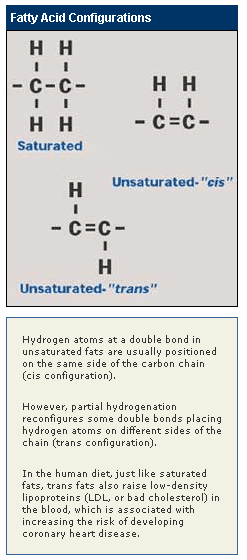
    Since Nov. 17, 1999, when FDA issued its proposed rule on labeling trans fats in foods, manufacturers have been speculating on the implications of the final rule. This past July, when the Institute of Medicine (IOM) published its Letter Report on Dietary Reference Intakes for Trans Fatty Acids, manufacturers realized that trans fat is likely even more of a health issue than once thought. The report indicates that a positive linear trend exists between human trans fat consumption and levels of total cholesterol and low-density lipoproteins, and therefore, increased risk of coronary heart disease.

    The report indicated a Tolerable Upper Intake Level for trans fats of zero. But since trans fats are unavoidable in most diets, the committee could not recommend such a Tolerable Upper Intake Level. The recommendation that the report did make is to keep dietary trans fat levels to a minimum, while maintaining adequate consumption of protein and certain micronutrients.

    Minimizing trans fat in the diet could potentially require significant lifestyle changes for a large number of people. A major source of dietary trans fats is hydrogenated vegetable shortening, which is used in manufactured baked products, snacks and fast food. In response to this information, McDonald’s Corp., Oak Brook, Ill., as well as Frito-Lay Inc., Plano, Texas, have announced that they will significantly reduce trans fat content in some products.

    Dairy products and meats contain smaller amounts of trans fats, and levels can vary seasonally. As presented in the IOM report, limited data suggests that certain trans fatty acids, which fall under the term “conjugated linoleic acid” (CLA), are naturally found in dairy products and may hinder uptake of lipids by adipocytes (fat cells), as well as possibly inhibit carcinogenesis and atherogenesis.

    FDA has reacted to the IOM report by taking an incremental approach to providing for mandatory declaration of trans fat on food labels. A document published in the Federal Register on Nov. 15, 2002, states that trans fat content will be required to appear within the Nutrition Facts panel, separately from and directly below saturated fat. This is said to become effective in early 2003.

    FDA also re-opened the comment period for 30 days after this November 15 publication, to receive comments on a footnote statement it is proposing be required on the label when trans fat is listed. An asterisk was proposed to appear in the % Daily Value column, referring consumers to an asterisk at the bottom of the Nutrition Facts panel near a footnote statement containing the following: Intake of trans fat should be as low as possible. (The proposed rule originally stated that trans fat would be included with saturated fat with an asterisk referring to a statement such as “includes X grams of trans fat.”)

    As this information is becoming available, some manufacturers are trying to get a jump on trans fat testing of their food products. Some manufacturers are even choosing to label trans fat before the ruling is finalized. FDA says that it is okay to do so in the format proposed in the document mentioned above, as long as the footnoted statement is also included. However, FDA cautions that the final ruling may differ from this proposal and manufacturers would then need to change their labels to remain in compliance with the law.

    An official method recommended by FDA for testing trans fats in food products is AOAC 996.06, which uses gas chromatography. FDA hesitates to speculate on technical questions regarding methods for analyzing CLA and whether or not CLA can somehow be differentiated from other trans fat on Nutrition Facts. And as for the final ruling, well we will all just have to wait and see.

    Share This Story

    Looking for a reprint of this article?
    From high-res PDFs to custom plaques, order your copy today!

    Recommended Content

    JOIN TODAY
    to unlock your recommendations.

    Already have an account? Sign In

    • Lifeway Organic Kefir in different flavors inside a refrigerated grocery shelf.

      Dairy Foods names Lifeway Foods 2025 Processor of the Year

      Lifeway Foods donates $10,000 to wildfire victims,...
      Innovation
      By: Brian Berk
    • Two female farmers are standing in a field, holding a large milk canister, looking at several cows at dairy farm.

      Honoring Women Leaders Shaping the Dairy Industry

      For the fourth consecutive year, Dairy Foods is proud to...
      Innovation
      By: Barbara Harfmann
    • Main feature for State of the Industry with dairy products album cover with a gradient circular--patterned backgorund.

      2025 State of the Dairy Industry

      Welcome to the 2025 State of the Industry report. For...
      Ingredients for Dairy Processors
    Manage My Account
    • eMagazine Subscription
    • Dairy Foods News & Views Newsletter
    • Online Registration
    • Manage My Preferences
    • Subscription Customer Service
    • Connect with Dairy Foods

    More Videos

    Sponsored Content

    Sponsored Content is a special paid section where industry companies provide high quality, objective, non-commercial content around topics of interest to the Dairy Foods audience. All Sponsored Content is supplied by the advertising company and any opinions expressed in this article are those of the author and not necessarily reflect the views of Dairy Foods or its parent company, BNP Media. Interested in participating in our Sponsored Content section? Contact your local rep!

       close
    • Xylem’s largest BVF reactor at a dairy farm
      Sponsored byXylem

      Preparing water systems for dairy growth in 2026

    Popular Stories

    Bel Group’s Babybel production facility in Brookings, S.D.

    Inside dairy’s $11 billion manufacturing surge

    Milk being poured from a glass container into a glass, the background is a teal color.

    How dairy processors can reduce membrane fouling and improve filtration performance

    Oberweis new protein ice cream

    Oberweis to debut High Protein Ice Cream

    Plant of the Year


    Food Safety webinar

    Events

    July 8, 2026

    Membrane Purification Enables Clean Beauty Actives

    The global cosmetics market is undergoing a major shift towards the use of natural bioactive ingredients as consumers grow more skeptical of traditional formulations and demand greater transparency and sustainability.

    View All Submit An Event

    Products

    Probiotic Ice Cream: Science and Technology

    Probiotic Ice Cream: Science and Technology

    See More Products
    health and wellness

    Related Articles

    • Trans Fatty Acids in Dairy Foods

      See More
    • From Trans Fat to Butterfat

      See More
    • Milk processors, milk drinkers take action in September, designated as Hunger Action Month

      See More

    Related Products

    See More Products
    • Handbook of Antioxidants for Food Preservation, 1st Edition

    • food book.jpg

      Validating Preventive Food Safety and Quality Controls 1st Edition

    • GlobalData_Consumer.jpg

      Category Packaging Opportunities: Dairy

    See More Products

    Related Directories

    • IFPC

      IFPC partners with dairies nationwide, delivering high-quality ingredients, Dairy House® custom systems, and expert support. Its Ingredient Technology & Applications team works with customers to optimize texture, flavor, nutrition, costs, and processing, backed by GFSI- and SQF-certified manufacturing. IFPC supports new product development, reformulation, and streamlined purchasing, and end-to-end dairy formulation expertise.
    ×

    Stay ahead of the curve. Unlock a dose of cutting-edge insights.

    Receive our premium content directly to your inbox.

    SIGN-UP TODAY
    • RESOURCES
      • Advertise
      • Contact Us
      • Directories
      • Store
      • Want More
    • SIGN UP TODAY
      • Create Account
      • eMagazine
      • Newsletter
      • Customer Service
      • Manage Preferences
    • SERVICES
      • Marketing Services
      • Reprints
      • Market Research
      • List Rental
      • Survey/Respondent Access
    • STAY CONNECTED
      • LinkedIn
      • Facebook
      • YouTube
      • X (Twitter)
    • PRIVACY
      • PRIVACY POLICY
      • TERMS & CONDITIONS
      • DO NOT SELL MY INFORMATION
      • PRIVACY REQUEST
      • ACCESSIBILITY

    Copyright ©2026. All Rights Reserved BNP Media, Inc. and BNP Media II, LLC.

    Design, CMS, Hosting & Web Development :: ePublishing