Dairy Foods logo
search
cart
facebook twitter linkedin youtube
  • Sign In
  • Create Account
  • Sign Out
  • My Account
Dairy Foods logo
  • NEWS
    • DAIRY REGULATIONS
  • PRODUCTS
    • New Products
    • Butter
    • Cheese
    • Cultured Dairy
    • Frozen Desserts
    • Ice Cream/Novelties
    • Milk
    • Non-Dairy Beverages
    • Sales Data
    • Whey, Milk Powder
    • Dairy Alternatives
  • INGREDIENTS
    • Cocoa
    • Colors/Flavors
    • Cultures/Enzymes
    • Fiber
    • Gums, Stabilizers, and Texturants
    • Inclusions
    • Omegas/Lipids
    • Prebiotics
    • Probiotics
    • Sweeteners
    • Other
  • OPERATIONS
    • SUSTAINABILITY
    • Equipment
    • Processing
    • Packaging
    • Food Safety & Sanitation
    • Membrane Technology
  • MEDIA
    • Dairy Foods TV
    • Podcasts
    • Webinars
  • DIRECTORIES
    • Buyers Guide
    • Dairy Plants USA
  • MEMBRANE FORUM
  • MORE
    • Associations
    • Dairy Foods' News & Views Newsletter
    • Blogs
    • Case Studies
    • Classifieds
    • Custom Content & Marketing Services
    • Dairy Foods Store
    • Market Research
    • Supplier Spotlights
    • Tradeshows and Events
    • Strategy Guides
  • AWARDS
    • Dairy Plant of the Year Award
    • Breakthrough Award
    • Dairy Processor of the Year
  • EMAGAZINE
    • eMagazines
    • Archive Issues
    • Contact
    • Advertise
    • SIGN UP!
    • Columnists
    • Dairy 100
    • State of the Industry Report

    New FDA Nutrition Facts Label gives dairy foods an edge over nondairy alternatives
    By James Carper
    table
    June 23, 2016

    Some people won’t eat foods originating from animals. I respect their moral or religious reasons from abstaining. Others won’t eat dairy foods because they believe the plant-based alternatives are better for them. Here, I have to probe what they mean by “better.” Do they mean fewer calories, less sugar, more “natural” or less “processed?”

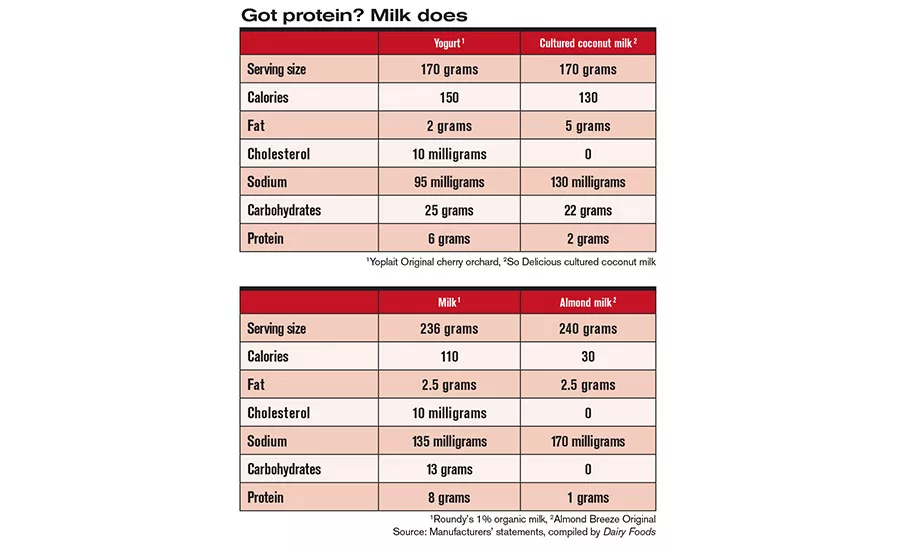
    June is National Dairy Month, so it is a great time to compare two dairy products to their analog competition. A serving of milk from a cow has more calories than “milk” from an almond tree and the same amount of fat. But the key line on the Nutrition Facts panel is protein. A glass of milk contains 8 grams of protein versus 1 gram in almond milk. If you aren’t drinking almond milk for the protein, then what’s the point? A glass of water is healthier and cheaper.

    Compare yogurt to a cultured coconut milk product. There are 6 grams of protein in the milk-based product and 2 grams in the dairy-free “Greek style” alternative. Again, what else are you going to eat (and buy) to make up the 4 grams difference in protein? A serving of yogurt delivers protein efficiently. (By the way, that coconut product had an unpleasant gray tinge to the “white mass” and the taste and mouthfeel were not to my liking.)

    It is not shocking news that the editor of a dairy publication finds that dairy foods are more nutrient-dense than plant-based alternatives. I think about these choices every day. But how about the millions of consumers who have other things to dwell on? They need education about food choices. On-pack labels are a start, but dairy processors also must undertake advertising, marketing and consumer education to promote the nutrition in dairy foods.

    The new labels mandated by the Food & Drug Administration in May will require food manufacturers to make calories more prominent and declare the amount of added sugars. Serving sizes have been updated, and actual amounts of Vitamin D, calcium, iron and potassium must be declared (currently percent Daily Value are shown). The compliance date for using the new label is July 26, 2018 (or one year later for manufacturers with less than $10 million in annual food sales).

    Those who fume about government intrusion and the nanny state need to change their perspective. Labeling is about information and leveling the playing field. The dairy industry has lost the standard of identity battle with the nondairy “milks,” but it can win the nutrition battle with information.

    The Milk Processor Education Program had a short-lived effort last year called “milk truth” in which it compared dairy milk to nondairy competitors. This year, MilkPEP made a bolder move by becoming a sponsor of the U.S. Olympic and Paralympic teams this year and through to the 2020 games in Tokyo.

    In the months leading up to the Summer Games in Rio de Janeiro, we’ll hear about elite athletes drinking milk. The images of hard-training, athletic and gold-medal winning (I hope) women and men (some of them teenagers) will promote milk’s attributes better than any nutrition panel. Milk processors have the rights to use the Olympic rings on their branded milk packages. See these examples.

    Years ago, a sports drink urged youngsters to “be like Mike” (Michael Jordan, that is). I don’t advise borrowing that tagline. Instead, make sure your children see our Olympians in action this summer.

    But the dairy industry might consider a former Coca-Cola boast: “It’s the real thing.”  Eat, drink and be dairy. It is the real thing.

    KEYWORDS: nutrition facts nutrition labeling

    Share This Story

    Jim Carper is the former editor-in-chief of Dairy Foods.

    Blog Topics

    Editor’s Thoughts

    Recent Comments

    Discount code

    Alex Shimray

    Thank you for sharing this! This is really...

    Thank you for sharing this! This is really...

    yes, nowadays more teenagers like to have a...

    Manage My Account
    • eMagazine Subscription
    • Dairy Foods News & Views Newsletter
    • Online Registration
    • Manage My Preferences
    • Subscription Customer Service
    • Connect with Dairy Foods

    More Videos

    Popular Stories

    An overhead and close-up view of a bowl of cottage cheese topped with fresh blueberries.

    Cottage cheese sales top $2 Billion

    A young Asian mother holding her son and a sippy cup, an older woman is in the blurred background.

    Finding the right infant formula is crucial to a baby’s growth and development

    A row of Frios Gourmet Pops with a tie dye pattern as a background.

    How Frios Gourmet Pops delivers happiness

    Outlook Report: Women in Dairy

    Products

    Probiotic Ice Cream: Science and Technology

    Probiotic Ice Cream: Science and Technology

    See More Products
    Let's Talk Dairy podcast promo

    ×

    Stay ahead of the curve. Unlock a dose of cutting-edge insights.

    Receive our premium content directly to your inbox.

    SIGN-UP TODAY
    • RESOURCES
      • Advertise
      • Contact Us
      • Directories
      • Store
      • Want More
    • SIGN UP TODAY
      • Create Account
      • eMagazine
      • Newsletter
      • Customer Service
      • Manage Preferences
    • SERVICES
      • Marketing Services
      • Reprints
      • Market Research
      • List Rental
      • Survey/Respondent Access
    • STAY CONNECTED
      • LinkedIn
      • Facebook
      • YouTube
      • X (Twitter)
    • PRIVACY
      • PRIVACY POLICY
      • TERMS & CONDITIONS
      • DO NOT SELL MY INFORMATION
      • PRIVACY REQUEST
      • ACCESSIBILITY

    Copyright ©2026. All Rights Reserved BNP Media, Inc. and BNP Media II, LLC.

    Design, CMS, Hosting & Web Development :: ePublishing