Dreyer's Gets Into the Groove
If officials at Dreyer's Grand Ice Cream Inc. and Nestlé SA wanted a symbol of their frozen snacks' merger, they couldn't do better than the expanded Dreyer's plant in Bakersfield, Calif.
If officials at Dreyer's Grand Ice Cream Inc. and Nestlé SA wanted a symbol of their frozen snacks' merger, they couldn't do better than the expanded Dreyer's plant in Bakersfield, Calif.
When the process of unifying the Nestlé and Dreyer's businesses began in 2003, Dreyer's management recognized the need to consolidate California operations, driving a major expansion at one of the remaining plants. "We considered several sites that initially did not include Bakersfield," recalls Doug Bame, Dreyer's capital engineering mgr. "Then we decided, ‘Let's not leave any stone unturned,' and came to look at Bakersfield."
What they found was a 250,000-sq.-ft. ice cream novelties plant on a 47-acre site in a former farming region that has morphed into southern California's fastest growing bedroom community. More importantly, the Bakersfield site had 20 open acres and the infrastructure to accommodate a tripling of plant capacity. The project team realized almost immediately they were standing on the future site of the future center of North American ice cream culture, Nestlé/Dreyer's style.
The relationship between Nestlé and Dreyer's traces back to 1994, when the Swiss food giant paid $106 million for three million newly minted Dreyer's shares and an option for two million more. The transition to Nestlé's ownership began in 2002, but in a big-fish-eats-bigger-fish twist, Nestlé consolidated its North American ice cream operations under Dreyer's management. The Oakland, Calif., Dreyer's team built an enormously successful sales and distribution system over the previous quarter-century, so why argue with success, Nestlé reasoned.
Dreyer's had not built a new plant since the late 1980s. The Bakersfield project gave Dreyer's manufacturing team its first blank canvass to implement design improvements and processing systems in a 332,000 sq ft, $100 million project. It also was an opportunity to complete the cultural transition to the Dreyer's way in Bakersfield.
"Dreyer's has a unique culture, which is reflected in the 10 grooves of (Chairman) Gary Rogers and (former President) Rick Cronk," explains Bame. "The grooves outline how you conduct yourself with others and what the company is committed to. One principle is to act if you have the majority of the information you need, because we're not afraid to try new things."
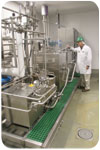
Safety is reflected in building details. Though not dramatic, they are plentiful. "The deck of installation details was 50 pages thick," remembers Bame. A no-compromise approach meant coordinating mechanical, electrical and ceiling-installation workers to avoid slotting of tiles, for example. Flush-mounted metal halide lights are sealed from the bottom to prevent dust and dirt from infiltrating the processing area. "Sanitary design details are an area where we didn't compromise," he emphasizes.
The project was still on the drawing board when Congress was debating the Food Allergen Labeling and Consumer Protection Act, heightening sensitivity to allergen cross contamination as a food safety issue. Four of the eight major allergens-milk, eggs, peanuts and tree nuts-are common ingredients in ice cream production, and adopting strict sanitation procedures and controls is critical if manufacturers are to avoid label declarations that discourage millions of consumers from buying their products. In Bakersfield, Dreyer's has taken the lead in allergen control.
Huhtamaki packaging machines form the 56-oz. cartons of Dreyer's Grand Ice Cream produced in the new 119,000-sq ft production area, feeding them down cable-guided conveyors from a mezzanine above the production floor (air conveyors were rejected because of the sanitation procedures that they often require). The potential exists for a carton of a nonallergenic product to be mixed with flats for ice cream containing, for example, eggs. To eliminate the hazard, Dreyer's engineers worked with the machine supplier to develop sensors that read a code adjacent to bar codes on each flat and kick out any incorrect cartons before they are formed.
High-shear mixers for melting product for rework featured a troublesome seal. At Dreyer's urging, the manufacturer, Breddo Likwifier, reengineered the component for flush mounting. "We've always believed in loyalty and a two-way relationship with key suppliers," says Bame. "We get good-quality equipment and help them take their equipment to a higher level."
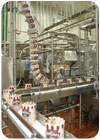 The most visible symbols of the allergen-control program are the clusters of mix-proof valves to regulate CIP cycles and product flow through a dozen pasteurized mix tanks. The tanks are grouped in fours, with 34 mix-proof valves regulating flow through each group "for ultimate protection" against any nicked valve seats and other unseen harborage points, Bame says.
Sequencing product and CIP flow patterns through those valves was the responsibility of The Dennis Group's Steve Guericke, who also designed the integrated controls network. Whereas production lines in the plant's older section draw mix from a central location, "each line is its own work center" in the new area, Guericke says. "They know when every tank was cleaned, inspected and signed off on, they know which mix tanks have the oldest inventory, and they know what is going on in all the other lines." Programming work stretched over six months and involved custom codes written in house and proprietary programming developed for Dreyer's by Carlson Engineering.
The controls architecture extends to the three 25-ft.-diameter spiral freezers. Variable frequency drives adjust residence time depending on product load. Product temperatures are reduced to 0
In ice cream production, air is an ingredient, Bame points out, and most plants rely on dedicated air-purification units for each ice cream freezer. With 15 freezers, Bakersfield's 85 maintenance workers would have faced a big challenge. Instead, air from the compressors is siphoned through a series of cartridge filters to deliver sterile air for overrun. A desiccant unit must be maintained, Landgraf allows, but the tradeoff beats the alternative.
Adequate amounts of process water can be a problem in a plant with 28 production lines. Municipal water runs through an activated carbon filtration system en route to storage in a 15,000-gal tank. UV technology subjects water leaving the tank to antimicrobial treatment. One stream carries the treated water past a heat exchanger and to a secondary hot-water holding tank. The result is an on-demand hot-and-cold water system that easily meets usage spikes of up to 200 gallons per minute.
Dreyer's-Bakersfield sits in uneasy proximity to the San Andreas Fault. Earthquake protection was part of the facility's original design, and the same considerations are reflected in the expansion. Disaster-control helped drive the installation of a flow-down refrigeration system, a design that reduces the quantity of ammonia stored on site and offers built-in safeguards against accidental ammonia release. Instead of storing liquid ammonia at 125-160 psi, Bakersfield's flow-down system stores 73,000 lbs in a slight vacuum in a massive tank capable of holding up to 103,000 lbs. The tank's -35 °F refrigerant constantly trickles ammonia downstream to higher pressure points. The refrigeration charge is one-fourth that of a conventional system, estimates Chuck Taylor, senior vice president of Jacksonville, Fla.-based The Stellar Group, which served as the refrigeration contractor.
Several lines produce the company's Slow Churned® ice cream, a product with a creamy texture despite its lower fat content. Dreyer's food scientists began work on the process, generically referred to as low temperature freezing, a decade ago, says Don Birnbaum, the company's R&D dir. "Others have approached texture from an ingredient angle; this is truly a process innovation," he says.
Whether it is shear, pressure or some other variable, the same mouthfeel change has been noted with fluid milk subjected to ultrafiltration. Adding cream as an ingredient with low temperature freezing would be overkill. "Using normal levels of milkfat would be like putting a stick of butter on a piece of toast," says Mark McLenithan, plant mgr. and head of the Dreyer's team on the expansion project. "It's too much."
The 25-ft. ceilings in the new processing area make the older building's 12-ft. clearances seem claustrophobic. The height was necessary to accommodate mezzanine levels on either side of the main floor. Carton forming is done on one side, with windows overlooking the production floor. "We think there's a lot of value in having that line of sight between operators on the mezzanine and the floor," says Bame.
 The opposite mezzanine receives cartons as they exit hardening spirals. After being case-packed or bundled and shrink-wrapped, cartons descend to a palletizing area. The temperature gradient between these two areas is approximately 40
 Dreyer's has a tradition of ice cream innovation, beginning with the development of Rocky Road in 1929. Nestlé dominates the frozen novelties segment, with many of its category-leading brands created in the Nestlé R&D Center in Marysville, Ohio. Moving forward, Bakersfield will be the center of ice cream innovation for Nestlé/Dreyer's in North America.
Fully staffed, Bakersfield will employ 1,100 operators, maintenance workers, food scientists and other professionals, McLenithan estimates. "This plant is designed to be our innovation engine for the next several decades," he says. If the R&D team designs a product, "whether it's extruded, molded, you name it, we can make it." It's simply a matter of finding the right groove.
"The grooves are how we leverage each person to make a positive difference," McLenithan explains. "It's about staying within parameters and not putting people and products at risk." In order to foster the mantra of "One Plant, One Culture," all team members will have to embrace the grooves philosophy. While Landgraf and his engineering team were erecting physical walls, McLenithan and his colleagues were building organizational bridges between those workers. "We're probably more in line with the original operating principles than the plant has been in a long time," he assures.
When Dreyer's $180 million Laurel expansion is complete, Bakersfield will be edged out as the company's largest ice cream plant. But sheer size isn't the measure of an outstanding food-production facility, and it is the sum of the food safety upgrades, infrastructure improvements and production innovations that distinguish Bakersfield as a plant that's among the cream of the ice cream crop.
This article appeared previously in Food Engineering magazine as Food Engineering's Plant of the Year 2006.
The Grooves cover more ground than continuous improvement, though that is certainly part of the underlying message. The 10 principles are:
If officials at Dreyer's Grand Ice Cream Inc. and Nestlé SA wanted a symbol of their frozen snacks' merger, they couldn't do better than the expanded Dreyer's plant in Bakersfield, Calif.
When the process of unifying the Nestlé and Dreyer's businesses began in 2003, Dreyer's management recognized the need to consolidate California operations, driving a major expansion at one of the remaining plants. "We considered several sites that initially did not include Bakersfield," recalls Doug Bame, Dreyer's capital engineering mgr. "Then we decided, ‘Let's not leave any stone unturned,' and came to look at Bakersfield."
What they found was a 250,000-sq.-ft. ice cream novelties plant on a 47-acre site in a former farming region that has morphed into southern California's fastest growing bedroom community. More importantly, the Bakersfield site had 20 open acres and the infrastructure to accommodate a tripling of plant capacity. The project team realized almost immediately they were standing on the future site of the future center of North American ice cream culture, Nestlé/Dreyer's style.
The relationship between Nestlé and Dreyer's traces back to 1994, when the Swiss food giant paid $106 million for three million newly minted Dreyer's shares and an option for two million more. The transition to Nestlé's ownership began in 2002, but in a big-fish-eats-bigger-fish twist, Nestlé consolidated its North American ice cream operations under Dreyer's management. The Oakland, Calif., Dreyer's team built an enormously successful sales and distribution system over the previous quarter-century, so why argue with success, Nestlé reasoned.
Dreyer's had not built a new plant since the late 1980s. The Bakersfield project gave Dreyer's manufacturing team its first blank canvass to implement design improvements and processing systems in a 332,000 sq ft, $100 million project. It also was an opportunity to complete the cultural transition to the Dreyer's way in Bakersfield.
"Dreyer's has a unique culture, which is reflected in the 10 grooves of (Chairman) Gary Rogers and (former President) Rick Cronk," explains Bame. "The grooves outline how you conduct yourself with others and what the company is committed to. One principle is to act if you have the majority of the information you need, because we're not afraid to try new things."
R&D Director Don Birnbaum inspects a freezer in a small-scale pilot line at Dreyer's expanded Bakersfield, Calif. plant. As development projects move closer to production, work moves to a line with throughput capacity 20 times greater.
Photo courtesy of Alexander Horvath.
Photo courtesy of Alexander Horvath.
Purity under control
A greater emphasis on food safety and advances in controls technology are the most dramatic changes in food production over the 17 years that separate the two plants under one roof in Bakersfield. As workers enter the plant, the new priorities and the operation's new operating philosophy are highlighted on an electronic message board that blinks, "Safety.....Quality....Grooves."Safety is reflected in building details. Though not dramatic, they are plentiful. "The deck of installation details was 50 pages thick," remembers Bame. A no-compromise approach meant coordinating mechanical, electrical and ceiling-installation workers to avoid slotting of tiles, for example. Flush-mounted metal halide lights are sealed from the bottom to prevent dust and dirt from infiltrating the processing area. "Sanitary design details are an area where we didn't compromise," he emphasizes.
The project was still on the drawing board when Congress was debating the Food Allergen Labeling and Consumer Protection Act, heightening sensitivity to allergen cross contamination as a food safety issue. Four of the eight major allergens-milk, eggs, peanuts and tree nuts-are common ingredients in ice cream production, and adopting strict sanitation procedures and controls is critical if manufacturers are to avoid label declarations that discourage millions of consumers from buying their products. In Bakersfield, Dreyer's has taken the lead in allergen control.
Huhtamaki packaging machines form the 56-oz. cartons of Dreyer's Grand Ice Cream produced in the new 119,000-sq ft production area, feeding them down cable-guided conveyors from a mezzanine above the production floor (air conveyors were rejected because of the sanitation procedures that they often require). The potential exists for a carton of a nonallergenic product to be mixed with flats for ice cream containing, for example, eggs. To eliminate the hazard, Dreyer's engineers worked with the machine supplier to develop sensors that read a code adjacent to bar codes on each flat and kick out any incorrect cartons before they are formed.
High-shear mixers for melting product for rework featured a troublesome seal. At Dreyer's urging, the manufacturer, Breddo Likwifier, reengineered the component for flush mounting. "We've always believed in loyalty and a two-way relationship with key suppliers," says Bame. "We get good-quality equipment and help them take their equipment to a higher level."
Formed cartons feed down a wire-guided conveyor to a filling machine in the new production area.
Photo courtesy of Alexander Horvath.
Photo courtesy of Alexander Horvath.
Sequencing product and CIP flow patterns through those valves was the responsibility of The Dennis Group's Steve Guericke, who also designed the integrated controls network. Whereas production lines in the plant's older section draw mix from a central location, "each line is its own work center" in the new area, Guericke says. "They know when every tank was cleaned, inspected and signed off on, they know which mix tanks have the oldest inventory, and they know what is going on in all the other lines." Programming work stretched over six months and involved custom codes written in house and proprietary programming developed for Dreyer's by Carlson Engineering.
The controls architecture extends to the three 25-ft.-diameter spiral freezers. Variable frequency drives adjust residence time depending on product load. Product temperatures are reduced to 0
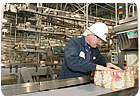
A mechanic inspects ice cream cartons as they emerge from a shrink-wrap bundling machine. From here, product descends to a palletizing area.
Photo courtesy of Alexander Horvath.
Photo courtesy of Alexander Horvath.
Utilities wish list
While the original facility was hailed for its sanitary design, the demand for food safety is magnitudes greater today. "The existing side of the plant needed better air," notes Karl Landgraf, project mgr. and a principal with The Dennis Group. His firm won the architectural design and engineering contract at Bakersfield after a rigorous A/E review process. Dennis Group also is directed a 600,000-sq ft expansion at Dreyer's Laurel, Md., facility, completed this spring.In ice cream production, air is an ingredient, Bame points out, and most plants rely on dedicated air-purification units for each ice cream freezer. With 15 freezers, Bakersfield's 85 maintenance workers would have faced a big challenge. Instead, air from the compressors is siphoned through a series of cartridge filters to deliver sterile air for overrun. A desiccant unit must be maintained, Landgraf allows, but the tradeoff beats the alternative.
Adequate amounts of process water can be a problem in a plant with 28 production lines. Municipal water runs through an activated carbon filtration system en route to storage in a 15,000-gal tank. UV technology subjects water leaving the tank to antimicrobial treatment. One stream carries the treated water past a heat exchanger and to a secondary hot-water holding tank. The result is an on-demand hot-and-cold water system that easily meets usage spikes of up to 200 gallons per minute.
Dreyer's-Bakersfield sits in uneasy proximity to the San Andreas Fault. Earthquake protection was part of the facility's original design, and the same considerations are reflected in the expansion. Disaster-control helped drive the installation of a flow-down refrigeration system, a design that reduces the quantity of ammonia stored on site and offers built-in safeguards against accidental ammonia release. Instead of storing liquid ammonia at 125-160 psi, Bakersfield's flow-down system stores 73,000 lbs in a slight vacuum in a massive tank capable of holding up to 103,000 lbs. The tank's -35 °F refrigerant constantly trickles ammonia downstream to higher pressure points. The refrigeration charge is one-fourth that of a conventional system, estimates Chuck Taylor, senior vice president of Jacksonville, Fla.-based The Stellar Group, which served as the refrigeration contractor.
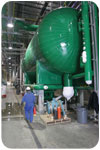
A 103,000-lb capacity anhydrous ammonia storage tank stores liquid ammonia in Bakersfield's flow-down refrigeration system.
Photo courtesy of Alexander Horvath.
Photo courtesy of Alexander Horvath.
Cutting edge processes
In adding a second processing room, engineers extended a service corridor in the existing plant an additional 300 feet, modifying tilt-up panels installed in 1988 to create a unified processing area. While ice cream novelties are manufactured in the older section, 56-oz. cartons are the focus in the new area. Designed for five high-volume carton lines, the room also hosts a line producing Dreyer's popular Dibs® novelties, and a seventh production line soon will be installed. Throughput is projected to be 90 million gals a year.Several lines produce the company's Slow Churned® ice cream, a product with a creamy texture despite its lower fat content. Dreyer's food scientists began work on the process, generically referred to as low temperature freezing, a decade ago, says Don Birnbaum, the company's R&D dir. "Others have approached texture from an ingredient angle; this is truly a process innovation," he says.
Whether it is shear, pressure or some other variable, the same mouthfeel change has been noted with fluid milk subjected to ultrafiltration. Adding cream as an ingredient with low temperature freezing would be overkill. "Using normal levels of milkfat would be like putting a stick of butter on a piece of toast," says Mark McLenithan, plant mgr. and head of the Dreyer's team on the expansion project. "It's too much."
The 25-ft. ceilings in the new processing area make the older building's 12-ft. clearances seem claustrophobic. The height was necessary to accommodate mezzanine levels on either side of the main floor. Carton forming is done on one side, with windows overlooking the production floor. "We think there's a lot of value in having that line of sight between operators on the mezzanine and the floor," says Bame.
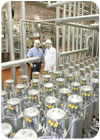
A sea of control tops on mix-proof valves attests to the serious approach to fail-safe programming to ensure allergens are removed in CIP cycles between production runs in Bakersfield.
Photo courtesy of Alexander Horvath.
Photo courtesy of Alexander Horvath.
Dreyer's employee Jim Lontz inspects an ice cream carton on a kickoff table.
Photo courtesy of Alexander Horvath.
Photo courtesy of Alexander Horvath.
Fully staffed, Bakersfield will employ 1,100 operators, maintenance workers, food scientists and other professionals, McLenithan estimates. "This plant is designed to be our innovation engine for the next several decades," he says. If the R&D team designs a product, "whether it's extruded, molded, you name it, we can make it." It's simply a matter of finding the right groove.
"The grooves are how we leverage each person to make a positive difference," McLenithan explains. "It's about staying within parameters and not putting people and products at risk." In order to foster the mantra of "One Plant, One Culture," all team members will have to embrace the grooves philosophy. While Landgraf and his engineering team were erecting physical walls, McLenithan and his colleagues were building organizational bridges between those workers. "We're probably more in line with the original operating principles than the plant has been in a long time," he assures.
When Dreyer's $180 million Laurel expansion is complete, Bakersfield will be edged out as the company's largest ice cream plant. But sheer size isn't the measure of an outstanding food-production facility, and it is the sum of the food safety upgrades, infrastructure improvements and production innovations that distinguish Bakersfield as a plant that's among the cream of the ice cream crop.
This article appeared previously in Food Engineering magazine as Food Engineering's Plant of the Year 2006.
Side bar: New Age industrial engineering
Self-directed work teams are an industrial engineering concept to achieve continuous improvement, and dozens of present day workers at Dreyer's Bakersfield plant were indoctrinated in the work-team concept when the plant opened in 1988 as a Carnation facility. Those same workers now are being indoctrinated in the Grooves, 10 organizational principles of the Dreyer's corporate culture.The Grooves cover more ground than continuous improvement, though that is certainly part of the underlying message. The 10 principles are:
- Respect for the individual
- Management is people
- Hire smart
- Ownership
- Learn, learn, learn
- Upside down organization
- People involvement
- Ready, fire, aim
- Hoopla
- Face-to-face communication
Looking for a reprint of this article?
From high-res PDFs to custom plaques, order your copy today!