Dairy Foods logo
search
cart
facebook twitter linkedin youtube
  • Sign In
  • Create Account
  • Sign Out
  • My Account
Dairy Foods logo
  • NEWS
    • DAIRY REGULATIONS
  • PRODUCTS
    • New Products
    • Butter
    • Cheese
    • Cultured Dairy
    • Frozen Desserts
    • Ice Cream/Novelties
    • Milk
    • Non-Dairy Beverages
    • Sales Data
    • Whey, Milk Powder
    • Dairy Alternatives
  • INGREDIENTS
    • Cocoa
    • Colors/Flavors
    • Cultures/Enzymes
    • Fiber
    • Gums, Stabilizers, and Texturants
    • Inclusions
    • Omegas/Lipids
    • Prebiotics
    • Probiotics
    • Sweeteners
    • Other
  • OPERATIONS
    • SUSTAINABILITY
    • Equipment
    • Processing
    • Packaging
    • Food Safety & Sanitation
    • Membrane Technology
  • MEDIA
    • Dairy Foods TV
    • Podcasts
    • Webinars
  • DIRECTORIES
    • Buyers Guide
    • Dairy Plants USA
  • MEMBRANE FORUM
  • MORE
    • Associations
    • Dairy Foods' News & Views Newsletter
    • Blogs
    • Case Studies
    • Classifieds
    • Custom Content & Marketing Services
    • Dairy Foods Store
    • Market Research
    • Supplier Spotlights
    • Tradeshows and Events
    • Strategy Guides
  • AWARDS
    • Dairy Plant of the Year Award
    • Breakthrough Award
    • Dairy Processor of the Year
  • EMAGAZINE
    • eMagazines
    • Archive Issues
    • Contact
    • Advertise
    • SIGN UP!
    • Columnists
    • Dairy 100
    • State of the Industry Report
    Operations

    Have You Tried a Peristaltic Pump for that Tough Application?

    August 31, 2004
    If you haven't tried one yet...maybe it is time. These unique pumps have been building a reputation throughout industry as the "pump for tough applications."

    If you haven't tried one yet...maybe it is time. These unique pumps have been building a reputation throughout industry as the "pump for tough applications." Peristaltic pumps (commonly referred to as hose pumps or tube pumps) have solved pumping problems for decades in industries ranging from food processing to mining. Many features of peristaltic pumps are truly unique in comparison with other pumping technologies. The pump has no valves, seals or glands, and the fluid only comes in contact with the inside of a hose or tube. Because they are simple to install, easy to operate and quick to maintain, they are the world's fastest-growing pump type. Peristaltic pumps combine precise positive displacement and low maintenance requirements with the ability to handle abrasive and aggressive fluids, which wear out many other pump types. This unique combination of features often proves to be a cost-effective alternative for difficult pumping applications.

    The basic principle of a peristaltic pump is a mechanical application of "peristalsis," a physiological term referring to the alternating contraction and relaxation of muscles around a tube (throat or intestines for example) to force the tube's contents through it. Understandably, the application of this basic peristaltic principle as a method of mechanical fluid transfer was developed in medical and biotechnology applications. A smooth wall flexible tube or hose is squeezed along its length, positively displacing the fluid contained within the tube. The tube's restitution after the squeeze creates a vacuum, which draws more fluid into the tube, creating a gentle pumping action with minimal damage to the media inside the tube, particularly when compared to other methods of mechanical transfer. Also, because the fluid is contained completely within the tube, the opportunity for contamination of the fluid is also minimal.

    Historically, the fundamental challenge in applying peristaltic technology to industrial applications was the development of a hose element, which could accommodate the high pressures and flow rates demanded by many industries, along with the capacity to handle highly viscous, abrasive and chemically aggressive fluids. The latest hose design is triple-layered with an extruded inner layer surrounded by a reinforcement cord matrix, and a durable, machined outer layer. The largest peristaltic pump manufacturer, Watson-Marlow Bredel, designed the first high pressure hose pump in 1973 and recently invested more than $2 million in a new hose manufacturing facility. This hose element is the "heart" of the pump. It dictates the suction lift capabilities, discharge pressure capabilities, metering accuracy and repeatability, as well as life of the pump. With new hose materials, new construction and manufacturing technology, today's industrial hose pumps are capable of over 350gpm, 230psi and metering accuracy to +/- 1%.
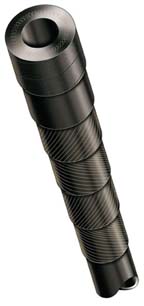
    Hose pumps have been successful in replacing traditional pump types in corrosive, viscous and abrasive handling applications. A traditional pump typically operates with the rotor and stator in the product zone. Abrasive particles in the product quickly open up critical tolerances between the rotor and stator, causing a drop-off in pumping efficiency and eventual failure. Traditional positive displacement pumps require tight tolerances in order to function.

    A hose pump rotor is located out of the pumped-product zone, and never touches the pumped media. A properly selected heavy-duty pump hose does not fail due to abrasive wear; it fails from fatigue, and number of compressions. Regardless of product, whether it is abrasive lime slurry or nonabrasive polymer, the hose life is the same.

    Many process streams, controlled by a combination of pumps and flowmeters, can in fact be served just as well with a well-designed hose pump and tachometer, a considerable savings in equipment costs. High concentrations of caustic materials or particulate matter can attack the wetted parts of the flowmeter and affect the reliability of the measurement. Viscous media can coat flow sensors, affecting their measurement, and many slurries have also proven difficult to measure with a flowmeter. Utilizing a hose pump, the chemically compatible hose material can be checked and selected prior to installation, and fluid characteristics or process pressure will not affect the metering accuracy of the pump. Another nice feature of the peristaltic design, when integrated into more complex systems, is that the pump can act as its own check valve. Some portion of the hose or tube is always occluded, so when the pump stops, that point stays squeezed shut. This feature removes the need for an additional valve to prevent over-dosing or backflow.

    Share This Story

    Looking for a reprint of this article?
    From high-res PDFs to custom plaques, order your copy today!

    Recommended Content

    JOIN TODAY
    to unlock your recommendations.

    Already have an account? Sign In

    • Lifeway Organic Kefir in different flavors inside a refrigerated grocery shelf.

      Dairy Foods names Lifeway Foods 2025 Processor of the Year

      Lifeway Foods donates $10,000 to wildfire victims,...
      Innovation
      By: Brian Berk
    • Two female farmers are standing in a field, holding a large milk canister, looking at several cows at dairy farm.

      Honoring Women Leaders Shaping the Dairy Industry

      For the fourth consecutive year, Dairy Foods is proud to...
      Innovation
      By: Barbara Harfmann
    • Main feature for State of the Industry with dairy products album cover with a gradient circular--patterned backgorund.

      2025 State of the Dairy Industry

      Welcome to the 2025 State of the Industry report. For...
      Dairy Foods & Beverages
    Manage My Account
    • eMagazine Subscription
    • Dairy Foods News & Views Newsletter
    • Online Registration
    • Manage My Preferences
    • Subscription Customer Service
    • Connect with Dairy Foods

    More Videos

    Popular Stories

    Close up of a whipped frozen dessert with a light green color.

    The keys to high-protein dairy formulations

    A row of Frios Gourmet Pops with a tie dye pattern as a background.

    How Frios Gourmet Pops delivers happiness

    Grilling foods

    Dairy’s Enduring Moment: Why Resilience and Renewal Define Today’s Dairy Story

    Outlook Report: Women in Dairy

    Products

    Probiotic Ice Cream: Science and Technology

    Probiotic Ice Cream: Science and Technology

    See More Products
    Let's Talk Dairy podcast promo

    Related Articles

    • Kai Lightner

      MilkPEP debuts ‘You’re Gonna Need Milk for That’ campaign

      See More
    • pickleball

      State of the Dairy Industry: Demand for functional ingredients that bolster health trending upwards

      See More
    • 4 award-winning flexible packages for dairy products that solve problems

      See More

    Related Products

    See More Products
    • Dairy Microbiology: A Practical Approach

    • Handbook of Antioxidants for Food Preservation, 1st Edition

    • df emerging.jpg

      Emerging Dairy Processing Technologies: Opportunities for the Dairy Industry

    See More Products
    ×

    Stay ahead of the curve. Unlock a dose of cutting-edge insights.

    Receive our premium content directly to your inbox.

    SIGN-UP TODAY
    • RESOURCES
      • Advertise
      • Contact Us
      • Directories
      • Store
      • Want More
    • SIGN UP TODAY
      • Create Account
      • eMagazine
      • Newsletter
      • Customer Service
      • Manage Preferences
    • SERVICES
      • Marketing Services
      • Reprints
      • Market Research
      • List Rental
      • Survey/Respondent Access
    • STAY CONNECTED
      • LinkedIn
      • Facebook
      • YouTube
      • X (Twitter)
    • PRIVACY
      • PRIVACY POLICY
      • TERMS & CONDITIONS
      • DO NOT SELL MY INFORMATION
      • PRIVACY REQUEST
      • ACCESSIBILITY

    Copyright ©2026. All Rights Reserved BNP Media, Inc. and BNP Media II, LLC.

    Design, CMS, Hosting & Web Development :: ePublishing