Formulating Without Sugar
The two most common sugar-replacing, high-intensity sweeteners used in dairy foods are aspartame and sucralose.

Leading sugar substitutes
Since its debut in 1981, aspartame has been providing product developers with a low-calorie, no-carbohydrate sugar alternative for sweetening all types of Dairy Foods.Aspartame is composed of two amino acids—aspartic acid and phenylalanine (as the methyl ester). It is quickly and completely metabolized in the body, just like any other protein. Upon digestion, aspartame breaks down into its original components (aspartic acid, phenylalanine and methanol). The body then uses these components in the same way as those found in foods that are eaten everyday.
Since aspartame is made of protein components, it does have the same four calories per gram that are found in protein; however, because aspartame is 200 times sweeter than sugar, only a small amount is needed to sweeten products. Therefore, it contributes negligible calories to a product formulation.
Sucralose is actually made from sugar through a patented, multi-step process that selectively replaces three hydrogen-oxygen groups on the sugar molecule with three chlorine atoms. The result is an exceptionally stable sweetener that tastes like sugar and has about 600 times the sweetness, but without sugar’s calories. After consumption, sucralose passes through the body without being broken down.
Sucralose has application in many dairy products, and in the past two years has started showing up in refrigerated and frozen yogurt, flavored milk and ice cream. It can be used in all thermal processes, including HTST, UHT and retort pasteurization conditions.
When used in the manufacture of fruit preparations for yogurt, sucralose allows for the optimal yield of sweetness retention and shelflife expectancy. Since the sweetness is retained during processing, a surplus of sweetener is not required, as with some other high-intensity sweeteners that are less stable to thermal processing. This provides a significant economic advantage, as well as ensures uniform product sweetness consistency and delivery.
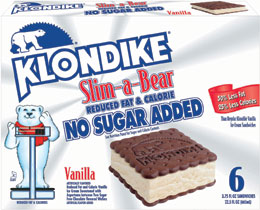
In fact, yogurt manufacturers such as LeMars, Iowa-based Wells’ Dairy Inc., say that sucralose actually enhances the taste of the fruit. Wells’ Dairy uses sucralose in its Lite 85 refrigerated yogurt, as well as in a variety of fat-free and reduced-fat no-sugar-added ice cream products and Sweet Freedom™ and Health Smart® fat-free frozen novelties.
Pierre’s French Ice Cream Co., Cleveland, recently rolled out no-sugar-added sucralose-sweetened Slender™ reduced-fat ice cream in eight flavors, including the basic chocolate, vanilla and strawberry, as well as more decadent combinations such as Caramel Pecan, which uses a no-sugar-added caramel swirl and Moose Tracks®, which includes sugar-free peanut butter cups and no-sugar-added Moose Tracks fudge.

Frozen dessert formulation tips
Dairy Foods columnists and ice cream formulating experts Bruce Tharp and Steve Young, presenters of the Tharp & Young On Ice Cream technical short course series (www.onicecream.com) have this to say about sugar replacement options for no-sugar-added ice cream:The composition of no-sugar-added ice cream must take into account the regulatory requirement that the amount of simple “sugars” from all added ingredients cannot exceed 0.5g per serving. It’s also necessary to consider elements of functionality other than the simple loss of sweetness due to conventional sweeteners being removed. This includes bulking effect, water immobilization (essential to maintaining shelflife) and freezing point management. A broad range of ingredients is available to provide these functionalities. The proper ingredient combination must take into account the complex interactions between ingredients, the targeted product properties (including sensory attributes) and cost.
Each ingredient and combination has its own set of useful properties. The goal is to find the right combination that delivers the targeted <0.5g added sugar per serving, the desired sweetness, proper water management (solids and bulk), desired freezing point management, flavor performance and cost.
When it comes to sweetness strength, most ice creams will try to achieve the equivalence of 13-17% sucrose. Chocolate ice creams normally require higher sweetness levels to offset the harshness of the cocoas used. Fruit flavors may require more or less sweetness to more appropriately deliver flavor quality.
High-intensity sweeteners such as aspartame and sucralose can typically provide most or all of the desired sweetness. However, there are limits with these sweeteners based on flavor contribution, cost and consumer perception. A combination of sweeteners can minimize flavor impact, reduce cost, improve sweetener stability and enhance perceived sweetness. Some bulking agents may effectively minimize the flavor contribution of high-intensity sweeteners as well. As high-intensity sweeteners provide no significant added solids to the mix, the selection of the proper bulking agent(s) to provide both water management and freezing point depression is daunting and complex.
Ingredients used can be self-limiting. For example, increasing the level of milk-solids-nonfat is restricted due to its potential impact on sandiness. Other limitations include the addition of simple sugars (after all, this is to be a no-sugar-added product), the contribution of undesirable flavors, the reaction of consumers to the addition of certain ingredients (is the ingredient “consumer friendly?”), any laxative effects (from ingredients such as polyols, hydrogenated starch hydrolysates, glycerin, etc.), regulatory limits and over stabilization. Again, blends can be used to balance desired sensory attributes, process stability, shelflife stability and cost.
Finally, the use of freezing profile analysis to determine the amount of water frozen at various temperatures can effectively assist in the selection and use of mix ingredients for no-sugar-added products. As always, care is necessary to insure success.

The role of polyols in frozen applications
Chemically, polyols are considered polyhydric alcohols or sugar alcohols because part of their structure resembles sugar and part resembles alcohol. Polyols are derived from sugars, but they are not processed by the body like sugars, which is why they can be used in no-sugar-added dairy applications.Their most common application is no-sugar-added frozen dessert, as they provide the solids, or bulk that such formulations are missing when the sugar is taken out. In frozen desserts, polyols also act as a crystal modifier, flavoring agent/ sweetener, a freezing point depressant, and texture/palatability enhancer. Unlike high-intensity sweeteners that are used in very small amounts, polyols are used in the same quantity as sucrose. The most common polyols used in frozen dessert applications are sorbitol and maltitiol.
Looking for a reprint of this article?
From high-res PDFs to custom plaques, order your copy today!