Quality on the Line: Identifying Spoilage Bacteria and Potential Shelf-Life Problems
The dairy industry loses millions of dollars every year from product deterioration caused by spoilage bacteria. Spoilage bacteria result in shorter shelf life and decreased quality for milk products. By identifying the specific types and numbers of microbes involved, we can improve shelf life and quality by reducing bacterial contamination.

 HR-1 Stress Test™-This test is designed to "red flag" products that have potential coliform and other Gram-negative contamination. It is done by stressing the product in a media containing selective bacterial inhibitors at a temperature (32°C) that favors the growth of coliform type (Gram-negative) bacteria. Using this test, products contaminated with coliform type bacteria can be identified in 18-22 hours by a change in color from purple to pink or white (Figure 1). A positive HR-1 test indicates a serious sanitation problem and virtually no chance for acceptable keeping quality.
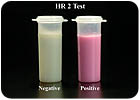 HR-2 Shelf-Life Test™-This is a qualitative test used to predict shelf life based on the level of post-pasteurization contamination. As with the HR-1 test, the HR-2 involves stressing the product in a media containing selective microbial inhibitors at temperatures (70-72°F) that favor the growth of spoilage bacteria. A change in color from white to pink indicates the presence of psychrotrophic bacteria and the likelihood of shelf-life problems. However, interpretation of the test results also depends on the time it takes for the color change to occur (Figure 2). A color change in less than 24 hours indicates a potentially serious shelf-life problem while no color change in 48 hours represents the potential for excellent shelf-life (14 days or better at 45°F).
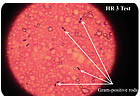 HR-3 Screening Test™-Unlike the HR-1 and HR-2 tests, which specifically indicate Gram-negative contamination, the HR-3 test is designed for screening raw and pasteurized milks for the presence of Gram-positive, spore-forming rods. As code life of fluid products has increased to beyond 14 days, these bacteria have become very important in determining quality. Not only do they survive pasteurization, but they may grow at sub-pasteurization temperatures of 130 to 145
Join Dr. Randolph and Associates in Birmingham, Ala. for an in-depth Dairy Technology Workshop May 1-4, 2006. For registration information, contact Kristy Clark: 205/595-6455 or e-mail kmclark@randolphconsulting.com.
Henry Randolph
205/595-6455
HERConsult@aol.com
205/595-6455
HERConsult@aol.com
The dairy industry loses millions of dollars every year from product deterioration caused by spoilage bacteria. Spoilage bacteria result in shorter shelf life and decreased quality for milk products. By identifying the specific types and numbers of microbes involved, we can improve shelf life and quality by reducing bacterial contamination. While various tests have been developed to "estimate and identify" spoilage bacteria, a series of dye reduction procedures has proved to be particularly useful. A brief explanation of each test follows:
Negative results for both tests (HR-1 and HR-2) indicate effective sanitation practices on the pasteurized side and the potential for excellent keeping quality. However, if actual keeping quality (45°F for 14 days) is not consistent with the negative test results, spoilage is likely related to the presence of heat-resistant, spore-forming bacteria.
Join Dr. Randolph and Associates in Birmingham, Ala. for an in-depth Dairy Technology Workshop May 1-4, 2006. For registration information, contact Kristy Clark: 205/595-6455 or e-mail kmclark@randolphconsulting.com.
Links
Looking for a reprint of this article?
From high-res PDFs to custom plaques, order your copy today!