Material Handling: Beyond Palletizers
Editors Note: This is an excerpt from a lengthier article on robotics appearing in this month's issue of our sister publication Food Engineering.
For thousands of years, the ability to work independently and perform repetitious tasks was the exclusive province of human beings, from construction of the pyramids to the Industrial Revolution. By the late 20th century, robotic machines started performing monotonous duties, though high costs and a lack of flexibility minimized their application in food and beverage manufacturing.
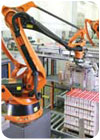
Fortunately, the situation is changing, led by articulated-arm robots for case packing, palletizing, depalletizing and other material-handling applications. The shift is due in part to a manufacturing environment where menial jobs are hard to fill and lean manufacturing encourages the use of machines for non-value added jobs. Another factor is the maturation of robotics technology and advances in complementary technologies. According to a recent survey by the Packaging Machinery Manufacturers Institute, 35% of manufacturers plan to purchase robots this year, with palletizing robots the most likely application.
In the past year, dairy equipment suppliers have begun incorporating robotics into their offerings. Delkor Systems Inc., Circle Pines, Minn., now offers robotics as part of some of its end-of-the-line packaging solutions. And just last fall, Norse Dairy Systems, Inc., Columbus, Ohio (see related story p. 74) introduced an ice cream sandwich system that utilizes new robotic technology for loading wafers into the filling equipment and finished sandwiches into cartons.
I can see clearly now
Robotic vision remains a solution of last resort for most integrators. "We use vision with flex pickers, but our first choice is to do projects without vision," says Thomas Doyle, pres. of Qcomp Technologies Inc., Greenville, Wis. "It's simpler and less expensive.""Vision systems add a level of complexity, there's no doubt about it," agrees Tim Schiller, key technology mgr.-robogistics at Clinton Township, Mich.-based Kuka Robotics Corp. "But vision adds a lot of power and flexibility, and unless you're getting involved in meat cutting, vision systems work well. And calibrating a camera for a robot is getting easier and easier."
Digital cameras compute pixels, while a robot relates to the world in millimeters. Translating those dimensions required significant engineering in years past; now plug-and-play solutions are surfacing. Additionally, some cameras can be cabled directly to a robot, eliminating the need for a separate processor for the camera. And today's processing power is magnitudes greater. "In the old days, you ran out of (computing) room if the robot had to process more than 500 kilobytes," says Schiller.
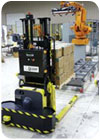
"Machine vision using stills and surveillance technology using moving images are coming together to allow manufacturers to track items coming down a (conveyor) line," says Dave Holland, a production mgr. at Fonterra Cooperative Group Ltd., a New Zealand dairy that deploys 1,283 PLCs in its facilities and has a controls infrastructure valued at $320 million. Fonterra has started using cameras with articulated-arm robots for depalletizing. Digital cameras also are being incorporated into automated guided vehicles (AGVs) to store and retrieve inventoried product.
Fonterra abandoned gantry systems 10 years ago and embraced articulated arm units because of their lower capitalization costs, pattern-forming flexibility and reprogramming advantages, Holland said in a presentation at this year's Worldwide Food Expo in Chicago. The company now has 60 such robots, including a two-robot, 10-lane system recently installed to palletize 55-lb. cases of butter. "It's a complex system that replaces 10 people and handles up to 1,200 boxes an hour," he said. "It's also rugged: The parts that tend to break down are the conveyors and box handling equipment, not the robots themselves."
In love with the car
Incorporating AGVs with robotic palletizing was an exotic and expensive option five years ago, but not today. Open software and declining capital costs are narrowing the price premium over conveyors, and the increased functionality and flexibility more than justify the investment, maintains QComp's Doyle. "It takes a while from the time you plant the seed for AGVs until you write an order for them, but using AGVs with robotic palletizers requires a smaller footprint and can be less expensive than conveyors with transfer carts," he says. "They're also safer: The safety issues I see in plants are people walking on conveyors."
QComp integrates ABB robots with a Danaher controls platform used "in tens of thousands of AGVs worldwide," Doyle says. Logic embedded in the program simplifies reprogramming of the AGV's path. Laser-guided systems offer the greatest flexibility. The lasers send a signal every 50 milliseconds to wall-mounted reflectors to triangulate their position and stay within one-quarter inch of trajectory. Speeds of up to 3.5 ft. per second are attained.
While OEMs emphasize the flexibility of articulated arms, they acknowledge the limiting nature of end-of-arm effectors. "That is the make or break of a palletizing robot," notes Laxmi "LP" Musunur, engineering manager of palletizing and packing at Fanuc Robotics America, Rochester Hills, Mich. "That is where a good systems integrator comes in."
About 80% of robotic palletizing involves corrugated cases. Vacuum effectors are great for corrugated, but club stores and other retailers are demanding display-ready cases. "There is a move away from vacuum technology because so much food and beverage product is shipped in trays and shrink bundles today," points out Pat O'Connor, product manager-palletizing systems at St. Louis's FKI Logistex NA. Fork-and-clamp tools provide more positive grip and lift, though the trade-off is slower speed.
One solution is a hybrid effector, which achieves 20 cycles per minute, Musunur suggests. Mechanical assists counteract the lateral shear from rapid acceleration and deceleration that can defeat a suction system.
Baby, it's cold inside
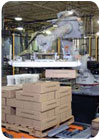
Ice cream freezers and other cold environments are a logical application for robots, though most freezer palletizing continues to be done manually. One factor retarding robotics was the slow development of customized solutions. Metallurgy is "at the critical edge" when temperatures reach -20Looking for a reprint of this article?
From high-res PDFs to custom plaques, order your copy today!