Dairy Foods logo
search
cart
facebook twitter linkedin youtube
  • Sign In
  • Create Account
  • Sign Out
  • My Account
Dairy Foods logo
  • NEWS
    • DAIRY REGULATIONS
  • PRODUCTS
    • New Products
    • Butter
    • Cheese
    • Cultured Dairy
    • Frozen Desserts
    • Ice Cream/Novelties
    • Milk
    • Non-Dairy Beverages
    • Sales Data
    • Whey, Milk Powder
    • Dairy Alternatives
  • INGREDIENTS
    • Cocoa
    • Colors/Flavors
    • Cultures/Enzymes
    • Fiber
    • Gums, Stabilizers, and Texturants
    • Inclusions
    • Omegas/Lipids
    • Prebiotics
    • Probiotics
    • Sweeteners
    • Other
  • OPERATIONS
    • SUSTAINABILITY
    • Equipment
    • Processing
    • Packaging
    • Food Safety & Sanitation
    • Membrane Technology
  • MEDIA
    • Dairy Foods TV
    • Podcasts
    • Webinars
  • DIRECTORIES
    • Buyers Guide
    • Dairy Plants USA
  • MEMBRANE FORUM
  • MORE
    • Associations
    • Dairy Foods' News & Views Newsletter
    • Blogs
    • Case Studies
    • Classifieds
    • Custom Content & Marketing Services
    • Dairy Foods Store
    • Market Research
    • Supplier Spotlights
    • Tradeshows and Events
    • Strategy Guides
  • AWARDS
    • Dairy Plant of the Year Award
    • Breakthrough Award
    • Dairy Processor of the Year
  • EMAGAZINE
    • eMagazines
    • Archive Issues
    • Contact
    • Advertise
    • SIGN UP!
    • Columnists
    • Dairy 100
    • State of the Industry Report
    Operations

    Can Consolidation Lead to Distribution Efficiency?
    October 7, 2003
    A logistics discussion from the Dairy Distribution Conference

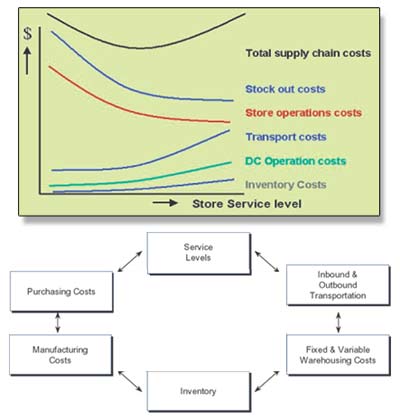
    Fig. 1
    It’s no secret that consolidation has been a growing trend in the dairy industry. By the count of one industry analyst, there have been 143 mergers, acquisitions and alliances in the U.S. dairy industry since January 1998. Consolidation was still making news as late as November, when National Dairy Holdings, Dallas, and H.P. Hood, Chelsea, Mass., proposed a merger.

    The consolidations have involved some of the largest dairy product companies in the world, and while the business rationale for these mergers has been varied according to the companies involved, the most common reasons for seeking consolidation include:

    • Become more efficient

    • Develop and propagate brands

    • Gain share-of-market

    • Strengthen relationships in the supply chain
    While facility optimization and processing efficiency are well-established reasons for consolidation, the industry has yet to realize the full potential of its ability to make its distribution more efficient and also has yet to utilize all of the tools that are available to do so.

    The necessity for the industry to become more efficient in logistics and distribution is tremendous. While regarding only one factor, the proliferation of different products, measured by Stock Keeping Units (SKUs) is dramatic.

    Even the number of locations where dairy products, in particular ice cream and frozen novelties, can be found has increased. The industry has established distribution in retail chains that now combine groceries and general merchandise, but it has also increased its presence in gasoline stations, convenience stores, shopping malls, hardware stores, factories and video outlets. The thinking behind such efforts is that non-conventional distribution adds to sales volume without cannibalizing sales in existing retail channels.

    Dairy products and drinks will have to take advantage of new means of distribution efficiency to reach these outlets, and the volume and variety of the places products are offered means distribution must become highly efficient.

    With the increase in locations, number of SKUs, and the increasing presence of consolidation, how much has the industry taken advantage of what efficiency in logistics can provide, particularly when considering distribution efficiency?
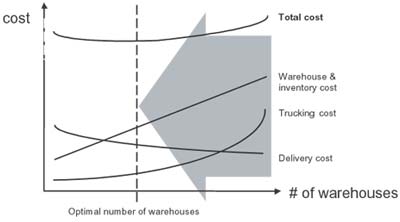
    Fig. 2
    While much of the industry's distribution is organized around handling fluid milk in bulk, the consolidation of the industry, and the shift to products which produce more profit, will demand a different structure in the future.

    Typical elements that play a role when considering distribution include: Manufacturing and purchasing costs; required service levels, inbound and outbound transportation costs, fixed and variable warehousing costs, and inventory costs.

    Figure 1 summarizes the relationships between these elements, with total supply chain costs plotted against store or outlet service costs. As might be expected, as service levels rise, total supply chain costs, transportation costs, distribution center operation costs, and inventory costs also increase. Theoretically, out of stock and per store operations costs would decrease as service levels rise.

    With the possible exception of temporary effects of rising fuel costs from the conflict in the Middle East, the cost of transportation in the dairy industry is currently highly optimized. Transportation has become more efficient due to improved infrastructure, better transportation communication systems and the increased involvement of highly efficient third party logistics providers.

    Given this dynamic in the industry, and by adopting more efficient means of product handling and automation within the distribution center, the optimal number of distribution centers is decreasing. Figure 2 shows the relationship between number of warehouses and distribution centers and overall costs.

    In a consolidated network, fewer, more efficient distribution centers with a higher throughput would be built. SKUs would be more numerous than single-product distribution facilities, and a higher throughput and volume would be assumed. A higher throughput opens the doors to using automation to reduce operations costs. And if a standardized crate or carton is used, robotics or other labor saving devices can be utilized.
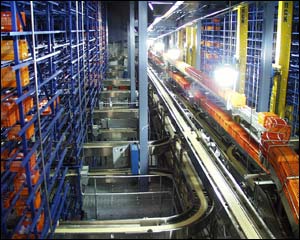
    This AS/RS is an example of Solution 2-Buffering in layer, where layers of crates are stored in the racking. This installation has 8,500 storage locations containing 25,500 crates.
    To illustrate an example of the highly efficient distribution center, we will assume that a typical automated dairy facility could resort to one of three scenarios to handle outbound product in standardized crates.

    Briefly, orders can be broken down into individual crates of product, and the crates can then be handled as either layers or stacks of crates that comprise a pallet. A pallet would be layers of nine (9) crates, stacks of five (5) crates, with a total pallet of 45 crates, comprising of five, nine-crate layers or nine, five-crate stacks.

    1) Buffering in Stack-Product buffered in stacks of five crates. The automated picking of crates and stacks; some manual orderpicking of less-than-crates, outbound shipment on pallets of individual stacks of crates

    2) Buffering in Layer-Product buffered in layers of nine crates. The automated picking of layers and rows of crates; some manual orderpicking of crates and less-than-crates, outbound shipment on pallets

    3) Buffering in Pallets- Product buffered in pallets of forty-five crates. The automated picking of pallets themselves, depalletizing, to individual stacks for crates, individual manual orderpicking of stacks of crates and less-than-crates, outbound shipment on pallets

    Each of these three scenarios would require a unique physical layout and equipment profile, and the rationale for each is dependent upon a detailed analysis of dairy production and distribution parameters including peak activity days and hours, routes and orders per day, destination of orders (direct-to-store or retail distribution center), volume per product shipped per day, and number of orders per SKU. Each scenario is intended to accommodate and function with the most appropriate mix of products, orders and volume found in a typical dairy.

    For example, in Solution 1) Buffering in Stack, physical equipment might include a Automated Storage and Retrieval System (AS/RS) with triple deep stack storage of stacks on pallets, consisting of 5,400 stack locations and 27,000 individual crates. Stack creation would involve a robotic gantry picking system that could create 1,800 stack locations and 9,000 individual crates. Manual order picking for less-than-crate quantities might include flow lanes, with pick-to-light systems that would handle approximately 250 SKUs and 195-crate output per hour.

    Solution 2) Buffering in Layer, physical equipment might include an triple deep AS/RS for individual crates that would handle three-carton subsets of nine-carton layers, with 8,500 storage locations containing 25,500 crates. Manual orderpicking for single crate and less-than-crate might include flow lanes, with pick-to-light systems that would handle 125 SKUs and 585 crates per hour.

    Solution 3) Buffering in Pallets would require bulk pallet storage, retrieval of full pallets from storage, a depalletizing process, and manual orderpicking of crate, stacks and less-than-crates. Manual orderpicking for less-than-case orders for slow movers could be done from static shelves or flow lanes to undriven roller conveyor for takeaway, and medium volume full-case picking could be done from stacks to belt conveyor.
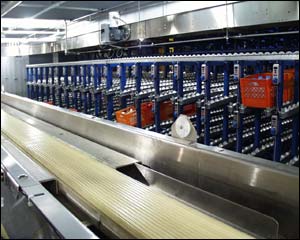
    This picking interface is found in the Buffering Solutions that call for a manual picking interface. Manual split carton picking is done from live storage lanes, often using a belt conveyor or pick to light system.
    Any of these solutions would require the proper benchmarking to establish the investment and personnel required, handling cost per unit, Return on Investment and other calculations of cost and return.

    The investment for two larger automated facilities can be the same for three conventional facilities. Automation can reduce the operational costs within the distribution centers by up to 20%, offsetting the premium for primary and secondary transportation, and inventory levels drop due to consolidation of the safety stock. A greater transparency of inventory levels also results from a standard warehouse management system, and there may be greater flexibility resulting from a combined transportation fleet. Traditionally, there is less dependency on labor, and there may even be reductions in the labor required in refrigerated and frozen areas, where labor costs have been high. Products are generally handled more safely with less product damage. Longer shelf life and more accuracy in handling dated products also can result.

    Share This Story

    Looking for a reprint of this article?
    From high-res PDFs to custom plaques, order your copy today!

    Recommended Content

    JOIN TODAY
    to unlock your recommendations.

    Already have an account? Sign In

    • Lifeway Organic Kefir in different flavors inside a refrigerated grocery shelf.

      Dairy Foods names Lifeway Foods 2025 Processor of the Year

      Lifeway Foods donates $10,000 to wildfire victims,...
      Innovation
      By: Brian Berk
    • Two female farmers are standing in a field, holding a large milk canister, looking at several cows at dairy farm.

      Honoring Women Leaders Shaping the Dairy Industry

      For the fourth consecutive year, Dairy Foods is proud to...
      Dairy Foods & Beverages
      By: Barbara Harfmann
    • Main feature for State of the Industry with dairy products album cover with a gradient circular--patterned backgorund.

      2025 State of the Dairy Industry

      Welcome to the 2025 State of the Industry report. For...
      Sales Data
    Manage My Account
    • eMagazine Subscription
    • Dairy Foods News & Views Newsletter
    • Online Registration
    • Manage My Preferences
    • Subscription Customer Service
    • Connect with Dairy Foods

    More Videos

    Popular Stories

    Close up of a whipped frozen dessert with a light green color.

    The keys to high-protein dairy formulations

    A row of Frios Gourmet Pops with a tie dye pattern as a background.

    How Frios Gourmet Pops delivers happiness

    Grilling foods

    Dairy’s Enduring Moment: Why Resilience and Renewal Define Today’s Dairy Story

    Nominate your product for the 2026 Dairy Foods Product of the Year!

    Products

    Probiotic Ice Cream: Science and Technology

    Probiotic Ice Cream: Science and Technology

    See More Products

    Outlook Report: Women in Dairy

    Related Articles

    • Many roads lead to sodium reduction in cheese products

      See More
    • Hunger Solutions Institute logo.jpg

      Nearly $3M gifted to Auburn to lead Healthy Fluid Milk Program

      See More
    • Julia Kadison is selected to lead MilkPEP

      See More

    Related Products

    See More Products
    • From Milk By-Products to Milk Ingredients: Upgrading the Cycle

    • GlobalData_Consumer.jpg

      Milk (Dairy & Soy Food) Market in the United States of America - Outlook to 2024: Market Size, Growth and Forecast Analytics

    See More Products

    Events

    View AllSubmit An Event
    • December 9, 2015

      Optimizing ‘Product Mix’ in a Volatile Global Dairy Ingredients Market: Unlocking Flexibility and Efficiency in your Production Lines

      On Demand FREE Webinar: Excellent long term growth in the dairy ingredient market is underpinned by strong fundamental drivers, however, volatility will remain a key challenge but also an opportunity.
    • November 11, 2025

      Membranes: Innovative Approaches to Boosting Production

      On-Demand This session will explore how membrane systems work and how cleaning and sanitation can unlock new levels of production efficiency. The discussion will cover strategies to optimize operations, reduce downtime, and enhance sustainability. Expert presenter Rachel McGiness will share innovative approaches and real-world applications, offering practical insights to support improved performance. 
    View AllSubmit An Event

    Related Directories

    • Whey To Go

    ×

    Stay ahead of the curve. Unlock a dose of cutting-edge insights.

    Receive our premium content directly to your inbox.

    SIGN-UP TODAY
    • RESOURCES
      • Advertise
      • Contact Us
      • Directories
      • Store
      • Want More
    • SIGN UP TODAY
      • Create Account
      • eMagazine
      • Newsletter
      • Customer Service
      • Manage Preferences
    • SERVICES
      • Marketing Services
      • Reprints
      • Market Research
      • List Rental
      • Survey/Respondent Access
    • STAY CONNECTED
      • LinkedIn
      • Facebook
      • YouTube
      • X (Twitter)
    • PRIVACY
      • PRIVACY POLICY
      • TERMS & CONDITIONS
      • DO NOT SELL MY INFORMATION
      • PRIVACY REQUEST
      • ACCESSIBILITY

    Copyright ©2026. All Rights Reserved BNP Media, Inc. and BNP Media II, LLC.

    Design, CMS, Hosting & Web Development :: ePublishing