Tharp and Young: Is it Possible to Formulate a True "Sugar-Free" Ice Cream?
The application of the descriptor “sugar-free” to ice cream would require the presence of <0.5 g per serving of sugars, i.e., the sum of all mono- and disaccharides. To produce such a product, it would be necessary to remove not only the conventional added sweeteners, as in no-sugar-added (NSA) products, but the lactose contributed by conventional dairy ingredients as well.

The application of the descriptor “sugar-free” to ice cream would require the presence of <0.5 g per serving of sugars, i.e., the sum of all mono- and disaccharides. To produce such a product, it would be necessary to remove not only the conventional added sweeteners, as in no-sugar-added (NSA) products, but the lactose contributed by conventional dairy ingredients as well. When lactose is removed, the composition of the finished product is outside the requirements of the ice cream standard of identity, making it necessary to refer to such a product as a “sugar-free frozen dairy dessert” (SFFDD).
Removing lactose is a key first step. Hydrolyzing lactose into glucose and galactose does not reduce total “sugars.” Thus, SFFDD hinges on availability of milk-solids-not-fat where lactose and salts are otherwise removed (ultra-filtered milks; see column in September 1999 Dairy Foods). This process can produce undesirable flavors and functionalities. Milk protein isolates (MPI; > 90% total milk protein) are ultimately the milk protein ingredients of choice. Selection criteria include the proper balance of function, flavor, color and ratio of casein-to-whey protein.
Besides sweetness, SFFDD composition must also provide other functionalities of sweetening systems. These include bulking, management of freezing point and water immobilization. Two useful ingredients are maltitol syrup (MS) and digestion resistant maltodextrin (DRM). MS is a novel polyol composition that can provide all the sweetness and a portion of the functional elements of sugars. DRM can provide the additional bulk and management of freezing point needed. Since DRM is a dietary fiber, its use supports various “good-for-you” claims. In combination, both MS and DRM produce a frozen water profile that adds smoothness, creaminess, and resistance to heat shock. Neither MS nor DRM negatively affect flavor (either naturally occurring or added) quality or intensity, so the base mix remains technically neutral relative to flavor.
 The choice of fat source is limited to butter and anhydrous milk fat (AMF). Butter (unsalted) is the preferred choice for a variety of reasons. Virtually any fat content can be formulated, but low fat (<3 g total fat per serving) options offer significant support for a variety of health-related claims.
Selection of the stabilizer and emulsifier system is critical to achieving superior eating quality and resistance to heat shock at ultra-low finished product weights. Conventional stabilizer/emulsifier combinations could be considered. Of particular interest is the use of improved microcrystalline cellulose (MCC), a.k.a. cellulose gel, as a critical component. This ingredient makes unique contributions to achieving superior eating qualities, heat shock resistance and high overruns without threat of over-stabilization properties. Emulsifier selection and use follow the same guidelines that apply to conventionally sweetened fat-modified products.
Overruns in access of 130%, depending on mix composition and claims to be made, are possible. This allows maximizing of total fat and minimizing total sugars.
As with all fat- and sugar-modified frozen desserts, flavor is the ultimate test. Proper mix ingredient selection and formulation is a start. The base mix must be compatible with support and delivery of the finest of flavors. A properly formulated, SFFDD can support a broad range of flavor profiles. Care in formulating is required to make sure flavor selection, type and amount is compatible with marketplace expectations.
Here is our recommended starting composition for a SFFDD: 4.7% milk fat, 3.5% MPI, 6.0% DRM, 23.0% MS (dry basis) and 0.60% of the advanced MCC-based system.
Other nutrient content and structure/function claims are available. For more details, including ingredient and flavoring selection, nutrition information and claims, formula options, regulatory insights and more, contact Dr. Bruce Tharp (610/975-4424) or Dr. Steven Young (281/596-9603) directly.
Check out Tharp & Young’s presentation at the theIDFA Ice Cream Technical Conference (www.idfa.org/meetings/2007_icecreamtech_agenda.cfm), “Sugar-Free Frozen Dairy Dessert.” Tharp and Young On Ice Cream Technical Short Course, Workshops, and Clinics, (www.onicecream.com) 10th Great Year! Dec 5-7, 2007, Las Vegas.
The application of the descriptor “sugar-free” to ice cream would require the presence of <0.5 g per serving of sugars, i.e., the sum of all mono- and disaccharides. To produce such a product, it would be necessary to remove not only the conventional added sweeteners, as in no-sugar-added (NSA) products, but the lactose contributed by conventional dairy ingredients as well. When lactose is removed, the composition of the finished product is outside the requirements of the ice cream standard of identity, making it necessary to refer to such a product as a “sugar-free frozen dairy dessert” (SFFDD).
Removing lactose is a key first step. Hydrolyzing lactose into glucose and galactose does not reduce total “sugars.” Thus, SFFDD hinges on availability of milk-solids-not-fat where lactose and salts are otherwise removed (ultra-filtered milks; see column in September 1999 Dairy Foods). This process can produce undesirable flavors and functionalities. Milk protein isolates (MPI; > 90% total milk protein) are ultimately the milk protein ingredients of choice. Selection criteria include the proper balance of function, flavor, color and ratio of casein-to-whey protein.
Besides sweetness, SFFDD composition must also provide other functionalities of sweetening systems. These include bulking, management of freezing point and water immobilization. Two useful ingredients are maltitol syrup (MS) and digestion resistant maltodextrin (DRM). MS is a novel polyol composition that can provide all the sweetness and a portion of the functional elements of sugars. DRM can provide the additional bulk and management of freezing point needed. Since DRM is a dietary fiber, its use supports various “good-for-you” claims. In combination, both MS and DRM produce a frozen water profile that adds smoothness, creaminess, and resistance to heat shock. Neither MS nor DRM negatively affect flavor (either naturally occurring or added) quality or intensity, so the base mix remains technically neutral relative to flavor.
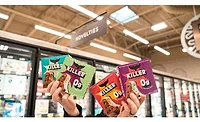
Photo Courtesy of Unilever Ice Cream
Selection of the stabilizer and emulsifier system is critical to achieving superior eating quality and resistance to heat shock at ultra-low finished product weights. Conventional stabilizer/emulsifier combinations could be considered. Of particular interest is the use of improved microcrystalline cellulose (MCC), a.k.a. cellulose gel, as a critical component. This ingredient makes unique contributions to achieving superior eating qualities, heat shock resistance and high overruns without threat of over-stabilization properties. Emulsifier selection and use follow the same guidelines that apply to conventionally sweetened fat-modified products.
Overruns in access of 130%, depending on mix composition and claims to be made, are possible. This allows maximizing of total fat and minimizing total sugars.
As with all fat- and sugar-modified frozen desserts, flavor is the ultimate test. Proper mix ingredient selection and formulation is a start. The base mix must be compatible with support and delivery of the finest of flavors. A properly formulated, SFFDD can support a broad range of flavor profiles. Care in formulating is required to make sure flavor selection, type and amount is compatible with marketplace expectations.
Here is our recommended starting composition for a SFFDD: 4.7% milk fat, 3.5% MPI, 6.0% DRM, 23.0% MS (dry basis) and 0.60% of the advanced MCC-based system.
Other nutrient content and structure/function claims are available. For more details, including ingredient and flavoring selection, nutrition information and claims, formula options, regulatory insights and more, contact Dr. Bruce Tharp (610/975-4424) or Dr. Steven Young (281/596-9603) directly.
Check out Tharp & Young’s presentation at the theIDFA Ice Cream Technical Conference (www.idfa.org/meetings/2007_icecreamtech_agenda.cfm), “Sugar-Free Frozen Dairy Dessert.” Tharp and Young On Ice Cream Technical Short Course, Workshops, and Clinics, (www.onicecream.com) 10th Great Year! Dec 5-7, 2007, Las Vegas.
Looking for a reprint of this article?
From high-res PDFs to custom plaques, order your copy today!