Processing Technology: Pumps and Valves
Answering processors’ call for hygiene and food safety should mean success for manufacturers of pumps and valves.
 With concerns over food safety sweeping through the food industry at a rapid pace, manufacturers of pumps and valves are benefitting from the new innovations in hygienic components they have to offer.
“The main drivers in the choice of valves for dairy processors are their requirements for round-the-clock production and being able to clean certain parts of the process while handling product in other parts of the system,” says David Medlar, president of GEA Tuchenhagen North America Inc., Portland, Maine. “Secondly, valves must be completely hygienic and cleanable, with a minimum impact on the environment while being cleaned. And finally, dairy processors require valves which are easy to maintain and exhibit longer intervals between required maintenance.”
Derrick Alig, general manager of Santa Rosa, Calif.-based Inoxpa, agrees about keeping up with changing hygienic standards. It’s also important, he says, to “be able to supply a flexible product of superior quality and reliability that is still affordable and will not negatively affect our customers’ product in any way.”
Easy cleaning and lowering the cost of ownership by reducing energy usage and reducing down time are critical factors in design of pumps, says Bill Rice, manager of technical support at SPX, Delavan, Wis.
Meanwhile, Christopher Sinutko, SPX product manager for valves, says the primary driving force in development of valves for the dairy industry is the increase in automation projects for dairy processing. “The revision in the PMO standard has given dairy customers the ability to run production with minimized downtime for cleaning similar to the way the rest of the food and beverage industry has been doing for years,” he says. “Companies are focusing on automation to help increase capacity and flexibility and to stay ahead of competition.”
Medlar adds: “I believe dairy processors are also looking for more enhanced valve diagnostics, including error signal transmission when there is any operational fault related to the valve; automatic setup of valve position feedbacks, rather than the manual switch adjustment more common in valves currently; and more bus communication and signaling options, such as ASI and Devicenet.”
Of course, pumps and valves have not escaped the current hot issue. “Sustainability is a major driver from our customer’s point of view and therefore drives our development focus,” says Jack Jordan, president of Rockford, Ill.-based Südmo North America. “Reducing product and water waste and cutting energy use are all very important goals for our customers. Norit Südmo’s 365it PMO Mix Proof and P3 Aseptic valves are designed to meet these sustainability goals by eliminating the need to shut down for cleaning and by extending intervals between routine maintenance.”
Sanitary standards
But above all, cleaning and simplicity of equipment are paramount to food safety, says Chuck Treutel, sales manager for the MasoSine Division of the Watson-Marlow Pumps Group, Wilmington, Mass. “The MasoSine Pump is capable of being CIP’d and is also easily disassembled for manual cleaning (COP),” he says. “MasoSine offers various CIP modifications depending upon the product being pumped and the cleaning protocol.”
Medlar says the importance of food safety is nowhere more evident than in the FDA’s 2007 authorization of the GEA Tuchenhagen mixproof 24/7 PMO Valve as the first valve to allow simultaneous handling of product and CIP. “FDA’s evaluation and ultimate acceptance of this valve was primarily based on the assurance that there could never be any negative impact on food safety – that is, never any cross contamination of CIP into product – under any circumstances, including full or partial valve gasket failure,” he says.
Südmo’s Jordan says his company’s mixproof components ensure consistent cleaning and sanitizing. “By implementing 365it PMO Mix Proof valve technology in their plants, dairy processors are guaranteed that the product is always protected from contamination by cleaning chemicals or other products,” he says. “This technology also ensures protection from food allergen cross-contamination, which is an increasing priority for food processors.”
3-A certification has become a gold standard for food safety, and Alig proudly notes all Inoxpa products carry the 3-A symbol.
“But we have seen a greater interest in having the pump tested by an independent third party,” SPX’s Rice says. “In addition to meeting 3-A standards, EHEDG (European Hygienic Engineering Design Group) certified pumps are increasingly being requested.”
In the mix
In 2009, GEA Tuchenhagen’s 24/7 PMO Tank Valve became the first such component authorized by FDA for 24/7 production, Medlar notes. “This valve can be mounted either horizontally to a silo or under a tank, greatly simplifying and reducing pressure drop in vessel pipework, making it ideal for application on cheese, viscous and large-particulate products,” he says. “In addition, GEA Tuchenhagen introduced the first legal flow-diversion valve assembly using electronic proximity switches rather than mechanical limit switches, greatly increasing operational reliability as well simplifying the regulatory testing procedures.”
Medlar says his company soon will launch a mixproof sample valve for sanitary inline or vessel sampling, allowing the sample line to be automatically cleaned or sterilized prior to taking the product sample without contaminating the product.
Mixproof and aseptic valve technology is at the top of Südmo’s list as well. “We continue to develop new valve products to meet the growing demands in food safety, sustainability and lower total cost of ownership,” Jordan says. “Our full range of PMO mixproof valves, long-life aseptic valves and mixproof aseptic valves fulfills our customers’ total valve technology needs.”
On the pump side, Rice says SPX has been able to use many of the same components to modify the function and purpose of its pump. “Our W+ can be modified from a standard centrifugal pump to include an inducer to reduce NPSHr. Adding additional components can change the pump into a self primer and or steam jacketed pump,” he says. “Modularity is not only a benefit to the manufacturer, but also to the end user because we use many common parts , thus reducing the cost to operate a number of pumps that support ever-increasingly complicated systems.”
On the valve side, Sinutko highlights SPX’s launch of its W75CP valve for mixproof automation in Grade A PMO applications, plus a tank outlet and curd valve version. “The W75CP mixproof valve was launched last year to allow dairies to continuously run production and clean simultaneously,” he says.
Alig says Inoxpa offers its RVS helicoidal impeller centrifugal pump for pumping cheese curd, along with new, more efficient centrifugals, Prolac and Hyginox.
Watson-Marlow serves cheesemakers as well. “The unique and innovative MasoSine Pump design is ideal for the transfer of cheese curd,” Treutel says. “Its large open cavities, a constant displaced volume and gentle transfer of product from inlet to discharge transfers curd with little damage. This feature produces a higher curd yield and fat content, and lowers the amount of fines created during transfer.”
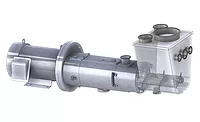
The MasoSine Pump design features a single shaft and single sinusoidal rotor, Treutel explains. “The undulating contour of its unique rotor transports product through the pump while still maintaining the product quality instead of the standard meshing rotors used by competitor rotary-style pumps, which create a compression action that damages sensitive products like cheese curd,” he says.
Coming soon
What’s next on the horizon in pump and valve technology?
“Valves with built-in diagnostic capabilities, allowing valves to self diagnose their performance,” Medlar says. “These valves will automatically inform the user not only if they are experiencing a fault but also transmit information detailing the cause of the fault … and [say] exactly when and what type of maintenance the valve requires, thereby reducing plant maintenance costs.”
Further, Medlar says valves with a minimum environmental impact, such as those requiring minimal water, chemicals and time to clean, will be highly sought after by dairy processors.
Alig says the future will bring more of a focus on efficiency. “Higher efficiency equals lower life-cycle cost, which equals greater savings for the customer,” he says.
Rice says reduction in cost has reached a point where all new pumps are designed with the lowest cost to manufacture. “Reducing the number of parts required to service a pump when performing preventive maintenance is a driving point of new designs,” he says. Meanwhile, Sinutko says SPX continues to expand its PMO mixproof valve product line to offer customers key pieces of equipment in automation projects. “This extension includes a tank outlet and curd PMO mixproof valves,” he says.
At Watson-Marlow, “new rotor and stator designs and materials are always a top priority for R&D,” Treutel says. “Better materials can increase pump life and performance, saving the customer money while increasing yield and quality.”
Südmo’s Jordan says valve technology will continue to innovate in an effort to lower the operating costs for customers. “This will include more development in mixproof technology for aseptic processors as well as innovative designs around elastomer and control technologies,” he says. “Also, new elastomer techniques are being developed to extend service life, which will reduce plant downtime, thus resulting in higher plant efficiencies.”
Extras
GEA Tuchenhagen North America Inc. www.tuchenhagen.us
Inoxpa www.inoxpa.com
SPX www.spxft.com
Südmo North America www.sudmona.com
Watson-Marlow Pumps Group www.watson-marlow.com
“The main drivers in the choice of valves for dairy processors are their requirements for round-the-clock production and being able to clean certain parts of the process while handling product in other parts of the system,” says David Medlar, president of GEA Tuchenhagen North America Inc., Portland, Maine. “Secondly, valves must be completely hygienic and cleanable, with a minimum impact on the environment while being cleaned. And finally, dairy processors require valves which are easy to maintain and exhibit longer intervals between required maintenance.”
Derrick Alig, general manager of Santa Rosa, Calif.-based Inoxpa, agrees about keeping up with changing hygienic standards. It’s also important, he says, to “be able to supply a flexible product of superior quality and reliability that is still affordable and will not negatively affect our customers’ product in any way.”
Easy cleaning and lowering the cost of ownership by reducing energy usage and reducing down time are critical factors in design of pumps, says Bill Rice, manager of technical support at SPX, Delavan, Wis.
Meanwhile, Christopher Sinutko, SPX product manager for valves, says the primary driving force in development of valves for the dairy industry is the increase in automation projects for dairy processing. “The revision in the PMO standard has given dairy customers the ability to run production with minimized downtime for cleaning similar to the way the rest of the food and beverage industry has been doing for years,” he says. “Companies are focusing on automation to help increase capacity and flexibility and to stay ahead of competition.”
Medlar adds: “I believe dairy processors are also looking for more enhanced valve diagnostics, including error signal transmission when there is any operational fault related to the valve; automatic setup of valve position feedbacks, rather than the manual switch adjustment more common in valves currently; and more bus communication and signaling options, such as ASI and Devicenet.”
Of course, pumps and valves have not escaped the current hot issue. “Sustainability is a major driver from our customer’s point of view and therefore drives our development focus,” says Jack Jordan, president of Rockford, Ill.-based Südmo North America. “Reducing product and water waste and cutting energy use are all very important goals for our customers. Norit Südmo’s 365it PMO Mix Proof and P3 Aseptic valves are designed to meet these sustainability goals by eliminating the need to shut down for cleaning and by extending intervals between routine maintenance.”
Sanitary standards
But above all, cleaning and simplicity of equipment are paramount to food safety, says Chuck Treutel, sales manager for the MasoSine Division of the Watson-Marlow Pumps Group, Wilmington, Mass. “The MasoSine Pump is capable of being CIP’d and is also easily disassembled for manual cleaning (COP),” he says. “MasoSine offers various CIP modifications depending upon the product being pumped and the cleaning protocol.”
Medlar says the importance of food safety is nowhere more evident than in the FDA’s 2007 authorization of the GEA Tuchenhagen mixproof 24/7 PMO Valve as the first valve to allow simultaneous handling of product and CIP. “FDA’s evaluation and ultimate acceptance of this valve was primarily based on the assurance that there could never be any negative impact on food safety – that is, never any cross contamination of CIP into product – under any circumstances, including full or partial valve gasket failure,” he says.
Südmo’s Jordan says his company’s mixproof components ensure consistent cleaning and sanitizing. “By implementing 365it PMO Mix Proof valve technology in their plants, dairy processors are guaranteed that the product is always protected from contamination by cleaning chemicals or other products,” he says. “This technology also ensures protection from food allergen cross-contamination, which is an increasing priority for food processors.”
3-A certification has become a gold standard for food safety, and Alig proudly notes all Inoxpa products carry the 3-A symbol.
“But we have seen a greater interest in having the pump tested by an independent third party,” SPX’s Rice says. “In addition to meeting 3-A standards, EHEDG (European Hygienic Engineering Design Group) certified pumps are increasingly being requested.”
In the mix
In 2009, GEA Tuchenhagen’s 24/7 PMO Tank Valve became the first such component authorized by FDA for 24/7 production, Medlar notes. “This valve can be mounted either horizontally to a silo or under a tank, greatly simplifying and reducing pressure drop in vessel pipework, making it ideal for application on cheese, viscous and large-particulate products,” he says. “In addition, GEA Tuchenhagen introduced the first legal flow-diversion valve assembly using electronic proximity switches rather than mechanical limit switches, greatly increasing operational reliability as well simplifying the regulatory testing procedures.”
Medlar says his company soon will launch a mixproof sample valve for sanitary inline or vessel sampling, allowing the sample line to be automatically cleaned or sterilized prior to taking the product sample without contaminating the product.
Mixproof and aseptic valve technology is at the top of Südmo’s list as well. “We continue to develop new valve products to meet the growing demands in food safety, sustainability and lower total cost of ownership,” Jordan says. “Our full range of PMO mixproof valves, long-life aseptic valves and mixproof aseptic valves fulfills our customers’ total valve technology needs.”
On the pump side, Rice says SPX has been able to use many of the same components to modify the function and purpose of its pump. “Our W+ can be modified from a standard centrifugal pump to include an inducer to reduce NPSHr. Adding additional components can change the pump into a self primer and or steam jacketed pump,” he says. “Modularity is not only a benefit to the manufacturer, but also to the end user because we use many common parts , thus reducing the cost to operate a number of pumps that support ever-increasingly complicated systems.”
On the valve side, Sinutko highlights SPX’s launch of its W75CP valve for mixproof automation in Grade A PMO applications, plus a tank outlet and curd valve version. “The W75CP mixproof valve was launched last year to allow dairies to continuously run production and clean simultaneously,” he says.
Alig says Inoxpa offers its RVS helicoidal impeller centrifugal pump for pumping cheese curd, along with new, more efficient centrifugals, Prolac and Hyginox.
Watson-Marlow serves cheesemakers as well. “The unique and innovative MasoSine Pump design is ideal for the transfer of cheese curd,” Treutel says. “Its large open cavities, a constant displaced volume and gentle transfer of product from inlet to discharge transfers curd with little damage. This feature produces a higher curd yield and fat content, and lowers the amount of fines created during transfer.”
The MasoSine Pump design features a single shaft and single sinusoidal rotor, Treutel explains. “The undulating contour of its unique rotor transports product through the pump while still maintaining the product quality instead of the standard meshing rotors used by competitor rotary-style pumps, which create a compression action that damages sensitive products like cheese curd,” he says.
Coming soon
What’s next on the horizon in pump and valve technology?
“Valves with built-in diagnostic capabilities, allowing valves to self diagnose their performance,” Medlar says. “These valves will automatically inform the user not only if they are experiencing a fault but also transmit information detailing the cause of the fault … and [say] exactly when and what type of maintenance the valve requires, thereby reducing plant maintenance costs.”
Further, Medlar says valves with a minimum environmental impact, such as those requiring minimal water, chemicals and time to clean, will be highly sought after by dairy processors.
Alig says the future will bring more of a focus on efficiency. “Higher efficiency equals lower life-cycle cost, which equals greater savings for the customer,” he says.
Rice says reduction in cost has reached a point where all new pumps are designed with the lowest cost to manufacture. “Reducing the number of parts required to service a pump when performing preventive maintenance is a driving point of new designs,” he says. Meanwhile, Sinutko says SPX continues to expand its PMO mixproof valve product line to offer customers key pieces of equipment in automation projects. “This extension includes a tank outlet and curd PMO mixproof valves,” he says.
At Watson-Marlow, “new rotor and stator designs and materials are always a top priority for R&D,” Treutel says. “Better materials can increase pump life and performance, saving the customer money while increasing yield and quality.”
Südmo’s Jordan says valve technology will continue to innovate in an effort to lower the operating costs for customers. “This will include more development in mixproof technology for aseptic processors as well as innovative designs around elastomer and control technologies,” he says. “Also, new elastomer techniques are being developed to extend service life, which will reduce plant downtime, thus resulting in higher plant efficiencies.”
Extras
GEA Tuchenhagen North America Inc. www.tuchenhagen.us
Inoxpa www.inoxpa.com
SPX www.spxft.com
Südmo North America www.sudmona.com
Watson-Marlow Pumps Group www.watson-marlow.com
Looking for a reprint of this article?
From high-res PDFs to custom plaques, order your copy today!