Cheese Supplement: Cheese -- It's What Consumers Want
Americans’ strong and growing appetite for cheese has them choosing cheese for many occasions, including dessert
|
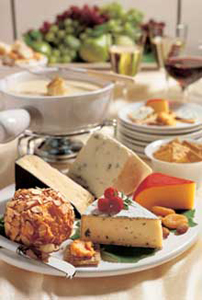
| Snacking and entertaining are two of this year's hottest trends, with cheese, in its many forms and varieties, playing an important role. |
Could it be true that cheese is the No. 1 food craving in America, even beating out chocolate, as the opening photo suggests by having cheese replace chocolate in the spring basket? Yes, it is true. Independent research on behalf of Dairy Management Inc., Rosemont, Ill., revealed that when consumers were asked which food gift they’d like to receive, more Americans said they would rather receive cheese (19%) than candy (13%).
This complements cheese trend No. 7 (see sidebar, p. xx ) from the Wisconsin Milk Marketing Board (WMMB), which states that Americans are leaning to love cheese all by itself thanks to many restaurants now offering an after-dinner cheese course, allowing consumers to enjoy flavorful cheeses with fruit, nuts or dessert breads. Move over death-by-chocolate layered cake. Make way for cheese!
|
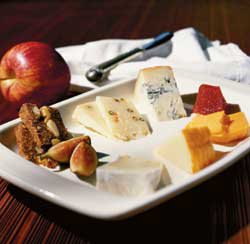
| The cheese course has made its way to the United States, enabling Americans to indulge on a practice Europeans have known for a long time -- Cheese makes a great dessert. |
Snacking and entertaining are hot, hot, hot
The American Dairy Association (ADA) says that snacking and entertaining are the two overall hottest food trends in 2003, and both include placing cheese on the dessert plate, among other eating places and occasions.
“Approximately 40% of eating occasions in America are snacks, and healthy snacking is important to moms,” says Kevin Burkum, v.p., cheese marketing, Dairy Management Inc., Rosemont, Ill. “In fact, 46% of moms say cheese is the perfect snack. As a result, you’re seeing more and more new cheese snack items being introduced into the marketplace.
“Cheese lovers are also entertainment focused,” Burkum says. “They are highly social and love to entertain at home.” Cheese is the perfect entertaining food.
The 2003 ADA Cheese Retail Program kit will assist retailers with focusing their merchandising efforts to snacking and entertaining opportunities. Kits include new custom TV, radio and newspaper over wrap visuals, as well as tools for in-store sampling events.
Cheese is big business for retailers. Volume sales in 2002 for food, drug and mass merchandisers, excluding Wal-Mart were 1.9 billion lbs, up 0.7% from 2001, and dollar sales were $7.6 billion, up 2.6%, according to Information Resources Inc., provided courtesy of the National Cheese Institute’s Cheese Market Research Report. This data includes natural, process and imitation cheeses, not cream cheese.
When it comes to sales by form, shredded cheese experienced the most growth in both volume (+4.8%) and dollar sales (+5.4%), with share by form of 23.1% for volume sales and 24.8% for dollar sales.
|
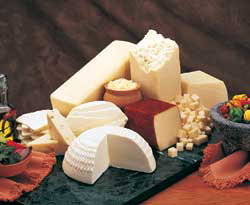
| Hispanic cheeses are not hot and spicy. Rather they are high in moisture and often taste like fresh whole milk. |
Expanding on WMMB’s trends
It’s well established that Americans have a strong and growing appetite for cheese. And we’re not just talking an extra slice of American on a burger or double-cheese stuffed-crust pizza. Americans are gobbling up cheeses of every form, flavor and fashion—to the tune of about 30 lbs per person annually.
According to WMMB’s 10th trend, if one cheese is good, three or four must be better. This is not only apparent at the retail level, where cheese marketers are offering consumers blends of cheeses in both shredded and chunk form, both also at the foodservice level, where pizzerias have been expanding beyond mozzarella.
According to cofounders Rick Rosenfield and Larry Flax of the adventuresome pizza chain California Pizza Kitchen Inc., Los Angeles, “A pizza is a canvas and you can paint it all day long.”
As a cheesemaker and marketer, it is important to offer your foodservice customers ideas and cheese usage tips so that both of you can benefit from this cheese blending opportunity. A vast array of domestic cheese varieties lends almost endless possibilities for manufacturers of frozen and fresh pizza. Certain physical performance issues and equipment considerations, however, need to be determined prior to selecting the appropriate cheese for pizza. These rules can differ depending upon whether the pizza is intended for immediate consumption or destined for a supermarket’s frozen food section.
Help in making critical decisions on matching cheese characteristics to the application and choosing proper equipment is available through the cheese lab at the Wisconsin Center for Dairy Research (WCDR), which is funded by America’s dairy farmers and supported by the Do it with dairy® ingredients marketing program at DMI.
Large-scale pizza operations must consider three factors, in addition to taste, when choosing the best-performing cheese for their type of pizza. The cheese must 1) come in a block size suitable to fit the plant equipment; 2) possess a consistency or texture that will allow it to shred; and 3) spread over the pizza top, or be machineable.
Cheddar and Colby have proven to be popular choices that fulfill these qualifications. A more recent trend is with using Muenster, which is sweeter tasting than mozzarella, and more buttery with a higher fat content.
General advice when choosing any of these three cheeses to blend with mozzarella is to select a young cheese less than three months old. As cheese ages, the pH and proteolysis affect not only the flavor, but also cheese performance in terms of oiling off on the pizza surface. If there is too much oiling off, the pizza surface will appear soupy. Hard cheeses such as Parmesan and Romano can work in a frozen pizza operation or in freshly baked foodservice operations, but are not recommended for fast-food operations where baking time is very short. This is because hard cheeses take a long time to melt and perform best when baked in an oven slowly; otherwise they dry too quickly and might scorch.
Swiss and Gouda cheeses also blend well with mozzarella, as do piquant varieties such as feta and Gorgonzola. A cheese like feta performs better as a topping, much like mushrooms and peppers, rather than as a base cheese. This is because feta does not melt or stretch.
For more information on WCDR’s cheese lab services, call DMI’s technical support hotline at 800/248-8829, or visit www.doitwithdairy.com.
|
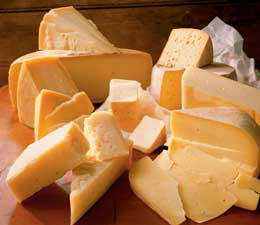
| Aged cheeses provide all applications with bold flavor, a sensory attribute that today's consumers crave. |
WMMB’s 12th trend is Hispanic cheese. With U.S. census figures released this past January indicating that the Hispanic population is now roughly 37 million, surpassing the black population, which is reported as numbering 36.2 million, this is one consumer segment and cheese trend that cheesemakers cannot afford to ignore. In fact, total Hispanic-style cheese production in the United States jumped 52% from 1996 to 2001, when more than 102 million lbs were sold, according to USDA’s National Agricultural Statistics Service. Hispanic cheeses are one of the fastest growing U.S. food markets, outpacing the growth of the Cheddar and mozzarella markets.
This is because America’s growing Hispanic population craves the cheeses available in their native countries. Typically these cheeses are made with raw milk, which gives them distinctive flavors, textures and cooking properties. Some American companies are producing Hispanic-style cheeses from pasteurized milk (a U.S. requirement for cheeses aged less than 60 days), however, these cheeses tend to not exhibit the full range of properties of cheeses made from raw milk.
Hispanic-style cheese does not mean hot-and-spicy. Other ingredients give Hispanic foods this kick. In general, Hispanic cheeses are white or off-white and high in moisture, tasting like fresh milk. They become soft and creamy when heated but do not lose shape, run or separate. Most of the time the cheeses are fresh, though some are aged. They run the gamut of being mild tasting and crumbly to harder with a strong flavor.
USDA Agricultural Research Service (ARS) scientists at the Eastern Regional Research Center, Wyndmoor, Pa., are helping U.S. cheesemakers meet the nation’s growing demand for Hispanic cheese. Researchers are evaluating the physical and chemical properties of Hispanic cheeses, relying not only on laboratory instruments but also on a panel of taste testers. They are looking at the cheeses’ chemical and physical makeup to learn how these properties relate to flavor, texture and functionality. The goal is to duplicate these characteristics by following U.S. practices and standards.
The scientists are focusing on four specific varieties. The first, queso blanco, is the most popular cheese south of the border. Its distinguishing characteristics are that it is soft and does not melt. Panela is mild, sweet, and crumbly. Asadero is a smooth, yellow cheese that is somewhat tangy and good for baking. And last, they are examining Mennonite-style cheeses from the state of Chihuahua. These semi-hard cheeses are named after the Mennonite settlers who introduced them to the region.
For more information on the ARS’ Hispanic cheese research, call the ARS Dairy Processing and Products Research Unit at 215/836-3777.
Sidebar #1: 2003 Wisconsin Cheese Industry Conference
This year’s Wisconsin Cheese Industry conference, April 15-16, in La Crosse, Wis., will have cheesemakers, farmers, suppliers, marketers, researchers and industry experts convening to exchange ideas, information and technology, in efforts to keep the cheese industry dynamic and successful. Sponsored by the Wisconsin Center for Dairy Research and Wisconsin Cheese Makers Association, the two-day gathering is the perfect opportunity to share knowledge, build relationships and discover the products and people that fuel this growing industry.
The conference kicks off on Tuesday, April 15, at 9:00 a.m., with the opening session: Trade Concerns for Global Marketing of U.S. Dairy Products, Including Protected Designations of Origin. The afternoon is open for attendees to visit the Tabletop Mini-Expo, which will feature 130 exhibits showcasing the latest innovations in equipment, ingredients, software, services and more. Tuesday ends with the annual wine and cheese reception and the U.S. Championship Cheese Auction.
The second day begins at 8:30 a.m. with sessions throughout the morning and afternoon. Topics include: Demand Prospects for U.S. Cheese, Cheese Flavor Development, Role of Cheese in Child Nutrition, Use of Dairy Proteins in Cheese Manufacture for Performance, and The New Wisconsin Cheese Quality Program. The conference ends Wednesday evening with the annual U.S. Championship Cheese Reception and Awards Banquet.
For more information, including a detailed schedule of events, call 608/828-4550, or visit www.wischeesemakersassn.org/expo/2003.
|
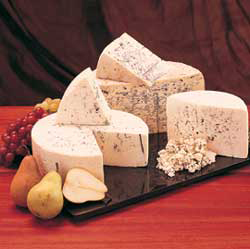
| Blue cheeses, with their distinct, robust flavors, are being used in applications ranging from pizza to nachos to pasta. |
Sidebar#2: Trends Keeping the Cheese Segment Sizzling
Here’s the Wisconsin Milk Marketing Board’s “What’s Hot” list in cheese for 2003.
1. Made in America--The cheesemaking industry in America is undergoing a renaissance much like California’s wine industry did 20-some years ago. American-made cheeses today stand rind-to-rind with the best cheeses in the world and are recognized as equal or better in quality. Smaller, local cheesemakers offering specialty and signature varieties are coming into their own, as demand for domestic cheeses continues to grow.
2. Flavored Cheeses--Several of the trends on this list are the result of consumers wanting more flavor. Familiar varieties such as smoked Cheddar, dill havarti and pepper jack are being joined by morel and leek, chipotle, horseradish and cranberry.
3. Washed Rinds--Again driven by a taste for bigger, bolder flavors, washed-rind cheeses include varieties such as Gruyere, surface-ripened brick, Limburger. During aging, these cheeses are regularly hand-washed or rubbed with brine, cider, wine, vinegar or other liquid of the cheesemakers’ choice. The liquid encourages surface bacteria growth, thus giving the cheese its distinctive aroma. As the liquid absorbs into the cheese, a rind forms. This keeps the cheese from drying out and helps it ripen from the outside in. In addition to boasting distinctive flavors, these cheeses also top the trend charts because of the skill, artistry and hands-on craftsmanship required to produce them.
4. Boutique Cheeses--Small-batch, one-of-a-kind cheeses sporting catchy names will continue to create buzz in the cheese category this year.
5. Farmstead Cheeses--Closely related to the boutique trend, farmstead cheeses offer a direct connection to the craftsmanship and artistry of cheesemaking, and to the very source of the cheese. This is because farmstead cheeses are typically made on the farm at which the milk is produced. Quality is controlled by the farmer/cheesemaker all along the way--from determining what the cows eat and how they’re handled, to producing the milk to making, aging and packaging the cheese.
6. Aged Cheeses--Chock it up again to the quest for flavor. Mild, relatively bland cheeses are giving way on the trend tracker to varieties that are being allowed to age…and age, and age and age. Cheddar aged four to seven years, for instance, is a dramatically different cheese in terms of both flavor and texture than the more common three- to four-month versions. Aged cheeses offer bigger, more complex flavors that are increasingly sought by chefs and cheese-savvy consumers. They also provide exceptional melt when used in sauces and other recipes.
7. Cheese for Cheese’s Sake--Americans are finally discovering that although cheese is a staple ingredient in countless well-loved dishes, it can also be enjoyed all by itself. Restaurant chefs who have introduced the European tradition of the after-dinner cheese course are partly to thank for fueling the cheese-alone trend here. Many restaurants now offer this menu option, and consumers are catching on to the idea that cheese, with perhaps some fresh or dried fruit, a few roasted nuts or a slice of nut bread, can be enjoyed any time.
8. Cheese Caves--Wine cellars may be trendy, but cheese caves are even trendier. For the truly serious cheese lover, having a cheese cave for storing and aging cheese is the ultimate in home accessories. Granted, in-home cheese caves are probably far off from hitting the mainstream, but at the restaurant level they’re catching on fast as a means to ensure top-quality cheese service and to add some merchandising panache. Of course, they’re not really caves. Rather, they’re special temperature- and humidity-controlled rooms or cabinets that mimic the atmosphere of a cave, where cheeses were historically stored and aged. On the production side, expect to see more cheeses marketed as “cave aged.”
9. Convenience--Regardless of the food category being discussed today, convenience remains a driving trend. New products geared largely to kids--cubes, slices beyond traditional American or process cheese, sticks, whips, etc.--are especially hot, as are upscale flavored cheese spreads for adults.
10. Cheese Blends--If one cheese is good, three or four must be better. A quick glance through the supermarket cheese case or your local pizzeria’s menu proves that blends of three, four or even more cheeses are popular. Flavor is what’s behind this trend. Bolder, more interesting flavors are easily achieved by blending different varieties of cheese, and manufacturers have made it easy for us to tap the trend by providing a myriad of ready-to-use blends.
11. The Blues--Blue-veined cheeses satisfy on many levels with their distinctive, robust flavors and textures that range from dry and crumbly to deliciously creamy. Category leaders blue cheese and Gorgonzola are showing up on or in everything from pizza to burgers, sandwiches, nachos, salads and pasta dishes. Blue cheese fans are also finding a growing number of other cheese varieties—Cheddar, in particular—spiked with a bit of blue.
12. Hispanic Cheeses—With Hispanics being the fastest growing ethnic group in the United States, this population segment is making a big impact on food and restaurant trends. As authentic Hispanic foods move further into the culinary mainstream, expect greater interest in Hispanic-style cheeses.
Looking for a reprint of this article?
From high-res PDFs to custom plaques, order your copy today!