Extreme Makeover Conveying System for Garelick
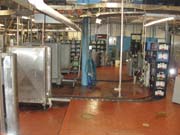
After a recent retrofit its conveying, filling, packing and handling operations have a capacity to achieve a "load-out" of more than 750,000 packages per day. The upgraded system, designed, fabricated and installed by American Conveyor, Ridgewood, N.Y., has already made fans at Garelick. Customers have come to realize faster product fill rates and better rotations.
"We were looking for a reliable conveyor system that would improve worker safety while it speeded up the handling and shipping process," says Cleland Cochran, Garelick's plant mgr. "And any system would have to be wash down proof and preferably easy to clean. We chose American Conveyor because of their focus on dairies and experience including a successful history of performing Extreme Makeovers for large dairy operations." Cochran says the results are stunning.
"The new system has decreased shipping and handling time by 40%; allowing us to ship upwards of 300 cases of milk, juice, and other beverages per minute."
Pick errors are practically non-existent and cold room dumps from rotational problems are down by 65%, Cochran says.
"And if that isn't impressive enough, the American installation team phased in the pick line as it was built which means that more than 3000 feet of stainless in-ground, knee-high and float-load conveyor and five unitizers were installed and running without shutting down operations for even an hour."
Stacks of six crates are collated "live" on 12 conveyors that exit the filling room on their way to the cooler. There twelve case stacking lines are divided into groups of four and which are in-turn routed to any one of the three American built unitizers.
After discharge the block of cases or unitized load is picked up by a clamp fork truck that transfers it to a racking system in the cooler for storage. Transactions are sent to the fork truck operator where the SKU is matched to a location of a computer assigned rack slot where similar product (product code, date code, time of day) is stored.
After being matched against the order number, product, quantity, location, and scheduled delivery time and date, orders are picked from five picking lines in the cooler and then merged downstream to build a load which is routed by a load-out coordinator to one of five outbound load-out lanes. Incomplete orders or segments are sent to a single location via no-load conveyor and held there until the completed order is assembled. Loading on trucks or trailers takes place in one of several ways including being conveyed directly to a trailer, dollied to a truck, pushed onto a truck with a stack pusher, or conveyed to a unitizer for load-out by a clamp fork truck.
The system was designed with optimal drainage for high-pressure wash-downs with water and chlorinated compounds, and includes over-sized, sealed bearings for durability. Recessed drives were inverted for ease of maintenance which means that pit-level conveyor motors and gearboxes are above floor.
Richard Dauphin, v.p. of American Conveyor Corporation says, "What Garelick was looking for is what most of our dairy customers are looking for in a new conveyor system. They wanted to reconfigure their conveyor layout to better use existing space. Dairies are traditionally driven by cost which also means we will most likely install a modern version of a floor chain system combined with a computerized place and pick system."
American Conveyor Corp., provides belt and roller conveyor systems to the dairy industry. For more information call 718/386-0480 or visit www.americanconveyor.net.
Looking for a reprint of this article?
From high-res PDFs to custom plaques, order your copy today!