Chillin' Out
With 14 varieties of RTD tea, Rutter’s Dairy’s York, Pa., plant has little time to rest.
 For a company with roots stretching back to the 1700s, Rutter’s Dairy is fortunate to have management with 21st century thinking.
Outside, the plant complex along Interstate 83 in York, Pa., may appear at first to be a hodgepodge of structures that look like they were expanded piecemeal on an as-needed basis, all rubbing shoulders with a barn that up until a few years ago was home to a working dairy herd.
But inside, you’ll see as efficient and modern an operation as you can find.
That said, company President Todd Rutter confirms the above assessment of the plant’s history. “Our fathers and their fathers never believed in building anything bigger than you needed,” Rutter says, acknowledging the patchwork of additions typically added one section and even one floor at a time as needed.
Dating back to the 1930s, the plant’s last complete renovation was in 1993, when it was nearly completely gutted. All new conveyors and overhead equipment were added; the project was completed over a weekend with minimal disruption to production, Rutter recalls. “That solved a lot of issues like people walking over conveyors,” he says of the project.
The result is a compact facility that still is laid out in a very linear-like fashion, much like newer, larger plants designed for end-to-end flow. While the plant’s footprint requires lines to bend, they’re very logical and straightforward, making best use of available space with little or no clutter and confusion.
As such, volume at the 24/7 facility has increased 45% within the same footprint in the years since the renovation, Rutter notes.
Milk is offloaded after passing lab tests and is HTST pasteurized. “Most of our milk is sourced from independent farms within 100 miles,” Rutter says. Teas are made from a powdered mix blended with water and other flavorings depending on variety.
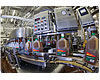
There are three rotary fillers for plastic bottles ranging from pints to gallons; one handles half gallons, another fills gallons and the third does small bottles. Gallons and halves are blow-molded on site in an adjacent building operated by Consolidated Container Co.; a 500-foot-long elevated conveyor system transports the containers to the bottling operation.
With milk, tea and drinks on the rotaries, paper half pints of milk for schools and foodservice are handled on two form-fill-seal machines. Rutter’s also packs a 4-ounce paper carton for hospitals and institutional use, says Brett Garner, operations manager.
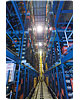
Finished products are packed into cases, which are stacked and conveyed by floor chain to an automated storage and retrieval system. The rack system offers about 2,000 pallet spaces, which tend not to stay occupied for long.
 “Most of it [turnover] is same day,” says Brian Ferry, warehouse supervisor, noting that the recent northeast winter storms pushed production to half-day turnover as snowbound consumers stocked up on milk and tea. “We have enough cushion that we can go two days. Some products like tea we only make twice a week, so we’ll have four- to five-day holding. But then you’re talking a 45-day shelf life versus two weeks [for milk].”

“We’ve been buying new components to better control what we have,” Rutter says. “A lot of the technology will help us with our energy drive [to counteract an expected utility rate hike] and make it easier to monitor and control equipment.”
Beyond that, it’s a process of constantly looking for ways to improve day-to-day routines.
“Every day, we look at what we’re doing and how to do it better,” says Gary Shaffer, maintenance supervisor. One way, he says, is to standardize parts and keep supplies on hand to minimize availability problems in the event of a breakdown.
“Something breaks on a Friday, you can’t wait until Monday to get a replacement,” Shaffer says. “Our parts inventory has almost doubled in the past 18 months. With all the cutbacks at the supplier level, we’ve had to become more self-sufficient.”
The company makes a habit of investing as much money back into the operation as possible, though a more significant planned expansion has been put on hold while the economy continues to regain its footing. “We try to put back as much money as we think we can afford,” Rutter says. “If we’re having a great year, we’ll spend more.”
 Last year, Rutter’s renovated its “tour room,” basically a conference room with a large window overlooking the plant floor from which visiting school groups can get a glimpse of operations. Also, the locker room and lunchroom, two of the oldest parts of the building that had previously just been cosmetically enhanced, were gutted and redone to replace systems as well as improve creature comforts for employees.
“There have been challenges in operating a modern business in an old facility, but it adds to our character,” Rutter says, explaining how the company’s casual corporate hierarchy makes it easier to get projects done. “I hate formal meetings, so we don’t have a lot of them. Instead, we have a lot of impromptu small-group sessions on a daily basis with the folks involved with whatever issue needs attention. Our team has matured into a very capable group of managers and supervisors that make very good decisions. We’ve gotten to the point where I can just be a coach and they make it happen.”
Garner says this empowering of individuals is one of the key benefits of being a family-run operation. “We do make our own decisions more often than at most companies,” he says. “We’ve learned it’s about what’s good for the whole company and what works, not just what is best for our own department.”
Rutter’s uses in-house and external training for its employee safety initiatives. In regards to food safety, the plant is HACCP certified and Sue Wise, QA manager, says she expects it to be SQF certified this fall.
In all, the Rutter’s Dairy plant team has a firm handle on operations. How the future plays out is to a certain extent dependent on forces beyond their control. But Rutter notes that the company’s hometown seems to have weathered the storm better than most.
“Our community is very resilient,” he says. “We’ve slowed down in this economic time, but we haven’t had the blood-letting of other areas that might have been reliant on one employer.”
Meanwhile, the folks at Rutter’s seem to be champing at the bit for the economy to climb back up into their comfort zone so they can launch a new expansion project. “We’re at the point of getting 20 pounds of stuff out of a 10-pound bag,” Rutter quips.
Garner adds: “In this economy, that’s a good position.”
Location: York, Pa.
History: Built 1930s, warehouse expansion 1989, last total renovation 1993.
Size: 120,000 square feet on 150 acres
Number of employees: 155
Products made: Fluid milk, teas, juices and drinks.
Total processing capacity: 140 SKUs (declined to provide volume)
Pasteurization: HTST, one unit @ 5,000 gallons/hour
Filling lines: Five (three plastic, two paper)
Storage capacity: 2,000 pallet spaces for finished product.
extras
These companies are among the key suppliers to Rutter’s Dairy:
Anderson Instruments
Consolidated Container Co.
Evergreen Packaging
Federal
GEA Westfalia
Green Spot
Jogue
Kline Process Systems
Portola Packaging
Robertet Flavors
US Label
Videojet
Westco
Outside, the plant complex along Interstate 83 in York, Pa., may appear at first to be a hodgepodge of structures that look like they were expanded piecemeal on an as-needed basis, all rubbing shoulders with a barn that up until a few years ago was home to a working dairy herd.
But inside, you’ll see as efficient and modern an operation as you can find.
That said, company President Todd Rutter confirms the above assessment of the plant’s history. “Our fathers and their fathers never believed in building anything bigger than you needed,” Rutter says, acknowledging the patchwork of additions typically added one section and even one floor at a time as needed.
Dating back to the 1930s, the plant’s last complete renovation was in 1993, when it was nearly completely gutted. All new conveyors and overhead equipment were added; the project was completed over a weekend with minimal disruption to production, Rutter recalls. “That solved a lot of issues like people walking over conveyors,” he says of the project.
The result is a compact facility that still is laid out in a very linear-like fashion, much like newer, larger plants designed for end-to-end flow. While the plant’s footprint requires lines to bend, they’re very logical and straightforward, making best use of available space with little or no clutter and confusion.
As such, volume at the 24/7 facility has increased 45% within the same footprint in the years since the renovation, Rutter notes.
Work flow
Tea and other non-dairy beverages are big business for Rutter’s, located in a region where RTD iced tea is as much of a mindset as religion or politics. Still, milk packaging outpaces tea most of the year (they run neck and neck during hot summers); beverages run about twice a week while milk runs daily.Milk is offloaded after passing lab tests and is HTST pasteurized. “Most of our milk is sourced from independent farms within 100 miles,” Rutter says. Teas are made from a powdered mix blended with water and other flavorings depending on variety.
There are three rotary fillers for plastic bottles ranging from pints to gallons; one handles half gallons, another fills gallons and the third does small bottles. Gallons and halves are blow-molded on site in an adjacent building operated by Consolidated Container Co.; a 500-foot-long elevated conveyor system transports the containers to the bottling operation.
With milk, tea and drinks on the rotaries, paper half pints of milk for schools and foodservice are handled on two form-fill-seal machines. Rutter’s also packs a 4-ounce paper carton for hospitals and institutional use, says Brett Garner, operations manager.
Finished products are packed into cases, which are stacked and conveyed by floor chain to an automated storage and retrieval system. The rack system offers about 2,000 pallet spaces, which tend not to stay occupied for long.
Making it happen
Since the last major renovation in 1993, improvements have been done on an as-needed basis to keep operations up to par. A shrink-sleeving machine for small bottles was added about seven years ago, tanks have been changed out and new customer service software and touchscreen control centers were added in 2008.“We’ve been buying new components to better control what we have,” Rutter says. “A lot of the technology will help us with our energy drive [to counteract an expected utility rate hike] and make it easier to monitor and control equipment.”
Beyond that, it’s a process of constantly looking for ways to improve day-to-day routines.
“Every day, we look at what we’re doing and how to do it better,” says Gary Shaffer, maintenance supervisor. One way, he says, is to standardize parts and keep supplies on hand to minimize availability problems in the event of a breakdown.
“Something breaks on a Friday, you can’t wait until Monday to get a replacement,” Shaffer says. “Our parts inventory has almost doubled in the past 18 months. With all the cutbacks at the supplier level, we’ve had to become more self-sufficient.”
The company makes a habit of investing as much money back into the operation as possible, though a more significant planned expansion has been put on hold while the economy continues to regain its footing. “We try to put back as much money as we think we can afford,” Rutter says. “If we’re having a great year, we’ll spend more.”
“There have been challenges in operating a modern business in an old facility, but it adds to our character,” Rutter says, explaining how the company’s casual corporate hierarchy makes it easier to get projects done. “I hate formal meetings, so we don’t have a lot of them. Instead, we have a lot of impromptu small-group sessions on a daily basis with the folks involved with whatever issue needs attention. Our team has matured into a very capable group of managers and supervisors that make very good decisions. We’ve gotten to the point where I can just be a coach and they make it happen.”
Garner says this empowering of individuals is one of the key benefits of being a family-run operation. “We do make our own decisions more often than at most companies,” he says. “We’ve learned it’s about what’s good for the whole company and what works, not just what is best for our own department.”
Rutter’s uses in-house and external training for its employee safety initiatives. In regards to food safety, the plant is HACCP certified and Sue Wise, QA manager, says she expects it to be SQF certified this fall.
In all, the Rutter’s Dairy plant team has a firm handle on operations. How the future plays out is to a certain extent dependent on forces beyond their control. But Rutter notes that the company’s hometown seems to have weathered the storm better than most.
“Our community is very resilient,” he says. “We’ve slowed down in this economic time, but we haven’t had the blood-letting of other areas that might have been reliant on one employer.”
Meanwhile, the folks at Rutter’s seem to be champing at the bit for the economy to climb back up into their comfort zone so they can launch a new expansion project. “We’re at the point of getting 20 pounds of stuff out of a 10-pound bag,” Rutter quips.
Garner adds: “In this economy, that’s a good position.”
AT a glance
Rutter’s DairyLocation: York, Pa.
History: Built 1930s, warehouse expansion 1989, last total renovation 1993.
Size: 120,000 square feet on 150 acres
Number of employees: 155
Products made: Fluid milk, teas, juices and drinks.
Total processing capacity: 140 SKUs (declined to provide volume)
Pasteurization: HTST, one unit @ 5,000 gallons/hour
Filling lines: Five (three plastic, two paper)
Storage capacity: 2,000 pallet spaces for finished product.
extras
These companies are among the key suppliers to Rutter’s Dairy:
Anderson Instruments
Consolidated Container Co.
Evergreen Packaging
Federal
GEA Westfalia
Green Spot
Jogue
Kline Process Systems
Portola Packaging
Robertet Flavors
US Label
Videojet
Westco
Looking for a reprint of this article?
From high-res PDFs to custom plaques, order your copy today!