Quantifying the Environmental Impact of Secondary Packaging
A comparison of the sustainability of “pad shrink” packaging systems versus RSC cases.

The term “sustainability” is heard in boardrooms everywhere these days because it is a concept that embraces both environmental and bottom-line business concerns. For product packagers, sustainability means reconciling what can be conflicting goals: minimizing whatever negative impacts their packaging may have on the environment while adequately protecting products during shipping and handling. Packagers today are facing increasing demands for “sustainability” from every direction – consumers, retailers and nonprofit watchdog groups – with few of these groups offering specific guidelines on how to measure it. What’s more, packagers are encouraged to achieve these dual goals while also controlling the costs of packaging to their customers.
This paper will examine the environmental advantages of pad shrink packaging as compared to traditional RSC (regular slotted containers) for secondary packaging of cans, rigid plastic bottles, glass jars, plastic jars, tapered plastic cups and paperboard canisters.

A. Beneficial, safe and healthy for individuals and communities throughout its life cycle
B. Meets market criteria for performance and cost
C. Sourced, manufactured, transported and recycled using renewable energy
D. Maximizes the use of renewables or recycled source materials
E. Manufactured using clean production technologies and best practices
F. Made from materials healthy in all probable end-of-life scenarios
G. Physically designed to optimize materials and energy
H. Effectively recovered and utilized in biological and/or industrial cradle-to-cradle cycles
While not all of the criteria for sustainable packaging listed above are necessarily achievable in every packaging application, a pad shrink packaging system represents a significant step toward sustainability in secondary packaging. This system reduces both the amount of material required to create the packaging and the amount of waste added to the environment throughout the product cycle.
Figure 1 - Raw Material Weight Comparison
Raw Material Type Weight (lbs) Raw Material Type Weight (lbs)
Pad and Overwrap RSC Container
Corrugated Pad 0.016 Corrugated Case 0.218
Shrink Film 0.019 BOPP Tape 0.002
Adhesive 0.004
Total R.M. Weight (lbs) 0.039 Total R.M. Weight (lbs) 0.220
Pad shrink system has 82.3% less R.M. weight (lbs) when compared to RSC container
The pad shrink packaging system combines three materials to build a stable secondary package bundle that replaces the traditional corrugated container.
A flat corrugated pad forms a base for rigidity
A holt-melt adhesive (applied to the flat pad) temporarily bonds the primary containers to the pad during packing
A low-cost, recyclable polyethylene (PE) shrink film securely encapsulates the assembled package
The resulting compact bundle often adds to savings by allowing an additional layer of packages to be added to each pallet load, thus increasing product density and reducing transportation energy and costs. The system is typically used to ship a variety of primary containers, including cans, rigid plastic bottles, glass jars, plastic jars, tapered plastic cups and paperboard canisters.

Allied used an Environmental Life Cycle Analysis tool that analyzed and compared the environmental impact of various complex packaging scenarios. The study examined the following factors:
Materials – Raw materials such as corrugated cardboard, PE film, glue and biaxially oriented polypropylene (BOPP) tape. The total weight of the materials needed by each system was considered for the comparison along with the amount of energy and greenhouse gases associated with their production and disposal.
Transportation – Energy used to ship raw materials from the converter to the packager and ultimately to the customer. The energy consumed for transportation was used to calculate its contribution to greenhouse gas production. While the transportation distances were the same for both packaging systems, greenhouse gas production varied with the weight and volume of materials shipped.
Energy – Electric energy used for manufacturing packaging materials and operating the packaging equipment. Total energy consumed was used to calculate the amount of greenhouses gases produced.
--PE resins are shipped via rail car and require no secondary packaging; PE film is usually shipped by truck and requires protection such as cores, liner bags, end caps, etc.
--Materials used in the pad shrink system and corrugated cases were assumed to be sourced and used in the same manner.
--Transportation distance for all raw materials was assumed to be 250 miles. Rail car shipments were assumed to contain 200,000 pounds of raw materials. Truck shipments were assumed to be 40,000 pounds of raw materials.
--Final product distribution to retailers assumed a distance of 500 miles. The volume of stretch film used for wrapping individual pallet loads was assumed to be equal for both types of shippers.-
--Manufacturing processes for each component (corrugated case, corrugated pad, shrink film, etc.) was based on a typical large-scale converting process.
In addition to the energy needed to produce raw materials, the study calculated the process energy required to produce the finished package components, including energy for production, warehousing and support space in each facility.The method of disposal for all packaging was assumed to be landfill, although corrugated cardboard and PE film are recyclable. Reusable items such as pallets were assumed to be reused 20 times. Production volumes were assumed to be the same for the pad shrink system and the corrugated case packaging. Final study results were based on a total volume of five million bottles of lotion, which translates to 833,333 pad shrink shippers or RSC cases.
Study findings support pad shrink system
When comparing the pad shrink packaging system to conventional corrugated containers, the study found that the pad shrink system reduced the amount of material to be recycled or disposed of in a landfill by 82% (see Figure 2).
Due to less raw material input and less material handling, the pad shrink system reduced the amount of process energy consumption by 62 percent. While shrink film requires more energy per pound to manufacture than corrugated cardboard, its significant reduction in energy consumed during transportation and processing still made it a clear winner, according to the study (see Figure 3).
Greenhouse gas emissions were found to be 55% lower with the pad shrink system. This was the result of less emissions during transportation combined with reduced process energy consumption and savings in raw materials (see Figure 4).
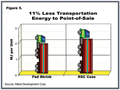
Due to the pad shrink system’s lower weight and greater product density, it was found to cut the amount of energy consumed in transporting the products to the point-of-sale by 11% (see Figure 5).
Conclusions
The results of this independent study demonstrate that the pad shrink packaging system fulfills many of the eight characteristics for sustainability identified by the SPC. The study data also supports the financial and environmental advantages of using the pad shrink system rather than RSC cases for end-of-line packaging due to the system’s 75 percent reduction in the volume of material – material that doesn’t have to be manufactured, transported or disposed of in a landfill.
Today all packagers need to be good stewards of natural resources and to act with environmental responsibility as they compete in their various markets. By comparing the sustainability of packaging system alternatives, secondary packagers can make informed choices that will benefit both their businesses and the environment.
About Delkor Systems Inc.
For more than 30 years, Delkor Systems Inc. has manufactured innovative packaging systems that automatically form, load, inspect, wrap and seal end-of-line trays, cartons and cases. The company’s practical solutions enable customers to become lower-cost producers through the use of automation, robotics and other packaging line efficiencies.
For more information about Delkor Systems Inc. and its products, contact Ken Sullivan, director of marketing, at ksullivan@delkorsystems.com or 763/746-1886, or visit www.delkorsystems.com.
Delkor’s Spot-Pak
The patented Delkor Spot-Pak® package is composed of three material elements: a flat corrugated pad; an applied pattern of hot-melt, temporary-bond adhesive; and polyethylene (PE) heat-shrink film. The adhesive bond is temporary and only intended to stabilize individual product containers on the pad as it moves through the package assembly process. The base pad, which is sized to accommodate a desired quantity and pack pattern of primary product containers, provides rigidity for individual Spot-Pak shippers and allows them to be stacked onto pallets in multilayer configurations. For added strength and rigidity, a top pad can be added to the package structure.
Prior to shipment and as the final step in the package assembly process, low-cost, recyclable PE film heat-shrinks around the flat pad after products have been placed onto it, thereby forming a secure, unitized bundle. Once a Spot-Pak shipper has reached its retail destination, the temporary bond adhesive allows easy release of each container so that packages can be manually stocked on store shelves.
The Delkor Spot-Pak packaging method is typically automated, using advanced end-of-line systems for high-speed production.
The term “sustainability” is heard in boardrooms everywhere these days because it is a concept that embraces both environmental and bottom-line business concerns. For product packagers, sustainability means reconciling what can be conflicting goals: minimizing whatever negative impacts their packaging may have on the environment while adequately protecting products during shipping and handling. Packagers today are facing increasing demands for “sustainability” from every direction – consumers, retailers and nonprofit watchdog groups – with few of these groups offering specific guidelines on how to measure it. What’s more, packagers are encouraged to achieve these dual goals while also controlling the costs of packaging to their customers.
This paper will examine the environmental advantages of pad shrink packaging as compared to traditional RSC (regular slotted containers) for secondary packaging of cans, rigid plastic bottles, glass jars, plastic jars, tapered plastic cups and paperboard canisters.
Setting standards for sustainable packaging
One organization that has tried to define sustainability is the Sustainable Packaging Coalition, an industry working group dedicated to transforming packaging into a system that encourages a sustainable flow of materials. This group lists these ideal attributes of sustainable packaging:A. Beneficial, safe and healthy for individuals and communities throughout its life cycle
B. Meets market criteria for performance and cost
C. Sourced, manufactured, transported and recycled using renewable energy
D. Maximizes the use of renewables or recycled source materials
E. Manufactured using clean production technologies and best practices
F. Made from materials healthy in all probable end-of-life scenarios
G. Physically designed to optimize materials and energy
H. Effectively recovered and utilized in biological and/or industrial cradle-to-cradle cycles
While not all of the criteria for sustainable packaging listed above are necessarily achievable in every packaging application, a pad shrink packaging system represents a significant step toward sustainability in secondary packaging. This system reduces both the amount of material required to create the packaging and the amount of waste added to the environment throughout the product cycle.
The pad shrink packaging system
The pad shrink packaging system was developed in the early 1990s primarily as a means to control packaging material costs and secondarily as a means to reduce end-of-life disposal costs for customers. It achieved those primary goals by reducing secondary packaging costs for a wide variety of users by up to 50 percent compared to trays and 75 percent compared to traditional corrugated cases (see Figure 1).Figure 1 - Raw Material Weight Comparison
Raw Material Type Weight (lbs) Raw Material Type Weight (lbs)
Pad and Overwrap RSC Container
Corrugated Pad 0.016 Corrugated Case 0.218
Shrink Film 0.019 BOPP Tape 0.002
Adhesive 0.004
Total R.M. Weight (lbs) 0.039 Total R.M. Weight (lbs) 0.220
Pad shrink system has 82.3% less R.M. weight (lbs) when compared to RSC container
The pad shrink packaging system combines three materials to build a stable secondary package bundle that replaces the traditional corrugated container.
A flat corrugated pad forms a base for rigidity
A holt-melt adhesive (applied to the flat pad) temporarily bonds the primary containers to the pad during packing
A low-cost, recyclable polyethylene (PE) shrink film securely encapsulates the assembled package
The resulting compact bundle often adds to savings by allowing an additional layer of packages to be added to each pallet load, thus increasing product density and reducing transportation energy and costs. The system is typically used to ship a variety of primary containers, including cans, rigid plastic bottles, glass jars, plastic jars, tapered plastic cups and paperboard canisters.
Quantifying the environmental advantages
While a packaging system that uses less raw material and results in less waste for landfills was presumed to be more “green,” this thesis was recently confirmed empirically in a study by Allied Development Corporation of Burnsville, Minn. In order to help secondary packagers to make informed decisions about the system that best meets their packaging and environmental goals, Allied compared the total environmental impact of a pad shrink system (the Spot-Pak® system from Delkor) versus a traditional corrugated RSC case when both are used to protect and transport a six-unit multipack of 10-ounce bottles of hand lotion.Allied used an Environmental Life Cycle Analysis tool that analyzed and compared the environmental impact of various complex packaging scenarios. The study examined the following factors:
Materials – Raw materials such as corrugated cardboard, PE film, glue and biaxially oriented polypropylene (BOPP) tape. The total weight of the materials needed by each system was considered for the comparison along with the amount of energy and greenhouse gases associated with their production and disposal.
Transportation – Energy used to ship raw materials from the converter to the packager and ultimately to the customer. The energy consumed for transportation was used to calculate its contribution to greenhouse gas production. While the transportation distances were the same for both packaging systems, greenhouse gas production varied with the weight and volume of materials shipped.
Energy – Electric energy used for manufacturing packaging materials and operating the packaging equipment. Total energy consumed was used to calculate the amount of greenhouses gases produced.
Study assumptions
As in all formal studies, it is important to understand the basic assumptions made about the test conditions. Following is a list of the underlying assumptions:--PE resins are shipped via rail car and require no secondary packaging; PE film is usually shipped by truck and requires protection such as cores, liner bags, end caps, etc.
--Materials used in the pad shrink system and corrugated cases were assumed to be sourced and used in the same manner.
--Transportation distance for all raw materials was assumed to be 250 miles. Rail car shipments were assumed to contain 200,000 pounds of raw materials. Truck shipments were assumed to be 40,000 pounds of raw materials.
--Final product distribution to retailers assumed a distance of 500 miles. The volume of stretch film used for wrapping individual pallet loads was assumed to be equal for both types of shippers.-
--Manufacturing processes for each component (corrugated case, corrugated pad, shrink film, etc.) was based on a typical large-scale converting process.
In addition to the energy needed to produce raw materials, the study calculated the process energy required to produce the finished package components, including energy for production, warehousing and support space in each facility.The method of disposal for all packaging was assumed to be landfill, although corrugated cardboard and PE film are recyclable. Reusable items such as pallets were assumed to be reused 20 times. Production volumes were assumed to be the same for the pad shrink system and the corrugated case packaging. Final study results were based on a total volume of five million bottles of lotion, which translates to 833,333 pad shrink shippers or RSC cases.
Study findings support pad shrink system
When comparing the pad shrink packaging system to conventional corrugated containers, the study found that the pad shrink system reduced the amount of material to be recycled or disposed of in a landfill by 82% (see Figure 2).
Due to less raw material input and less material handling, the pad shrink system reduced the amount of process energy consumption by 62 percent. While shrink film requires more energy per pound to manufacture than corrugated cardboard, its significant reduction in energy consumed during transportation and processing still made it a clear winner, according to the study (see Figure 3).
Greenhouse gas emissions were found to be 55% lower with the pad shrink system. This was the result of less emissions during transportation combined with reduced process energy consumption and savings in raw materials (see Figure 4).
Due to the pad shrink system’s lower weight and greater product density, it was found to cut the amount of energy consumed in transporting the products to the point-of-sale by 11% (see Figure 5).
Conclusions
The results of this independent study demonstrate that the pad shrink packaging system fulfills many of the eight characteristics for sustainability identified by the SPC. The study data also supports the financial and environmental advantages of using the pad shrink system rather than RSC cases for end-of-line packaging due to the system’s 75 percent reduction in the volume of material – material that doesn’t have to be manufactured, transported or disposed of in a landfill.
Today all packagers need to be good stewards of natural resources and to act with environmental responsibility as they compete in their various markets. By comparing the sustainability of packaging system alternatives, secondary packagers can make informed choices that will benefit both their businesses and the environment.
About Delkor Systems Inc.
For more than 30 years, Delkor Systems Inc. has manufactured innovative packaging systems that automatically form, load, inspect, wrap and seal end-of-line trays, cartons and cases. The company’s practical solutions enable customers to become lower-cost producers through the use of automation, robotics and other packaging line efficiencies.
For more information about Delkor Systems Inc. and its products, contact Ken Sullivan, director of marketing, at ksullivan@delkorsystems.com or 763/746-1886, or visit www.delkorsystems.com.
Delkor’s Spot-Pak
The patented Delkor Spot-Pak® package is composed of three material elements: a flat corrugated pad; an applied pattern of hot-melt, temporary-bond adhesive; and polyethylene (PE) heat-shrink film. The adhesive bond is temporary and only intended to stabilize individual product containers on the pad as it moves through the package assembly process. The base pad, which is sized to accommodate a desired quantity and pack pattern of primary product containers, provides rigidity for individual Spot-Pak shippers and allows them to be stacked onto pallets in multilayer configurations. For added strength and rigidity, a top pad can be added to the package structure.
Prior to shipment and as the final step in the package assembly process, low-cost, recyclable PE film heat-shrinks around the flat pad after products have been placed onto it, thereby forming a secure, unitized bundle. Once a Spot-Pak shipper has reached its retail destination, the temporary bond adhesive allows easy release of each container so that packages can be manually stocked on store shelves.
The Delkor Spot-Pak packaging method is typically automated, using advanced end-of-line systems for high-speed production.
Looking for a reprint of this article?
From high-res PDFs to custom plaques, order your copy today!