Tools for Innovation: Dairy Foods for Today's Pre-teens
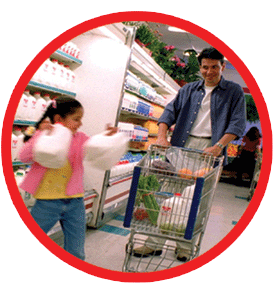
Because today's on-the-go lifestyles allow kids early, and many times unguided, access to more convenient foods and beverages, kids do not always make the most nutritious choices. Healthful foods have historically been under-marketed to kids, or simply not marketed. It's not just at school, but also at home and everywhere in between, especially for kids with pocket money. This eating and drinking environment is one of the factors contributing to the epidemic of overweight and obese children in the United States.
Nutritionally dense dairy foods-particularly milk, yogurt and cheese-are well suited to be marketed directly to kids. Most kids love the taste of milk, yogurt and cheese. They just need it to be packaged and positioned as cool and fun, like soda, chips and candy bars. (Tools for such improvements can be found throughout this supplement.)
Food manufacturers willing to innovate to differentiate kids' products from mainstream foods must be finding that the investment is worth the payoff, as new kid-focused products are showing up in grocery stores, vending machines and convenience stores around the country.
"With kids' products, the innovation timeline is much shorter than with foods for mainstream America," says Marilyn Raymond, director of new business development, New Product Works, Ann Arbor, Mich. "Innovative product changes must be shorter than a year to keep kids interested."
According to Census 2000, about 20% of the U.S. population, or 56.3 million people, is under 13 years old. That's a lot of potential customers. And 8- to 12-year-old kids, also known as "tweens," influence or are directly responsible for $335 billion in spending annually, with 30%-40% of that going towards food and beverage, according to the 1999 Nickelodeon/Yankelovich Youth Monitor Survey.
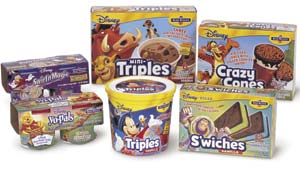
Marketers of salty and sweet snacks, breakfast cereals and beverages have traditionally been successful with appealing to kids through formulation, packaging and graphics. With other food categories, the kid-focused trend really took off a few years ago with the debut of yogurt in tubes and ketchup in colors. Now grocery stores carry kids' products such as pizza-flavored salad dressing and squeezable peanut butter tubes. (See accompanying Take Note article)
What kids like
Kids like color-sometimes, and not all colors in all foods. Kids like flavor-sometimes, but nothing too bizarre, or at least not on a regular basis. Kids like characters and collectables. Interactivity and packaging also influence purchase decisions. Kids see the package as part of the product, and both must support their lifestyle and image.Because products for a 3-year-old are very different than products for a 12-year-old, marketers need to be aware of what influences kids at different ages in order to find success in the emerging kids' food products category.
For kids under eight, parents are it. Mom and dad are gatekeepers, and it is their dollar laid down at the register for purchases. This is not to say that the under-eight-group doesn't have likes and dislikes. It just means products for this group must always earn parental approval.
Tweens, on the other hand, tend to be very involved with purchase decisions, with many away-from-home snacks and meals having no parental acknowledgement at all. In the tween years, kids are in a stage of exerting self-expression. At times they are rebellious, and at other times, they crave comfort. The bottom line, though, is they can't be fooled. They are a marketing-savvy consumer segment that is highly cynical of anyone or any product that talks at them instead of to them.
"Behaviorally, physically and maybe even cognitively, kids are getting older younger," says Marsha Williams, v.p. of research and planning, Nickelodeon, a Viacom company, New York. "They are more skeptical than any generation of kids before. These are some of the reasons it is so challenging to ‘wow' them."
Martha Seidner Gelber, v.p., Smith Design, Glen Ridge, N.J., a brand design agency specializing in family, kid and tween brands, says, "Successful kids' products speak to kids' lifestyles and answer a need-and successful package design communicates a message that's relevant to the consumer you're trying to reach-no matter their age."
"Kids' emotional chords are different, but no less important in marketing efforts," Williams concludes. "It is important to appeal to kids' desire for more autonomy and independence, their need for belonging or their need to feel competent and smart."
New Product Works recently conducted focus groups with two age groups of kids.
"The 9- and 10-year-old group made it very clear that color and tactile feel influence the products they like," says Raymond. "Tactile feel, which includes shape and texture, is a strong visual cue for signaling play value for this group. And play value is very important."
As kids get a little older, play value is no longer as important, nor considered cool. This is exemplified by an evaluation of tube foods, such as squeezable yogurts.
"The younger group preferred tubes for yogurt, describing the tube as cool and easy-to-use," says Raymond. "The 11- and 12-year-old group preferred their yogurt in a cup. Grossness and feeling babyish are strong factors for moving towards the adult versions.
"Kids in the younger age group also told us that contests or special limited-time offers on labels will get them to try a product," Raymond says. "With older kids, they said portability is an attractive feature, as they are more independent from their parents, and rely on the ability to throw a snack into their backpack for after-school activities."
Interestingly, all kids, as well as adults who are kids at heart, like characters. It's just the type of character that changes through the years.
"If a character is appropriate for the brand and product, it can really help the overall graphic approach, since characters are such obvious visual cues for adults and kids," says Gelber. "Generally speaking, it's best to skew characters up in age, since kids are aspirational-always looking to what's next, and to the older kids. And if you're marketing a non-gender-specific product, it's best to show a boy or a group of kids. Avoid ‘girls-only' messages. For ages 6-12, girls are more accepting of products with boys on the package, but the opposite is seldom true."
With pre-tweens (kids under eight), collecting characters is very popular, which is one of the reasons why McDonald's Happy Meals® are such a hit with this group. They want to go back every week to complete their set of whatever series of toys is part of the meal.
In Zone Brands, Atlanta, manufactures BellyWashers®, which are single-serve drinks that come in reusable bottles with character sports tops. They sell for up to $3.00 a piece. In Zone Brands knows the power of character collecting very well.
"With BellyWashers, we are focusing on a life stage product, and instead of simply marketing a fruit drink to young children, we are selling them a fun experience," says Kathy VerEecke, v.p., marketing. "The package is the purchase driver. In many cases, kids don't even realize what flavor the drink is until they taste it.
"There are currently 46 BellyWashers characters in the marketplace," says VerEecke. "After anywhere from three months to a year, we will retire the package and redesign the bottle. Kids know that, and buy each new character based on its ‘limited availability.' Kids want their BellyWashers character set to be complete."
School success screams opportunity
There's nothing like quantitative research to support some of the aforementioned attributes that influence kids to buy and consume foods.Recently the National Dairy Council and the American School Food Service Association set out to learn how a combination of upgrades in milk packaging, flavor variety, refrigeration and merchandising locations impact students' selection and consumption of milk. This School Milk Pilot Test (SMPT) involved more than 100,000 students enrolled in 146 elementary and secon-dary schools (47 controls, 99 tests) from 18 school districts in different parts of the country.
Results are very positive. Milk sales increased 15% in elementary test schools and 22% in secondary test schools. Overall, the increase was 18% for all participating test schools, with 86% of sales coming from the meal line.
Not only did students take more milk, but they drank more of the milk they took, as indicated by milk plate waste findings. The average decrease in plate waste was 18% in elementary schools and 26% in secondary schools.
Students participating in the SMPT were queried on their food and beverage attitudes and behaviors, and a majority indicated a preference for plastic resealable bottles over cartons. Secondary school students also liked larger servings of milk (10-oz, as compared to 8-oz).
The key here is that by presenting a more appealing package on the school meal line, the nutritional profiles of a greater number of children can be enhanced.
Nine dairy processors participated in the study, each providing its current style of plastic resealable bottle. Improving the package for school meal lunches is critical to the future of fluid milk manufacturers. Marketers must view the more than 27 million students who pass through the lunch line every day as future milk customers. The SMPT research also indicates that to get the best improvement in milk sales, all school milk merchandising venues (meal line, a la carte and vending) should be upgraded. A model of this pilot, if implemented on a national basis, would result in a 67 million gallon increase in milk consumption at schools.
Who owns milk in the beverage category?
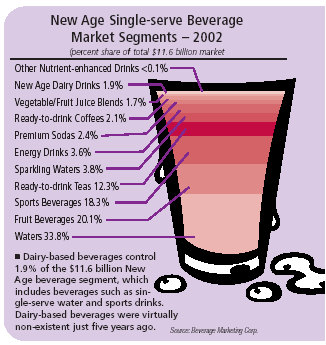
It is safe to say that fluid milk marketers lost their franchise on calcium, as almost every beverage type has a calcium-fortified offering. Until February of this year, within the beverage segment, milk still had exclusive FDA approval for vitamin D fortification, but now fruit juices and juice drinks can be formulated to contain vitamin D.What's left? It's milk's inherent nutrient-dense profile, creamy flavor and appealing opaque appearance. All reasons why "other" beverage manufacturers are increasingly adding milk to their beverage formulations.
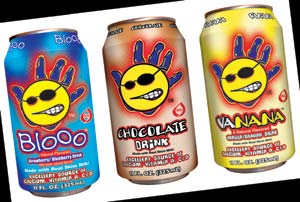
Referred to as New Age Dairy Beverages, this category should not be frowned upon by the milk industry, as such drinks are getting more milk into more kids. It presents a growth opportunity for fluid milk processors, particularly with those drinks that contain more than 51% milk and are able to sport the Real Seal. The question must be asked: Would you rather kids drink 12-oz cans of carbonated sugar water or 12-oz cans of flavored milk-based drinks, which contain at least 6-oz of milk?
Leading soft drink companies are marketing such beverages. Dairies need to show these beverage giants that the dairy industry owns milk by applying effective formulation, packaging and marketing techniques to grab hold of young consumers and keep them hooked on dairy as they grow up.
Links
Looking for a reprint of this article?
From high-res PDFs to custom plaques, order your copy today!