Fiber's Fit for Dairy
Dairy and fiber have never been thought to be synonymous. Nevertheless, using modern food science, dairy products formulated to include fiber can provide a wide array of health benefits including acting as a prebiotic to improve intestinal health. And don't worry, using high-quality, prebiotic fiber will improve the taste and texture of dairy products at the same time it increases consumers' well being.
Not all prebiotics are equal
Although all prebiotic fibers increase beneficial microflora to some degree, not all are highly bifidogenic at very low inclusion rates. Bifidogenic fibers not only stimulate the growth of beneficial probiotic organisms in the gut, they restrict the growth of potentially pathogenic ones.Short-chain fructooligosaccharide (scFOS[tm]) is a prebiotic fiber with application in dairy foods. It consists of GFn type molecules, where G is glucose, F is fructose and n is the degree of polymerization (DP), which is the number of fructose units linked in a linear chain and ranges from 2 to 4. ScFOS is produced from sucrose (sugar cane or sugar beets) by a natural fermentation process, and is a proven bifidogenic factor.
The efficiency of a prebiotic fiber is directly related to the molecular chain length and percent purity. The short chain length of scFOS allows more probiotic microorganisms to ferment this fiber than longer-chain or mixed-chain prebiotics. For example, some long-chain prebiotics do not effectively support the growth of either Lactobacilli or many strains of Bifidobacteria. However, with 95% pure scFOS, bifidogenicity is apparent with a daily dose of just a single gram.
Calcium absorption
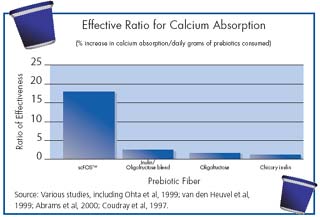
Bifidogenicity is also associated with increased calcium absorption. This graph illustrates the relative benefit, shown as a ratio of calcium absorption to dose, of a variety of prebiotic ingredients. Only 3g of scFOS in a single daily dose significantly increased calcium absorption. As shown in the graph, longer-chain and mixed-chain prebiotics have various bifidogenic profiles, and require much larger amounts to provide a significant increase in mineral absorption. Only scFOS gives significant results with a low dose.Furthermore, many of the health benefits of a prebiotic come from the formation of short chain fatty acids (SCFA). Not digested in the upper gastrointestinal tract, rather fermented by friendly probiotic gut bacteria in the colon, scFOS (being small in chain length) is quickly converted to beneficial SCFA. This is because there are fewer chemical linkages to be broken. SCFA directly nourish colon cells, strengthen the gut wall and increase mineral absorption.
Other added benefits of scFOS are safety for diabetics and minimum calorie contribution for diet and light applications. Most fermentable carbohydrates contribute 4cal/g, but the fermentation of scFOS yields 1.5cal/g as SCFA. Consequently, scFOS does not raise blood glucose or cause an insulin response.
Sensory analysis has shown that scFOS is a very effective flavor enhancer. For example, scFOS minimizes the undesirable metallic/bitter aftertaste of some high-intensity sweeteners. This is due to the very clean, mild, sweet taste of this particular prebiotic fiber. The flavor refreshes the palate and masks a variety of undesirable notes. The effect improves overall flavor profile, increasing the acceptability of dairy products.
Highly soluble and with good water-holding capacity, scFOS will provide a smooth, soft and creamy texture, and may also aid in preventing syneresis. These characteristics will also help to improve the quality and appeal of fat-reduced or fat-free dairy products.
Dairy processors will be pleased with the versatility and compatibility of scFOS when adding it to their formulations. Fiber and dairy have never been a better match.
Looking for a reprint of this article?
From high-res PDFs to custom plaques, order your copy today!