Churning the Pallets
A dairy cooperative improves its butter operation with a robotic palletizer.

With a fluctuating economy and pressure to keep dairy prices low, the Maryland & Virginia Milk Producers Cooperative Association was looking for ways to improve product processes for its Laurel, Md., manufacturing plant, which processes butter, condensed milk and non-fat dry milk for use in infant formula, ice cream, candy and bakery items.
One area under specific scrutiny was the plant's packaging and palletizing process, which required manually packaging and palletizing its perishable butter in 50-lb. and 25-kg. boxes with plastic liners. This process, on average, required two-and-a-half workers per shift. But in times of seasonal flux when more product was being handled, the worker's throughput rate of 100 boxes per hour was too static to get the job done.
"The average age of our workforce is 45," says Randall Fischer, assistant division manager at Maryland & Virginia Milk Producers. "Lifting hundreds of 50-lb. boxes each day would be hard on even younger workers. For this reason, the stacking job was the least popular, most strenuous job in the facility, and there was always a significant risk of injury when the job was done by hand."
To improve manufacturing efficiency, Maryland & Virginia Milk Producers approached Westfalia Technologies, a York, PA, provider of material handling and warehousing automation systems, about a robotic palletizer. The company determined that the Westfalia/Fuji EC-61's rate and size characteristics fit the co-op's requirements. Another benefit of the robotic palletizer was that it required only 220 volts of power, which eliminated the need for an electrical upgrade.
In addition, the system features user-friendly programming software with a touch-screen operating system that enables operators to program changes in seconds, perform inventory monitoring, onboard diagnostics and real time I/O monitoring. Operators can also access an onboard lubrication schedule system and a fault history log.
While the equipment was ideal, there were three distinct challenges associated with installing it in the Laurel plant: a harsh environment, restricted budget and short, three-month timeframe for installation.
"We were particularly concerned about finding equipment to fit the environment," says Fischer. "Because we steam clean the butter churn and butter silo daily using the clean-in-place method, it creates a very warm, damp atmosphere. Some vendors offer stainless steel equipment, but that would have been cost prohibitive."
Further complicating matters was the floor of the butter line which was constructed of brick laid over a sand base. Westfalia's engineers had to determine how to keep the robotic palletizer and its base platform dry in this damp environment while properly anchoring and supporting the weight of the system.
The engineers decided to remove the floor where the robotic palletizer would be installed down to the concrete sub floor and pour a 4-ft.-by-4-ft. concrete pad/curb to an elevation of about 4 in. above the sand and brick floor grade. The base and the robotic palletizer were installed on this pad, providing the needed stability and allowing the base to be kept out of the water that accumulates during washdown.
Westfalia engineers were able to have the system installed eight weeks after receiving the purchase order and the final cost was less than the cooperative had budgeted for the project. So, not only were the location, time and cost obstacles overcome, but the process has benefited, as well.
"One person can now operate the line," says Fischer. "This system saves on manpower and eliminates the liability associated with a manual palletizing operation. Within two years, the palletizer will have paid for itself."
This article appeared previously in Food Engineering Magazine.
For more information: Tom Price; Westfalia Technologies; 570/945-7834; tprice@westfaliausa.com.
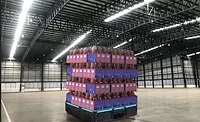
A Westfalia/Fuji EC-61 robotic palletizer was installed in Maryland & Virginia Milk Producers' Laurel, Md., plant where it helps the company save manpower and increase efficiency.
With a fluctuating economy and pressure to keep dairy prices low, the Maryland & Virginia Milk Producers Cooperative Association was looking for ways to improve product processes for its Laurel, Md., manufacturing plant, which processes butter, condensed milk and non-fat dry milk for use in infant formula, ice cream, candy and bakery items.
One area under specific scrutiny was the plant's packaging and palletizing process, which required manually packaging and palletizing its perishable butter in 50-lb. and 25-kg. boxes with plastic liners. This process, on average, required two-and-a-half workers per shift. But in times of seasonal flux when more product was being handled, the worker's throughput rate of 100 boxes per hour was too static to get the job done.
"The average age of our workforce is 45," says Randall Fischer, assistant division manager at Maryland & Virginia Milk Producers. "Lifting hundreds of 50-lb. boxes each day would be hard on even younger workers. For this reason, the stacking job was the least popular, most strenuous job in the facility, and there was always a significant risk of injury when the job was done by hand."
To improve manufacturing efficiency, Maryland & Virginia Milk Producers approached Westfalia Technologies, a York, PA, provider of material handling and warehousing automation systems, about a robotic palletizer. The company determined that the Westfalia/Fuji EC-61's rate and size characteristics fit the co-op's requirements. Another benefit of the robotic palletizer was that it required only 220 volts of power, which eliminated the need for an electrical upgrade.
In addition, the system features user-friendly programming software with a touch-screen operating system that enables operators to program changes in seconds, perform inventory monitoring, onboard diagnostics and real time I/O monitoring. Operators can also access an onboard lubrication schedule system and a fault history log.
While the equipment was ideal, there were three distinct challenges associated with installing it in the Laurel plant: a harsh environment, restricted budget and short, three-month timeframe for installation.
"We were particularly concerned about finding equipment to fit the environment," says Fischer. "Because we steam clean the butter churn and butter silo daily using the clean-in-place method, it creates a very warm, damp atmosphere. Some vendors offer stainless steel equipment, but that would have been cost prohibitive."
Further complicating matters was the floor of the butter line which was constructed of brick laid over a sand base. Westfalia's engineers had to determine how to keep the robotic palletizer and its base platform dry in this damp environment while properly anchoring and supporting the weight of the system.
The engineers decided to remove the floor where the robotic palletizer would be installed down to the concrete sub floor and pour a 4-ft.-by-4-ft. concrete pad/curb to an elevation of about 4 in. above the sand and brick floor grade. The base and the robotic palletizer were installed on this pad, providing the needed stability and allowing the base to be kept out of the water that accumulates during washdown.
Westfalia engineers were able to have the system installed eight weeks after receiving the purchase order and the final cost was less than the cooperative had budgeted for the project. So, not only were the location, time and cost obstacles overcome, but the process has benefited, as well.
"One person can now operate the line," says Fischer. "This system saves on manpower and eliminates the liability associated with a manual palletizing operation. Within two years, the palletizer will have paid for itself."
This article appeared previously in Food Engineering Magazine.
For more information: Tom Price; Westfalia Technologies; 570/945-7834; tprice@westfaliausa.com.
Links
Looking for a reprint of this article?
From high-res PDFs to custom plaques, order your copy today!