Dairy Detective: What's New in Process Cheese?
Most consumers think of process cheese as orange American slices. But it may soon come in red, white and even blue shades as well as an entire melting pot of ethnic varieties. It might also be lower in sodium and fat. New Dairy Management Inc.-supported research in process cheese is aiding in the development of products that appeal to children and other demographics, and increase opportunities for use in healthy sandwiches, snacks and entrees.

Most consumers think of process cheese as orange American slices. But it may soon come in red, white and even blue shades as well as an entire melting pot of ethnic varieties. It might also be lower in sodium and fat. New Dairy Management Inc.-supported research in process cheese is aiding in the development of products that appeal to children and other demographics, and increase opportunities for use in healthy sandwiches, snacks and entrees.
Process cheeses in fun flavors have taken off in Europe and Japan. In Korea, a chocolate cheese is a big hit with the younger generation. Here in the United States, John Jaeggi, researcher with the Wisconsin Center for Dairy Research at University of Wisconsin-Madison, has been working to incorporate berry and fruit flavors into process cheeses for kids. These products are sweetened with either sugar or sucralose and can easily be cut into shapes such as letters or animals to appeal to children. “We’re completing some additional work to make this product shelf stable so that it can be sold on the retail shelf,” rather than just in the dairy case, notes Jaeggi.
The Wisconsin center also is developing ethnic process cheeses. A feta process cheese can be made into individually wrapped slices, ideal to top a burger or use in a Greek sandwich or wrap. Non-melting Hispanic cheeses such as queso fresco, queso blanco and queso para frier can be incorporated into a process Hispanic cheese that is pumpable and suitable as a filling in pastries or in applications where dough enrobes the cheese.
Another new development is a process mozzarella with improved bake characteristics. This product can also be used as a flavor carrier. The processed version has a window of optimum melt performance over six months, compared with two to four weeks for regular mozzarella. This cheese works well on pizza or frozen entrees. It can also be shredded and sold as part of a multiple cheese blend in combination with natural cheese.
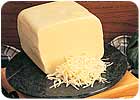 Dean Sommer, cheese and food technologist at the Wisconsin Center for Dairy Research, notes that while cheese has traditionally been either process or natural, now some cheese manufacturers are producing a type of hybrid cheese with some emulsifying salts and improved functionality. An example is process cream cheese, which has slightly different mouthfeel and functional properties than regular cream cheese.
Process cheese, because of the variety of melt properties, can be a value-added ingredient in a range of meat applications, including hot dogs, cheese smokies and ring bologna. This is an area in which a new variety, such as process blue cheese in a hot dog, may boost sales.
To develop a process cheese for use in reduced-fat and fat-free foodservice sandwiches, Lloyd Metzger, director of the Midwest Dairy Foods Research Center and associate professor at the College of Agricultural and Biological Sciences at South Dakota State University in Brookings, is working on a “slice on slice” (SOS) fat-free process cheese. “While it’s fairly easy to make a fat-free individually wrapped slice typically sold at retail, the line used to process SOS for foodservice is less forgiving, and so it’s more difficult to produce a fat-free SOS,” explains Metzger.
Metzger is using a variety of formula adjustments to produce process cheese that is lower in both fat and sodium. First, his group is modifying the natural cheese base so that it is easier to emulsify. Researchers also are replacing some sodium-based emulsifying salts with potassium-based salts. There is a limit, however, to the amount of potassium that can be used without the cheese taking on bitter, metallic flavor notes. To date, they have been able to achieve 50% to 70% reductions in sodium. Because fat helps to mask those flavor notes, the challenge is greater with low-fat process cheese. n
Dairy Management Inc.-supported research continues to provide new and improved process cheese concepts and solutions to industry. For example, the Wisconsin center helped improve cheese performance in the microwave and evaluate adherence of queso sauce to chips. For more information on process cheese, visit www.innovatewithdairy.com. Technical Support Consultant Sharon Gerdes can be reached at 800/248-8829.
Most consumers think of process cheese as orange American slices. But it may soon come in red, white and even blue shades as well as an entire melting pot of ethnic varieties. It might also be lower in sodium and fat. New Dairy Management Inc.-supported research in process cheese is aiding in the development of products that appeal to children and other demographics, and increase opportunities for use in healthy sandwiches, snacks and entrees.
Process cheeses in fun flavors have taken off in Europe and Japan. In Korea, a chocolate cheese is a big hit with the younger generation. Here in the United States, John Jaeggi, researcher with the Wisconsin Center for Dairy Research at University of Wisconsin-Madison, has been working to incorporate berry and fruit flavors into process cheeses for kids. These products are sweetened with either sugar or sucralose and can easily be cut into shapes such as letters or animals to appeal to children. “We’re completing some additional work to make this product shelf stable so that it can be sold on the retail shelf,” rather than just in the dairy case, notes Jaeggi.
The Wisconsin center also is developing ethnic process cheeses. A feta process cheese can be made into individually wrapped slices, ideal to top a burger or use in a Greek sandwich or wrap. Non-melting Hispanic cheeses such as queso fresco, queso blanco and queso para frier can be incorporated into a process Hispanic cheese that is pumpable and suitable as a filling in pastries or in applications where dough enrobes the cheese.
Another new development is a process mozzarella with improved bake characteristics. This product can also be used as a flavor carrier. The processed version has a window of optimum melt performance over six months, compared with two to four weeks for regular mozzarella. This cheese works well on pizza or frozen entrees. It can also be shredded and sold as part of a multiple cheese blend in combination with natural cheese.
Process cheese, because of the variety of melt properties, can be a value-added ingredient in a range of meat applications, including hot dogs, cheese smokies and ring bologna. This is an area in which a new variety, such as process blue cheese in a hot dog, may boost sales.
To develop a process cheese for use in reduced-fat and fat-free foodservice sandwiches, Lloyd Metzger, director of the Midwest Dairy Foods Research Center and associate professor at the College of Agricultural and Biological Sciences at South Dakota State University in Brookings, is working on a “slice on slice” (SOS) fat-free process cheese. “While it’s fairly easy to make a fat-free individually wrapped slice typically sold at retail, the line used to process SOS for foodservice is less forgiving, and so it’s more difficult to produce a fat-free SOS,” explains Metzger.
Metzger is using a variety of formula adjustments to produce process cheese that is lower in both fat and sodium. First, his group is modifying the natural cheese base so that it is easier to emulsify. Researchers also are replacing some sodium-based emulsifying salts with potassium-based salts. There is a limit, however, to the amount of potassium that can be used without the cheese taking on bitter, metallic flavor notes. To date, they have been able to achieve 50% to 70% reductions in sodium. Because fat helps to mask those flavor notes, the challenge is greater with low-fat process cheese. n
Dairy Management Inc.-supported research continues to provide new and improved process cheese concepts and solutions to industry. For example, the Wisconsin center helped improve cheese performance in the microwave and evaluate adherence of queso sauce to chips. For more information on process cheese, visit www.innovatewithdairy.com. Technical Support Consultant Sharon Gerdes can be reached at 800/248-8829.
Looking for a reprint of this article?
From high-res PDFs to custom plaques, order your copy today!