Kickin' It Old School
New era of yogurt is no problem for Anderson Erickson’s Des Moines plant.

 Cultured products have made great strides in the United States in recent years, but yogurt has always been big business for Anderson Erickson Dairy.
The family-owned processor has made constant improvements at its Des Moines, Iowa, plant to keep up with demand for its products in its core five-state Midwestern market, fueled by a relentless pursuit of quality and a wide variety of flavors dreamed up by the marketing folks and their enthusiastic chief executive.
The past five years have brought, among other things, a new yogurt filling line and a 20,000-square-foot addition to the cooler, exclusively for cultured products.
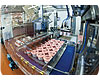
Installed in March 2005, the six-wide Modern Packaging line can fill 270 6-ounce cups of yogurt every minute, says Alan Schneider, AE’s cultured products manager. “We’re really happy with our Modern equipment,” he says. “They do a really good job.”
At the same time, the company also put a Delkor Spot-Pak system on that line, which allowed AE to streamline the process of getting yogurt and other cultured products from the filler to the loading dock. “We used to put all the yogurt in cases and it took up too much space,” Schneider explains. “Now we pallet it, load the trucks and put the pallets away.”
Nearby in the cultured department, there’s a four-wide filler for sour cream and dips, and another for cottage cheese. The latter arrived in 2003, when AE finally automated its cottage cheese packaging operation after decades of hand packing the product; 24-ounce yogurt containers are also filled on this line.
Rounding out the cultured lineup is a single line for filling 5-pound institutional-size containers of yogurt and cottage cheese. “A big portion of that product goes to colleges,” Schneider notes.
Schneider explains the basic process for turning milk into AE yogurt: In the culture tanks (two 5,000 gallon and two 3,000 gallon), milk is incubated for seven hours to introduce live and active cultures. Next, it’s sent to one of two 400-gallon and one 600-gallon blend tanks, mixed with fruit as appropriate, at a programmed ratio. “We’re pumping product and metering the fruit into these tanks,” Schneider says of the automated system installed about three years ago. “You type in what you want, what percentages, how many gallons.”
After it’s mixed with fruit and other flavors, the yogurt is pumped from the blend tanks to the fillers.
Sour cream is a bit more time consuming. “We like to have an 18-hour incubation on sour cream,” Schneider explains. “You don’t want to risk it. You lose a lot of flavor without a proper set time.”
Cottage cheese processing is typically performed in the evening, with three vats and three drainer/creamers.
Once filled and sealed, cultured products move through the Spot-Pak system before the resulting flats are robotically palletized and shrink-wrapped. Pallets are stored in the cultured cooler addition to await shipment. With plenty of room allotted for future growth, the cooler is filled with varying quantities of product “all depending on the day of the week,” says Norm Dostal, director of plant operations.

Four other lines handle plastic containers, the newest being a Fogg enclosed rotary filler, with a HEPA-filtered environment, for 8- and 12-ounce bottles. This line runs 8-ouncers for schools two days a week and 12-ouncers three days a week, Dostal says. Regular and flavored milks move through this line, as well as juices and drinks.
AE purchases its small bottles but blow molds its own gallon and half-gallon bottles, with two four-head, one six-head and one eight-head blow-molding machines. These containers are fed to two gallon lines and one half-gallon line.
Crates of finished products from all the fluid lines are conveyed up and over Hubbell Avenue, which bisects AE’s plant complex, to get to the cooler. All of these lines converge in a marshalling yard where they’re stacked six high and move into the automated storage and retrieval system. The stacks of crates are racked on either side of the ASRS based on their ultimate destination, Schneider explains.
“Orders go into the computer by transport route,” says distribution manager Sean Thomas. “They’ll pick every order for that route, then go on to the next one.”
Meanwhile, as semi trucks leave the shipping dock with finished product, loaded tankers keep arriving with more raw milk. AE takes in up to 30 tankers per day in its two receiving bays. “The majority of our milk comes from Iowa, from individual farms,” Dostal says, noting milk also arrives from Kansas and Missouri.
Samples are tested in an office above the receiving area before milk is offloaded into the raw tanks; there are five 50,000-gallon silos and one at 30,000 gallons.
The plant receives milk around the clock; Dostal says the operation is quiet enough not to disturb neighbors of the facility, which backs up onto a residential area. “The only thing we try not to do is unload resin [for blow molding] before 8 a.m.,” he says. “That’s pretty noisy.”
There are three HTST systems for milk destined for fluid and cultured products, running at 240 gallons per minute. A fourth HTST, operating at 10,000 pounds per hour, handles milk for ice cream mix. One of the pasteurizers is in a separate room, but Dostal says they’ll soon all be united in a common area.
Samples of all products at various stages of production are kept in the quality assurance lab, where they’re held through code at 45 degrees, “so they’re pretty mistreated,” Dostal remarks.
“That goes hand in hand with [local] employee training,” Just says. “We have to get information down to the employee level, putting that food-safety awareness and mentality into their minds.”
AE also has implemented SQF standards, with an increasing number of employees certified on this global food-safety program. Just says documented operating procedures and limited turnover have boosted the company’s consistent attention to safety. “A lot of our employees have been around for many years, which we feel is very important,” he says.
An approval team OKs all incoming ingredients, packaging and other components. “We have written specifications on all our products; they’re very comprehensive,” Just says. “Food safety starts at the beginning of the process: raw milk. We have established relationships with the vendors.”
AE requires certificates of analysis from all of its vendors, then performs test runs before committing to a purchase, Just says. “We like to see their HACCP program before we buy,” he says.
Once all the inputs have cleared their hurdles, AE keeps its products under a perpetual microscope, literally and figuratively. “We test the product all the way from the beginning, when it arrives at our door, through the shelf life of the product,” Just says.
And just in case, after all these safeguards, a recall might still be necessary, AE has a procedure in place. “We have a recall team that’s tested frequently,” Just says, noting that a new computerized tracking system on AE’s cooler enhances recall efforts. “We know at any given point where product is. That really helps with our mock recalls.”
But even with all the financial, regulatory and safety issues surrounding the industry, what does Just say is the biggest challenge for AE’s plant team? “When Miriam and Kim dream up new flavors,” he quips, referring to Miriam Erickson Brown, AE’s chief executive officer, and Kim Peter, the director of marketing. “The biggest challenge is to perfect the flavors we’re looking for.”
And with 50 different flavors of yogurt available to customers at any given time – and more undoubtedly on the way – that is no small task. But the folks at AE know investment on the operations level is crucial to success in the supermarket dairy aisle.
“We’re blessed,” Just says, “because the family’s always been so good at giving us the things we need to hold up Miriam’s high standards.”
History: Built 1939; five-story cooler added 1999, expanded 2003.
Size: About 200,000 square feet on 27-acre site.
Number of employees: 570
Products made: Fluid milk, yogurt, cottage cheese, sour cream, dips, ice cream mix, buttermilk, half and half, whipping cream, juices.
Pasteurization: HTST fluid, three units totaling 240 gallons per minute; HTST mix, 10,000 pounds per hour.
Filling lines: Four cultured, eight fluid (four FFS, four plastic).
Storage capacity: Raw, 280,000 pounds; pasteurized, 290,000 pounds; cooler, more than 150,000 cases.
Extras
AGC Engineering
Allen-Bradley
Anderson Instruments
APV
Berry Plastics
Bostik
Cannon Equipment
Dairy America
Deam
Delkor
Ecolab
Evergreen Packaging
Fanuc
Fogg
Fruitcrown
General Films
Klenzade
Kusel
Leprino Foods
Modern Packaging
Orion
Osgood
Portola Packaging
Smurfit-Stone
Tetra Pak
The family-owned processor has made constant improvements at its Des Moines, Iowa, plant to keep up with demand for its products in its core five-state Midwestern market, fueled by a relentless pursuit of quality and a wide variety of flavors dreamed up by the marketing folks and their enthusiastic chief executive.
The past five years have brought, among other things, a new yogurt filling line and a 20,000-square-foot addition to the cooler, exclusively for cultured products.
Installed in March 2005, the six-wide Modern Packaging line can fill 270 6-ounce cups of yogurt every minute, says Alan Schneider, AE’s cultured products manager. “We’re really happy with our Modern equipment,” he says. “They do a really good job.”
At the same time, the company also put a Delkor Spot-Pak system on that line, which allowed AE to streamline the process of getting yogurt and other cultured products from the filler to the loading dock. “We used to put all the yogurt in cases and it took up too much space,” Schneider explains. “Now we pallet it, load the trucks and put the pallets away.”
Nearby in the cultured department, there’s a four-wide filler for sour cream and dips, and another for cottage cheese. The latter arrived in 2003, when AE finally automated its cottage cheese packaging operation after decades of hand packing the product; 24-ounce yogurt containers are also filled on this line.
Rounding out the cultured lineup is a single line for filling 5-pound institutional-size containers of yogurt and cottage cheese. “A big portion of that product goes to colleges,” Schneider notes.
Schneider explains the basic process for turning milk into AE yogurt: In the culture tanks (two 5,000 gallon and two 3,000 gallon), milk is incubated for seven hours to introduce live and active cultures. Next, it’s sent to one of two 400-gallon and one 600-gallon blend tanks, mixed with fruit as appropriate, at a programmed ratio. “We’re pumping product and metering the fruit into these tanks,” Schneider says of the automated system installed about three years ago. “You type in what you want, what percentages, how many gallons.”
After it’s mixed with fruit and other flavors, the yogurt is pumped from the blend tanks to the fillers.
Sour cream is a bit more time consuming. “We like to have an 18-hour incubation on sour cream,” Schneider explains. “You don’t want to risk it. You lose a lot of flavor without a proper set time.”
Cottage cheese processing is typically performed in the evening, with three vats and three drainer/creamers.
Once filled and sealed, cultured products move through the Spot-Pak system before the resulting flats are robotically palletized and shrink-wrapped. Pallets are stored in the cultured cooler addition to await shipment. With plenty of room allotted for future growth, the cooler is filled with varying quantities of product “all depending on the day of the week,” says Norm Dostal, director of plant operations.
Stacking up
Over in the fluid department, two Evergreen form-fill-seal machines run constantly to fill paper half pints of school milk. Two other Evergreen machines fill and seal paper pints, quarts and half gallons of fluid products.Four other lines handle plastic containers, the newest being a Fogg enclosed rotary filler, with a HEPA-filtered environment, for 8- and 12-ounce bottles. This line runs 8-ouncers for schools two days a week and 12-ouncers three days a week, Dostal says. Regular and flavored milks move through this line, as well as juices and drinks.
AE purchases its small bottles but blow molds its own gallon and half-gallon bottles, with two four-head, one six-head and one eight-head blow-molding machines. These containers are fed to two gallon lines and one half-gallon line.
Crates of finished products from all the fluid lines are conveyed up and over Hubbell Avenue, which bisects AE’s plant complex, to get to the cooler. All of these lines converge in a marshalling yard where they’re stacked six high and move into the automated storage and retrieval system. The stacks of crates are racked on either side of the ASRS based on their ultimate destination, Schneider explains.
“Orders go into the computer by transport route,” says distribution manager Sean Thomas. “They’ll pick every order for that route, then go on to the next one.”
Meanwhile, as semi trucks leave the shipping dock with finished product, loaded tankers keep arriving with more raw milk. AE takes in up to 30 tankers per day in its two receiving bays. “The majority of our milk comes from Iowa, from individual farms,” Dostal says, noting milk also arrives from Kansas and Missouri.
Samples are tested in an office above the receiving area before milk is offloaded into the raw tanks; there are five 50,000-gallon silos and one at 30,000 gallons.
The plant receives milk around the clock; Dostal says the operation is quiet enough not to disturb neighbors of the facility, which backs up onto a residential area. “The only thing we try not to do is unload resin [for blow molding] before 8 a.m.,” he says. “That’s pretty noisy.”
There are three HTST systems for milk destined for fluid and cultured products, running at 240 gallons per minute. A fourth HTST, operating at 10,000 pounds per hour, handles milk for ice cream mix. One of the pasteurizers is in a separate room, but Dostal says they’ll soon all be united in a common area.
Samples of all products at various stages of production are kept in the quality assurance lab, where they’re held through code at 45 degrees, “so they’re pretty mistreated,” Dostal remarks.
Watchful eyes
With food safety issues still frequent headline-grabbers after recent major recalls, AE strives to stay one step ahead of any potential issues. The company employs folks who are HACCP trained and certified through programs offered by the International Dairy Foods Association, says John Just, quality assurance and research director.“That goes hand in hand with [local] employee training,” Just says. “We have to get information down to the employee level, putting that food-safety awareness and mentality into their minds.”
AE also has implemented SQF standards, with an increasing number of employees certified on this global food-safety program. Just says documented operating procedures and limited turnover have boosted the company’s consistent attention to safety. “A lot of our employees have been around for many years, which we feel is very important,” he says.
An approval team OKs all incoming ingredients, packaging and other components. “We have written specifications on all our products; they’re very comprehensive,” Just says. “Food safety starts at the beginning of the process: raw milk. We have established relationships with the vendors.”
AE requires certificates of analysis from all of its vendors, then performs test runs before committing to a purchase, Just says. “We like to see their HACCP program before we buy,” he says.
Once all the inputs have cleared their hurdles, AE keeps its products under a perpetual microscope, literally and figuratively. “We test the product all the way from the beginning, when it arrives at our door, through the shelf life of the product,” Just says.
And just in case, after all these safeguards, a recall might still be necessary, AE has a procedure in place. “We have a recall team that’s tested frequently,” Just says, noting that a new computerized tracking system on AE’s cooler enhances recall efforts. “We know at any given point where product is. That really helps with our mock recalls.”
But even with all the financial, regulatory and safety issues surrounding the industry, what does Just say is the biggest challenge for AE’s plant team? “When Miriam and Kim dream up new flavors,” he quips, referring to Miriam Erickson Brown, AE’s chief executive officer, and Kim Peter, the director of marketing. “The biggest challenge is to perfect the flavors we’re looking for.”
And with 50 different flavors of yogurt available to customers at any given time – and more undoubtedly on the way – that is no small task. But the folks at AE know investment on the operations level is crucial to success in the supermarket dairy aisle.
“We’re blessed,” Just says, “because the family’s always been so good at giving us the things we need to hold up Miriam’s high standards.”
At a Glance: Anderson Erickson Dairy
Location: Des Moines, IowaHistory: Built 1939; five-story cooler added 1999, expanded 2003.
Size: About 200,000 square feet on 27-acre site.
Number of employees: 570
Products made: Fluid milk, yogurt, cottage cheese, sour cream, dips, ice cream mix, buttermilk, half and half, whipping cream, juices.
Pasteurization: HTST fluid, three units totaling 240 gallons per minute; HTST mix, 10,000 pounds per hour.
Filling lines: Four cultured, eight fluid (four FFS, four plastic).
Storage capacity: Raw, 280,000 pounds; pasteurized, 290,000 pounds; cooler, more than 150,000 cases.
Extras
AGC Engineering
Allen-Bradley
Anderson Instruments
APV
Berry Plastics
Bostik
Cannon Equipment
Dairy America
Deam
Delkor
Ecolab
Evergreen Packaging
Fanuc
Fogg
Fruitcrown
General Films
Klenzade
Kusel
Leprino Foods
Modern Packaging
Orion
Osgood
Portola Packaging
Smurfit-Stone
Tetra Pak
Links
Looking for a reprint of this article?
From high-res PDFs to custom plaques, order your copy today!